
You may be the person colleagues ask to “check the numbers” before a report goes out. Or perhaps you enjoy solving differential equations, building spreadsheets that actually make sense, or explaining why a graph behaves the way it does.
Those abilities can feel ordinary when they are part of your coursework or day job. Outside a classroom or engineering team, however, many people need help translating a practical question into numbers they can use.
A student may need to understand Fourier series rather than memorize steps. A small manufacturer may need a sensible way to forecast material use. A researcher may have data but no reproducible analysis. These are different needs, but each involves mathematical reasoning.
Turning mathematics into income is not simply a matter of being “good at math.” It means identifying a useful problem, choosing an appropriate level of rigor, communicating clearly, and delivering work people can trust. The most sustainable opportunities sit at that intersection.
🧭 Start with the Problems Mathematics Solves
Mathematics becomes valuable when it reduces uncertainty, improves a decision, or helps someone learn a difficult idea. The client rarely wants algebra, calculus, or statistics as an abstract product. They want a budget that reconciles, a model that explains a process, or a lesson that makes an assignment manageable.
This shift in perspective matters. Instead of advertising “I can solve equations,” describe the outcome: “I help engineering students understand numerical methods,” or “I build transparent spreadsheet models for planning and forecasting.”
Skill alone is not the offer; a clear result for a defined user is the offer.
🎓 Recognize the Transferable Parts of Strong Math Skills
Strong mathematical ability includes more than fast calculation. It often combines abstraction, logical sequencing, estimation, error checking, data interpretation, and the patience to revise an approach when assumptions fail.
These habits transfer well to paid work because real questions are often vague at first. A client may say sales are “unpredictable,” measurements “look wrong,” or a student is “lost in calculus.” Your first job is to turn that statement into a precise question.
- What quantity needs to be estimated, explained, or optimized?
- What information is available, and how reliable is it?
- What constraints matter: time, cost, accuracy, privacy, or format?
- What decision will the result support?
🧩 Choose a Specific Starting Niche
“Math freelancer” is broad enough to confuse potential clients. A narrower starting niche makes it easier to show relevant examples and to learn what questions people actually ask.
You might focus on undergraduate calculus tutoring, Excel-based engineering calculations, Python data cleaning for laboratory teams, operations-research prototypes, or technical editing of quantitative reports. A niche is not a permanent identity; it is a practical starting point.
Choose an area where your knowledge, available tools, and audience overlap. Someone with civil engineering experience may be more credible helping with quantity takeoffs and hydrology coursework than offering generic machine-learning services.
👩🏫 Treat Tutoring as Teaching, Not Answer Delivery
Tutoring is often the most accessible route because it requires relatively little equipment and gives immediate feedback on your explanations. Yet effective tutoring is not doing a learner’s work for them. It is diagnosing the gap between what they know and what the course expects.
A productive session might begin with a student attempting one problem aloud. Their method reveals whether the obstacle is arithmetic, notation, a missing prerequisite, or a misunderstanding of the physical meaning behind a formula.
When a student leaves with a completed answer but cannot begin a similar problem independently, the tutoring has not produced much durable value.
🗺️ Map Prerequisites Before Explaining Advanced Topics
Many apparent difficulties in advanced mathematics are really prerequisite problems. A student struggling with Laplace transforms may need more fluency with exponent rules, integration by parts, or interpreting piecewise functions.
Build a quick concept map rather than repeatedly explaining the final procedure. For example, before teaching Newton’s method, check whether the learner understands tangent lines, derivatives, iteration, and why an initial guess affects the result.
This approach can feel slower during the first meeting, but it prevents sessions from becoming a sequence of temporary fixes.
🧠 Use Multiple Representations in Lessons
Mathematical notation is compact, but it is not always the best first explanation. Move among words, sketches, tables, graphs, units, and equations. Each representation reveals something the others can hide.
For instance, a differential equation can be presented as a symbolic relation, a slope field, and a physical description of change. A graph can help a learner see stability or growth before they manipulate a solution formula.
Ask students to explain a result in plain language. If they can say what a negative derivative means in context, they are less likely to treat notation as a collection of disconnected rules.
📝 Build Repeatable Tutoring Materials
Preparation becomes more efficient when you create reusable materials. Develop a small bank of diagnostic questions, annotated examples, common-error notes, and short practice sets arranged by topic.
For engineering mathematics, useful sets might cover dimensional analysis, complex numbers, linear systems, numerical approximation, probability distributions, and differential equations. Keep worked examples separate from independent practice so learners have a chance to think before seeing a method.
Reusable does not mean generic. Adapt examples to the learner’s course notation, permitted methods, and current level.
⚖️ Maintain Clear Academic Integrity Boundaries
Tutoring can cross an ethical line when it becomes completion of assessed work. Explain concepts, demonstrate comparable examples, review a student’s reasoning, and help them plan their own solution. Do not present someone else’s work as their own.
Be especially cautious with take-home examinations, graded online quizzes, and projects where a course prohibits outside assistance. If the rules are unclear, encourage the learner to ask their instructor what support is permitted.
Clear boundaries protect the student’s learning and your professional reputation.
📊 Understand What Mathematical Modeling Actually Is
A mathematical model is a simplified representation of a system used to explore relationships, estimate outcomes, or compare choices. It is not a crystal ball. Its usefulness depends on the question, assumptions, data quality, and the decisions being made.
A model might estimate heat loss from a room, simulate queue lengths at a service desk, predict inventory requirements, or calculate the forces in a simple component. The model need not be complicated to be useful.
Good modeling is disciplined simplification. It includes enough detail to answer the intended question, but not so much that the result becomes impossible to understand or maintain.
🔍 Define the Decision Before Building a Model
Before selecting equations or software, ask what decision the model is meant to support. Is a manager choosing between two production schedules? Is a designer checking a preliminary concept? Is a student comparing numerical methods?
The decision determines the necessary accuracy and complexity. A rough planning estimate may need transparent assumptions and ranges. A safety-critical engineering calculation may require qualified review, applicable standards, validated inputs, and formal documentation beyond a freelance deliverable.
Never imply that an exploratory model is suitable for high-consequence design approval.
📥 Turn a Messy Request into Defined Inputs and Outputs
Most modeling work starts with ambiguity. Convert the request into a short specification that identifies inputs, outputs, constraints, assumptions, units, and acceptance criteria.
Suppose a client asks for a production forecast. Clarify the time interval, product categories, capacity limits, planned downtime, missing records, and whether the output is a single estimate or a range of scenarios.
- Inputs: source data, parameter values, and their units.
- Outputs: charts, tables, calculated measures, or recommended scenarios.
- Constraints: physical limits, budget, policy, capacity, or deadlines.
- Assumptions: conditions treated as fixed or approximately true.
🧱 Make Assumptions Visible
Every model makes assumptions, even a simple spreadsheet. Demand may be assumed stable, a material property may be treated as constant, or a linear relationship may stand in for a more complex one.
Hidden assumptions are risky because users may treat outputs as facts rather than conditional estimates. Put them near the result, in language a non-specialist can understand.
For a hypothetical delivery model, say “travel time is estimated from typical conditions and does not include unusual closures,” rather than burying that limitation in a formula tab.
🧪 Validate Models with Reality Checks
Validation asks whether a model behaves reasonably for its purpose. This is broader than checking whether code runs without errors. Compare outputs with known cases, inspect units, test extreme inputs, and ask whether the direction of change makes physical sense.
If increasing a resistance parameter makes predicted heat flow increase, the sign or formula deserves investigation. If a forecast produces negative inventory where that is impossible, the model may need constraints.
When historical data exist, reserve some observations for checking rather than fitting every available point. Agreement with past data is useful evidence, but it does not guarantee future performance under changed conditions.
📈 Use Sensitivity Analysis to Show What Matters
Sensitivity analysis changes one or more inputs to see how much the output moves. It identifies assumptions that deserve better data and those that have little practical effect.
Imagine a cost model in which labor hours, material price, and scrap rate are uncertain. Varying each within plausible ranges may show that labor hours dominate the estimate while minor price changes do not. That is a decision-relevant finding.
Presenting a range is often more honest and useful than presenting a single precise-looking number.
💻 Match the Tool to the Work
Spreadsheets are excellent for transparent calculations, small operational models, scenario analysis, and client handover. Python, MATLAB, R, or similar tools can be better for repeatable data processing, optimization, simulation, and larger analyses.
Do not choose a programming language merely because it appears more advanced. A well-structured spreadsheet may be the best product when a client needs to inspect assumptions and update inputs without coding.
| Need | Often suitable approach | Main caution |
|---|---|---|
| Simple planning calculations | Spreadsheet with labeled inputs | Formula errors can spread silently |
| Repeated data processing | Scripted workflow | Document dependencies and versions |
| Concept optimization | Solver or numerical code | Check constraints and local optima |
| Technical visualization | Plots and concise report | Do not let graphics hide uncertainty |
🧹 Data Cleaning Is Often the Real Job
Clients may describe a task as analysis when the immediate need is organizing inconsistent data. Dates may use mixed formats, columns may contain text and numbers together, units may differ, and missing values may have no clear meaning.
Data cleaning is legitimate technical work because conclusions depend on what the dataset actually represents. Keep an audit trail: preserve the original file, document transformations, and flag records you excluded or corrected.
Never invent missing measurements to make a dataset look complete. If an assumption or imputation is necessary, state it explicitly and explain its likely effect.
🧮 Build Transparent Spreadsheets
A spreadsheet becomes unreliable when important constants are scattered inside formulas, tabs have ambiguous names, and units are omitted. Make inputs visually distinct, keep formulas readable, and include a short “how to use this” section.
Use checks that catch obvious failures, such as totals that must reconcile or ratios that should remain within a meaningful range. Where possible, test the spreadsheet with hand calculations for a few cases.
A client is paying not only for a current answer but also for an artifact they can understand later.
🐍 Create Reproducible Code Deliverables
For coding projects, reproducibility means another person can follow the workflow and obtain the intended result from the supplied inputs. Use meaningful variable names, organize files sensibly, and explain how to install or access required packages.
A concise readme, clear comments around non-obvious decisions, and a sample input-output run are often more valuable than clever but opaque code. Avoid embedding passwords, confidential data, or private access tokens in a deliverable.
If the client cannot run the code independently, say so upfront and define whether maintenance is part of the engagement.
🗣️ Translate Results for Non-Specialists
Many freelance opportunities exist because technical teams need someone who can explain quantitative work to decision-makers. A useful report leads with the finding, then shows the method and limitations at the level needed for review.
Instead of writing only “the optimal value is 42,” explain what 42 represents, which conditions it assumes, what changes could alter it, and what action it supports. Label axes, define abbreviations, and avoid equations that do not help the reader make a decision.
Clear communication is not a simplification of rigorous work; it is part of rigorous work.
📦 Package Services Around Concrete Deliverables
Potential clients understand defined packages more easily than a long list of techniques. A package might be a one-hour exam-preparation session with a follow-up practice plan, a cleaned dataset plus documentation, or a spreadsheet model with two revision rounds.
Describe what is included, what is not included, what the client must provide, and what format they will receive. Scope clarity prevents misunderstandings such as expecting an ongoing dashboard when the agreement covered a one-time analysis.
For custom work, use a short written scope before beginning substantial effort.
💰 Price Time, Complexity, and Responsibility
There is no universal correct rate for quantitative freelance work. Pricing depends on your experience, local market, specialist knowledge, urgency, overhead, and the responsibility attached to the output.
For a new service, estimate the time for discovery, data review, work, testing, communication, revisions, and administration—not only the time spent solving equations. A fixed-price project can work well when the scope is clear; hourly billing may be safer when the inputs are uncertain.
Be wary of underpricing complex work simply to win a first client. Extremely low prices can attract poorly defined tasks with high expectations.
📄 Use a Written Scope and Revision Process
Even modest projects benefit from a written record of the objective, deliverables, timeline, assumptions, payment arrangement, and revision limits. This need not be a lengthy legal document to be useful, although high-value or high-risk work may require professional legal advice.
Define what counts as a correction versus a new request. Fixing an error in the agreed calculation is different from adding a new dataset, a dashboard, or a second model after delivery.
Written scope protects both sides by turning an informal conversation into shared expectations.
🔒 Protect Confidential Information and Privacy
Math work can expose sensitive information: student records, operational data, customer lists, financial information, or proprietary designs. Ask only for data you need, store it carefully, and avoid using real client material in public portfolios.
Clarify ownership of the files, code, models, and reports. If a client has confidentiality requirements, read them before accepting the work and do not promise security measures you cannot realistically provide.
For regulated, personal, or highly sensitive data, the appropriate process may exceed what an independent freelancer can safely handle.
🦺 Know When Work Requires Licensed or Specialist Review
Some mathematical work is educational or exploratory. Other work may affect public safety, regulated decisions, financial outcomes, or contractual obligations. The latter can require licensed professionals, domain-specific approvals, or independent verification.
For example, a structural calculation used to construct a building is not equivalent to an illustrative beam-deflection exercise. Likewise, a model used for investment, medical, or legal decisions has consequences beyond producing a neat chart.
State your role accurately, disclose limitations, and refer work when it exceeds your competence or authority.
🌱 Build a Portfolio Without Misrepresenting Experience
A portfolio should demonstrate how you think, not pretend that hypothetical work came from a paying client. Create clearly labeled sample projects based on realistic but invented datasets or public-domain-style scenarios.
Useful examples include a documented energy-use model, a queue simulation for a fictional service counter, a cleaned and visualized sample dataset, or a short lesson plan that explains eigenvalues visually.
Show the question, assumptions, method, checks, result, and limitations. That structure reassures prospective clients that you can work systematically.
⭐ Collect Evidence of Reliability
Early credibility often comes from consistent professional behavior: responding clearly, meeting agreed deadlines, documenting assumptions, and making files easy to use. With permission, satisfied clients may provide a brief testimonial or allow you to describe the type of outcome achieved without revealing confidential details.
Do not claim expertise you have not demonstrated. It is better to say that you are building experience in a narrow service than to advertise yourself as an expert in every technical field.
Reliability compounds over time because referrals tend to follow work that was understandable and easy to hand over.
🚫 Avoid Common Freelance Math Mistakes
A frequent mistake is accepting a vague request and beginning work before the objective is agreed. Another is delivering a technically correct calculation with no explanation of assumptions, units, or limits.
Watch for these warning signs:
- A request to complete graded work secretly or impersonate a student.
- Pressure to certify, approve, or guarantee an outcome beyond your role.
- Unclear access to source data or unclear permission to use it.
- Repeated scope changes without an updated agreement.
- A demand for false certainty from incomplete or unreliable inputs.
Declining unsuitable work is part of professional judgment, not a failure of customer service.
🔄 Develop Skills Through Small, Reviewable Projects
The fastest path is usually not waiting until you feel qualified for every possible project. Start with work whose limits you understand and whose results can be checked: tutoring a familiar topic, automating a repetitive calculation, or building a small scenario model.
After each project, review what took longer than expected, where clients became confused, and which checks caught issues. Improve one reusable element—a template, lesson plan, intake form, or code skeleton—before the next engagement.
Small projects create a feedback loop between technical skill, communication, and business judgment.
🤝 Combine Teaching, Modeling, and Freelance Work Carefully
These income paths can reinforce one another. Teaching exposes common misconceptions and strengthens explanation. Modeling develops practical judgment about assumptions. Freelance projects reveal the formats and communication habits organizations value.
But they also compete for time. A heavy tutoring schedule may leave little uninterrupted time for analysis work, while custom modeling can create unpredictable deadlines. Decide which service is primary for the current season and keep capacity limits visible.
A balanced approach might begin with tutoring for steady practice, then add a small number of defined technical projects as your portfolio and workflow mature.
🎯 Focus on Trustworthy Usefulness
The durable advantage of strong math skills is not the ability to produce complicated formulas on demand. It is the ability to frame a question, select an appropriate method, check whether the answer makes sense, and explain what it does and does not mean.
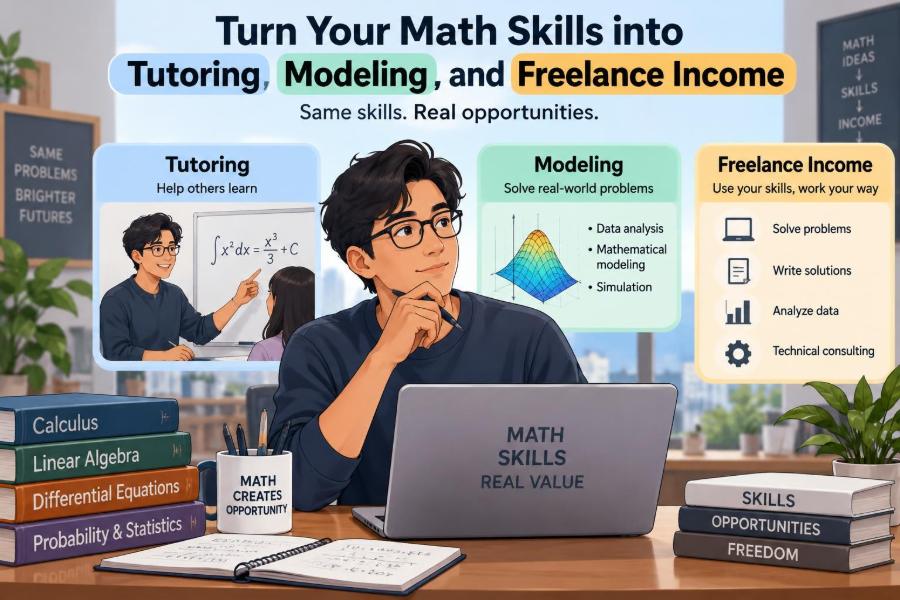
Tutoring turns that ability into learning. Modeling turns it into structured decisions. Freelance work turns it into a professional service when scope, ethics, communication, and limitations are handled with care.
The most valuable mathematical work helps another person move from confusion to a justified next step.
Begin with a problem you can solve responsibly, make your process clear, and let each completed piece of work improve the next one. Mathematical confidence grows into income most reliably when it is paired with judgment, transparency, and genuine help. 📐💼🌱