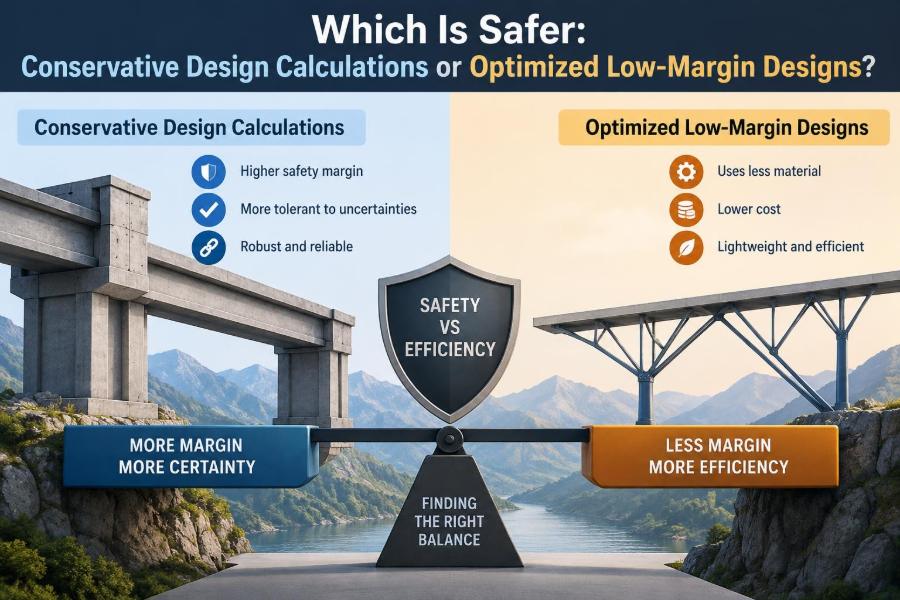

A beam is sized for a factory floor. One engineer chooses a section with substantial reserve capacity; another uses a lighter member that satisfies every required check, but only narrowly. Both calculations may be correct. Yet the two designs can behave very differently after years of loading, minor alterations, imperfect construction, and unusual weather.
The same tension appears in pressure vessels, electrical systems, retaining walls, aircraft components, software-controlled machinery, and everyday products. Extra margin usually costs material, mass, money, or energy. Reducing that margin can make a design more efficient, but it also leaves less room for the real world to disagree with the model.
This is not a simple contest between “safe” and “unsafe.” A conservative design can waste resources or create new problems, while a highly optimized design can be entirely appropriate when loads, manufacturing, inspection, and consequences are well understood.
The useful question is therefore not which philosophy wins in every case. It is: what uncertainty remains, what happens if the assumptions are wrong, and what layers of protection exist beyond the first calculation?
🧭 The false choice behind the question
Conservative and optimized designs are often described as opposites, but they are better understood as positions on a spectrum. Every engineered system must allocate margin somewhere: in strength, redundancy, operating capacity, tolerances, monitoring, maintenance, or emergency response.
A conservative design calculation deliberately leaves a larger gap between expected demand and available capacity. An optimized low-margin design seeks to reduce unnecessary reserve while still meeting stated performance and safety requirements.
Neither label tells us enough by itself. A thick component made from poorly characterized material is not automatically safer than a lighter component with reliable properties, robust testing, and continuous monitoring.
📏 What engineers mean by design margin
Design margin is the buffer between what a system can resist or deliver and what it is expected to experience. In simple structural terms, it may be the difference between member resistance and the governing design load.
Engineers often express the relationship through a factor of safety, a load factor, a resistance factor, an allowable stress, or a reserve factor. The exact method depends on the field and the governing design standard.
For a simplified illustration, if a bracket is expected to carry 10 kN and its relevant failure capacity is 20 kN, its nominal capacity is twice the expected load. That does not mean the bracket has a universally meaningful “factor of safety of two”; the answer changes with uncertainty, load combinations, failure mode, and the method used to define capacity.
🧮 Why a passing calculation is not the whole story
A calculation is a model of reality, not reality itself. It uses assumed geometry, material behavior, boundary conditions, loading patterns, and environmental conditions. Its result is only as dependable as those inputs and the appropriateness of the model.
Even a carefully checked equation can omit a practical issue: a weld detail that concentrates stress, a support that is less rigid than assumed, debris accumulation, misuse by an operator, or a future modification that adds load.
This is why engineers distinguish between calculation adequacy and system safety. A design needs both sound mathematics and a credible understanding of how the finished system will be made, used, inspected, and changed.
🎲 Uncertainty is the real reason margins exist
Margins are not admissions that engineering is imprecise. They are a disciplined response to unavoidable variation. Loads vary, materials vary, dimensions vary, and human operation varies.
Some uncertainty is measurable from testing or long operational experience. Other uncertainty is epistemic: it arises because the designer does not yet know enough about a new load case, a novel material, or an unusual interaction.
When uncertainty is large, a narrow numerical margin may give a misleading impression of control. Improving information can sometimes be a better safety investment than simply adding material.
🏗️ Loads are rarely as tidy as the load schedule
Dead loads, such as the self-weight of a structure, are often relatively predictable. Live loads, impact, vibration, wind, thermal movement, snow, fluid surges, seismic action, and accidental loads can be much less predictable.
Load combinations matter because demanding actions can occur together. A member that is adequate for vertical load alone and lateral load alone may be inadequate when both cause stress in the same critical region.
Low-margin designs need especially careful attention to load paths and combinations. A small overlooked eccentricity, dynamic amplification, or restraint force can consume the reserve that appeared available in a simplified check.
🧱 Material properties are distributions, not single numbers
Material certificates and design values are useful, but they do not turn every piece of steel, concrete, polymer, timber, or composite into an identical specimen. Strength, stiffness, toughness, fatigue resistance, and durability can vary with batch, direction, temperature, moisture, aging, and manufacturing history.
Design standards account for much of this through characteristic values, partial factors, prescribed testing, and quality controls. Those methods work best when the material and process remain within their intended scope.
An optimized design becomes more fragile when it relies on properties near the edge of what production can reliably deliver. In that situation, tighter procurement requirements and inspection may be essential rather than optional.
🔩 Manufacturing tolerances can spend the margin
Every manufactured system has tolerances: holes are slightly offset, plates have thickness variation, assemblies have gaps, and installed supports are not perfectly aligned. These deviations are expected and should be included in the design basis.
Consider a slender compression member. A small initial crookedness or unintended eccentric connection can introduce bending in addition to compression. If the design has little reserve, this secondary effect can control performance.
Conservative geometry can absorb ordinary variation. Alternatively, optimized geometry can be safe when fabrication tolerances are demonstrably achievable and verification is built into production.
🧩 Boundary conditions deserve suspicion
Many calculations begin by idealizing a connection as pinned, fixed, free, or perfectly rigid. Real connections sit somewhere between these ideal states, and their behavior may change with load, wear, temperature, settlement, or construction sequence.
A pipe support intended to allow thermal movement can seize. A nominally fixed base can rotate. A bolted joint may slip before it fully transfers force. These are not exotic possibilities; they are ordinary reasons to test sensitivity to assumptions.
Where a result changes sharply with support stiffness or restraint, the design is sensitive. Sensitivity is a warning that a larger margin, a better connection model, or field verification may be needed.
📉 Failure modes do not all provide warning
Some systems yield gradually, deform visibly, or trigger alarms before complete failure. Others fail suddenly through brittle fracture, buckling, fatigue crack growth, electrical breakdown, or unstable loss of control.
A ductile steel tension member may redistribute some load after local yielding, depending on its detail and system. A slender column near buckling or a brittle component at low temperature may have far less forgiving behavior.
For low-warning failure modes, designers generally need stronger control of uncertainty and inspection. A narrow margin that might be manageable in a gradual, observable process can be unacceptable where collapse is abrupt.
⚖️ Consequence changes the meaning of “enough”
The required safety approach should reflect what failure could cause. The consequence may involve injury, environmental release, service disruption, expensive repair, data loss, or a cascade into connected systems.
A minor consumer fitting and a component whose failure could endanger a crowded public space should not be judged by the same informal appetite for risk. Higher consequence typically justifies more robust analysis, independent review, testing, and reserve capacity.
This does not require treating all infrastructure as massively overbuilt. It requires proportionate decision-making: put the strongest controls where errors and failures matter most.
🛡️ Codes set a floor, not a substitute for judgment
Engineering codes translate accumulated knowledge into practical minimum requirements. They prescribe loads, combinations, factors, detailing rules, material limits, and verification procedures for common situations.
Code compliance is a major part of responsible practice, but it does not remove the need to understand the project. A code may not cover unusual geometry, a new material system, extreme operational conditions, or interactions outside its assumptions.
Conversely, exceeding every familiar rule without understanding the load path is not sound conservatism. The purpose of a standard is to support reliable judgment, not to replace it with checkbox thinking.
🔍 Reliability-based design formalizes the trade-off
Modern design methods often separate uncertain actions from uncertain resistance using calibrated factors. Rather than applying one blanket multiplier to everything, they recognize that a highly variable load and a well-controlled material do not deserve identical treatment.
Reliability-based design aims to make outcomes reasonably consistent across different failure modes and applications. It is more refined than a single global safety factor, but it still depends on the underlying data and assumptions.
Its practical lesson is valuable even outside formal code work: margin should be targeted at the uncertainties that actually govern the risk, not applied blindly in the easiest place.
📊 A simple comparison of design approaches
| Question | Conservative capacity approach | Optimized low-margin approach |
|---|---|---|
| Material use | Usually higher | Usually lower |
| Tolerance for unplanned loads | Often greater | Usually smaller |
| Dependence on accurate assumptions | Moderate | High |
| Need for fabrication and inspection control | Important | Often critical |
| Potential operating efficiency | May be lower | May be higher |
| Best fit | Uncertain use, severe consequences, difficult inspection | Well-characterized systems with strong verification and controls |
This comparison is directional, not absolute. An optimized design may use redundancy and monitoring to achieve excellent safety, while a supposedly conservative one may conceal a serious unexamined failure mode.
💡 Optimization is not the same as cutting corners
True optimization balances several objectives: safety, cost, mass, energy use, constructability, durability, maintainability, and environmental impact. It is not merely the pursuit of the smallest possible section or least expensive part.
For example, reducing the mass of a moving machine component can lower motor demand, bearing loads, and energy use over its life. In aircraft and vehicles, weight reduction can have system-wide benefits that a simplistic “add more material” response would ignore.
The danger begins when cost reduction is treated as the only objective and uncertainties are quietly assumed away. That is not optimization; it is transferring risk into places the spreadsheet does not show.
🌱 Overdesign also carries real costs
Extra capacity can increase embodied material, transport effort, foundation loads, installation difficulty, and project cost. A larger pump may cycle inefficiently; an oversized electrical protection setting may fail to protect a smaller downstream conductor correctly.
In dynamic systems, more mass can increase seismic force, inertia, or required actuator power. In thermal systems, overly thick or stiff elements can introduce unwanted restraint and stress elsewhere.
Good engineering does not celebrate excess for its own sake. It asks whether each added margin improves the governing risk or merely shifts cost and performance penalties to another part of the system.
🔗 Redundancy can be safer than raw strength
Redundancy means the system has more than one load path, sensor, power source, barrier, or component able to perform a critical function. If one element fails, another can limit the consequence or maintain operation.
A bridge arrangement with alternate load paths, a control system with independent shutdown protection, or a piping layout with isolation capability may be safer than a single very strong component with no backup.
Redundancy has limits. Common-cause failures can defeat duplicated components if both share the same power supply, environment, design error, or maintenance mistake. Independence matters as much as quantity.
👀 Inspection and monitoring can justify tighter margins
A low-margin design is more defensible when degradation can be detected before capacity is exhausted. Examples include strain monitoring, vibration trends, leak detection, non-destructive examination, temperature alarms, and scheduled dimensional checks.
Monitoring does not create strength. It creates information and, ideally, time to intervene. Its value depends on sensor reliability, alarm thresholds, access to the component, and a real maintenance response when an alert occurs.
A remote, inaccessible component that cannot be inspected should generally not be designed with the same dependence on condition monitoring as an accessible, regularly tested one.
⏳ Time changes the original calculation
Many failures develop slowly. Corrosion reduces section thickness, repeated loading initiates fatigue cracks, creep accumulates at elevated temperature, seals harden, foundations settle, and protective coatings degrade.
Design must consider the required service life and expected maintenance. A member with adequate initial capacity may become inadequate if a realistic corrosion allowance, fatigue spectrum, or loss of prestress is omitted.
Conservative initial sizing can be a sensible response to uncertain degradation. In other cases, durable detailing, drainage, coatings, replaceable wear parts, and inspection access provide a more efficient long-term solution.
🏭 Construction quality is part of the engineering system
Calculations commonly assume specified weld quality, bolt preload, concrete strength, reinforcement placement, compaction, alignment, and curing. Field execution determines whether those assumptions become true.
Low-margin designs leave little room for routine workmanship variation. They may require detailed installation procedures, qualified personnel, hold points, inspection records, and clear acceptance criteria.
Designers should avoid creating details that are theoretically elegant but difficult to build or inspect. Constructability is not an afterthought; it is a path from analysis to actual safety.
🧑🔧 Human factors create loads no spreadsheet predicts
Operators may overload a platform, bypass an alarm, use the wrong lifting point, omit a maintenance step, or misunderstand an indicator. These actions are often shaped by confusing interfaces, time pressure, poor access, or inadequate training rather than simple carelessness.
Robust design anticipates plausible misuse. Physical interlocks, clear labeling, guards, error-tolerant controls, and visible load ratings can prevent an error from becoming a failure.
Where human action is an essential safety layer, assess whether the action is realistic under normal working conditions. A safety strategy that depends on perfect behavior is a low-margin strategy, even if the structure itself is strong.
🧪 Testing reduces uncertainty, but has boundaries
Prototype tests, proof tests, material testing, commissioning trials, and model validation can reveal behavior that calculations miss. Testing is particularly valuable for novel configurations and complex interactions.
Yet a successful test proves only what was tested under those conditions. It may not represent long-term degradation, manufacturing variation, rare combinations of events, or loads outside the test envelope.
A useful program connects test results to a defined acceptance criterion and operating limit. Testing should refine the design basis, not become a reason to ignore uncertain modes that were never exercised.
🖥️ Simulation can create false confidence
Finite element analysis, computational fluid dynamics, and digital twins can model complex behavior with impressive detail. They are powerful tools when mesh quality, material models, contact conditions, loads, and validation are handled competently.
But colorful contour plots can hide uncertain inputs. A highly precise numerical answer may still be inaccurate if the model assumes a perfect bond, neglects residual stress, or uses an unrealistic constraint.
Independent hand checks, mesh-sensitivity studies, limiting cases, and comparison with physical behavior remain valuable. A model should be challenged, not admired.
🧾 Sensitivity analysis reveals fragile designs
Sensitivity analysis asks what happens when an input changes within a plausible range. Increase the load, reduce thickness, alter support stiffness, vary friction, or include a temperature change: does the conclusion remain stable?
If a minor input change turns a pass into a fail, the design is fragile. That does not automatically reject it, but it signals a need for better data, tighter control, more margin, or a revised concept.
For working engineers, this is one of the most practical habits available. Do not only calculate the nominal answer; calculate the answer when ordinary reality is slightly inconvenient.
🚧 A hypothetical bracket illustrates the distinction
Imagine a wall-mounted equipment bracket whose analysis predicts a peak service load of 8 kN. Design A has 16 kN of relevant resistance after applicable design checks. Design B has 10 kN, but uses controlled shop fabrication, verified anchors, a load limiter, and periodic inspection.
Neither design can be declared safer from these figures alone. If the bracket is installed in a variable field condition, may be overloaded by unknown users, and is difficult to inspect, Design A may provide the more credible safety case.
If the bracket is a controlled machine subassembly with defined duty cycles, reliable limiting devices, and rigorous production verification, Design B could be justified. The comparison is hypothetical; real selection requires applicable standards and project-specific analysis.
🧠 Common mistakes in “conservative” work
One common mistake is adding thickness or capacity without checking connections, supports, and foundations. The strengthened component can simply transfer greater force to a weaker part of the system.
Another is double-counting margin without knowing it. Combining several conservative assumptions may create needless cost, weight, or poor performance, while still overlooking the actual governing risk.
- Using nominal loads while assuming extreme material weakness without a consistent design method.
- Ignoring buckling, fatigue, serviceability, or durability because static strength appears generous.
- Calling a design conservative without documenting the assumptions that make it so.
Conservatism is effective when it is explicit, traceable, and directed toward credible failure mechanisms.
⚠️ Common mistakes in low-margin work
Optimized designs most often fail conceptually when a nominal calculation is treated as a guaranteed prediction. Narrow reserve amplifies the consequences of omitted loads, model error, fabrication deviation, and unplanned changes.
Another mistake is assuming future inspection or maintenance will occur because it appears in a plan. If access is poor, ownership is unclear, or downtime is expensive, planned activities may be deferred.
- Using average operating conditions rather than credible extremes.
- Relying on a single sensor, actuator, or load path for a critical function.
- Applying a design outside the validated range of its model or test data.
Optimization needs a disciplined operational story, not just a slenderer drawing.
🗂️ Documentation preserves margin through change
Many systems begin life within their intended limits and drift beyond them through modifications. Added cable trays, new equipment, altered process fluids, changed duty cycles, and replacement parts can quietly invalidate original assumptions.
Clear records should identify design loads, environmental limits, allowable modifications, inspection requirements, and critical details. This helps future engineers distinguish a harmless alteration from one that consumes safety reserve.
Configuration control is especially valuable for low-margin systems because there is less spare capacity to absorb undocumented change. But even robust systems benefit from knowing what their original design basis was.
🤝 Independent review catches different errors
Independent review is not merely proofreading arithmetic. A reviewer can question the load path, identify an omitted failure mode, challenge an optimistic boundary condition, or notice that a detail cannot be inspected.
The review should be scaled to consequence and novelty. A routine, low-consequence item may need a standard check, while an unusual or critical system may warrant specialist review and formal design verification.
Teams gain the most when reviewers are invited early enough to influence the concept. Late review still finds errors, but early challenge can avoid committing to a fragile design direction.
🧱 Choosing the right place for margin
Margin can be added in several forms, and the cheapest one is not always the safest. A little extra thickness may be less valuable than a detail that prevents water ingress, a backup sensor, an overload stop, or easy inspection access.
Ask which uncertainty dominates. If loading is uncertain, improve load definition or provide capacity. If manufacturing variation dominates, tighten tolerances and verification. If deterioration dominates, improve durability and maintenance access.
This approach turns “be conservative” into an actionable design decision. It also avoids spending resources on reserve that does not address the governing weakness.
✅ A practical decision framework
Before choosing a low-margin or more conservative solution, work through a short set of questions:
- What failure modes are credible, including degradation and misuse?
- Which inputs have the greatest uncertainty or sensitivity?
- What are the consequences if the system fails or performs poorly?
- Can fabrication, installation, operation, and maintenance be controlled as assumed?
- Are redundancy, monitoring, inspection, or fail-safe behavior available?
- Will future modification be likely, and can the design basis be preserved?
If several answers are uncertain, a more forgiving design is often justified. If answers are well controlled and independently verified, optimization may deliver legitimate value without weakening safety.
🎯 The core principle: robust, not merely oversized
The safest design is not automatically the heaviest, cheapest, or closest to a calculated limit. It is the one that continues to meet its required function when credible variation, deterioration, human behavior, and imperfect information are considered.
Conservative capacity is often an excellent tool, particularly for high-consequence systems, poorly controlled conditions, inaccessible components, and uncertain future use. Optimized low-margin design can also be responsible when it is backed by validated models, controlled production, inspection, monitoring, redundancy, and clearly enforced operating limits.
The mature engineering aim is robustness: a system that is not unduly vulnerable to small departures from assumptions. That is a stronger standard than simply passing a calculation with either a large or small number beside it.
Choose design margin according to uncertainty, consequence, and the reliability of every supporting control—not according to a reflex for “more” or “less.” Good engineering makes the assumptions visible, tests their limits, and builds protection where reality is most likely to challenge them. 📐🛡️🔧