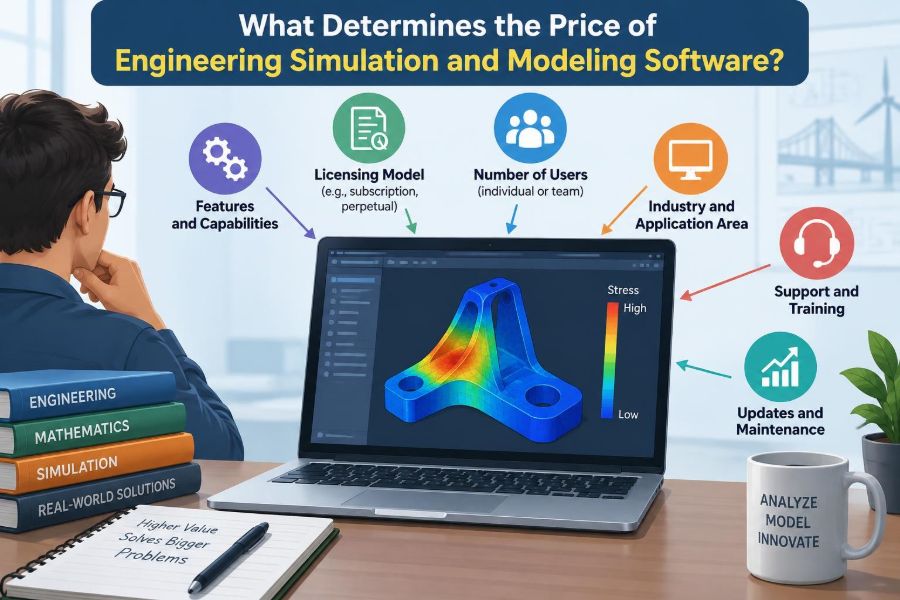

A design team needs to test whether a lightweight bracket will crack under repeated loading. A thermal engineer needs to predict hot spots in an electronics enclosure. A process engineer wants to understand why a pump system is becoming unstable. In each case, simulation software can turn a difficult physical question into a model that can be explored before a costly prototype is built.
Then comes a less mathematical question: why does one engineering simulation package appear inexpensive, while another requires a substantial annual commitment, specialist hardware, and paid training? The difference is rarely just the brand name on the interface.
Software pricing reflects the depth of physics being modeled, the size of the problems being solved, the computing resources involved, and the operational support needed to use results responsibly. It may also reflect the commercial model: a permanent license, a subscription, cloud credits, or a charge tied to a solver, user, or workload.
Understanding these factors helps students evaluate academic tools and helps working engineers build a realistic software budget. More importantly, it helps teams avoid paying for capabilities they will not use—or choosing a low-cost tool that cannot answer the engineering question.
🧭 The price is not the same as the value
The purchase price is the visible number, but the economic value comes from the decisions a tool improves. A simulation that identifies an unsafe fatigue region before tooling is released can be worth far more than its license cost. Conversely, a sophisticated package has little value if the team lacks the inputs, expertise, or time to build a defensible model.
Think of simulation software as part calculator, part workflow platform, and part risk-management tool. Its price commonly includes far more than the ability to draw geometry and press “solve.”
🧩 The physics modules included
One of the largest price drivers is the range and sophistication of physical phenomena the software can represent. Linear structural analysis is generally a narrower problem class than nonlinear contact, computational fluid dynamics (CFD), electromagnetics, acoustics, chemical reactions, or coupled multiphysics.
A module for a specialized field usually requires dedicated mathematical formulations, material models, meshing methods, and validation work. A user analyzing a simple static frame does not necessarily need the same package as a team modeling turbulent flow through a heat exchanger.
- Structural mechanics: stress, deformation, vibration, buckling, and fatigue.
- Fluid flow: pressure, velocity, turbulence, and free surfaces.
- Thermal analysis: conduction, convection, radiation, and phase change.
- Multiphysics: interactions such as fluid-structure, thermal-stress, or electrothermal behavior.
📏 Model fidelity and mathematical complexity
Fidelity means how closely a model represents the relevant behavior of the real system. Higher fidelity can require more detailed geometry, nonlinear material data, finer meshes, smaller time steps, and more solver controls. These capabilities add development complexity and often place the product in a higher pricing tier.
Higher fidelity is not automatically better. For an early concept comparison, a beam model or simple resistance network may provide the answer faster than a detailed three-dimensional simulation. The useful model is the simplest model that can support the decision.
🧮 Solver technology behind the interface
The solver is the numerical engine that converts equations into approximate results. Its algorithms determine how efficiently it handles large matrices, contact conditions, nonlinear convergence, turbulence, transient effects, or coupled fields.
Robust solver development is costly because engineering problems can fail in subtle ways. A solver must not only produce an answer; it must report convergence behavior, manage numerical stability, and remain dependable across a broad range of models. Mature solvers may therefore command a premium, especially in workflows where failed runs delay major projects.
🔢 Mesh size and degrees of freedom
Most finite element and finite volume simulations divide a domain into many small elements or cells. The number of unknown quantities to solve is often called the number of degrees of freedom. More cells and more unknowns generally mean greater computational demand.
Vendors may limit model size by nodes, elements, cores, memory, or solve capacity. An entry-level product might be suitable for small assemblies and teaching models, while enterprise licensing may be needed for a large vehicle, plant system, or detailed transient CFD case.
These limits matter because a model that is technically importable but too large to solve is not a practical capability.
⚙️ Serial, parallel, and high-performance computing
A serial solver mainly uses one processing core at a time. Parallel computing divides suitable portions of a calculation across many cores, processors, or machines. Efficient parallel scaling is difficult to engineer, particularly when processors must repeatedly exchange data.
Licenses may include only a limited core count, charge for additional parallel capacity, or use tokens that are consumed according to requested resources. A team should ask not simply, “Does it run in parallel?” but “At what model size and core count does parallel execution reduce turnaround enough to justify its cost?”
☁️ Cloud computing and usage-based charges
Cloud simulation can reduce the need to buy and maintain local hardware. It also makes occasional large runs feasible for smaller teams. Instead of owning compute capacity that sits idle between projects, users may pay for compute time when they need it.
The trade-off is variable cost. A long transient analysis, repeated design study, or poorly configured run can consume credits rapidly. Cloud pricing should be estimated from realistic workloads, including reruns, mesh studies, and post-processing—not only from a single ideal solve.
🖥️ Hardware requirements outside the license
Software cost is only part of the total cost of ownership. Large models can require substantial RAM, fast storage, capable graphics hardware for visualization, and reliable network access. Data backup and security controls can also matter when models contain proprietary product information.
For example, purchasing a low-cost CFD license does not solve a workflow bottleneck if the available workstation cannot hold the mesh in memory. Hardware planning should follow expected problem sizes and solver recommendations, not generic specifications alone.
🔗 CAD, PLM, and data-system integration
Simulation is rarely isolated from design. Engineers may need associative CAD links, material databases, product lifecycle management (PLM) integration, requirements traceability, or automated report generation. These integrations reduce manual file transfer and help preserve a clear connection between a result and the design version that produced it.
Integration can be valuable in a controlled product-development process, but it is not free. Connectors, enterprise permissions, deployment work, and maintenance all influence price. A student or small consultancy may prefer a simpler file-based workflow; a large manufacturer may require tightly managed data flow.
🧑💻 User roles and named-seat licensing
Many products are priced by user. A named-user license is assigned to a particular person, while a shared or floating license can be used by one member of a defined group at a time. The right approach depends on how often people actually run simulations.
A small core analysis team may use expensive specialist seats intensively. A wider design department may benefit from lower-cost viewer, reviewer, or simplified-analysis roles. Paying every occasional user for a full expert seat is often inefficient.
🎟️ Token and floating-license models
Token systems allocate a pool of license units across products and computational tasks. A user may consume a certain number of tokens for a solver module, additional cores, or a specialized analysis type. This can offer flexibility when project demands change from month to month.
However, flexible licensing requires monitoring. If several urgent jobs begin at once, the token pool can become a bottleneck. Teams should examine peak simultaneous demand rather than estimating from average use.
📅 Perpetual licenses, subscriptions, and rentals
A perpetual license generally gives continuing rights to a particular software version, often with separate maintenance for updates and support. A subscription provides access for a defined period. Rental arrangements can suit a short project, contract work, or a temporary capacity increase.
There is no universally cheaper model. A long-running team with stable needs may evaluate a perpetual arrangement differently from a startup with uncertain workload. Compare multi-year costs, update requirements, and the consequences of losing access to old project files before deciding.
| Model | Often suits | Planning consideration |
|---|---|---|
| Perpetual license | Stable, long-term use | Up-front cost and ongoing maintenance |
| Subscription | Teams needing current features and flexibility | Recurring budget commitment |
| Rental or project term | Short, defined workloads | Access ends when the term ends |
| Cloud credits | Variable or burst computing demand | Usage can be hard to predict |
🧰 Pre-processing and model-building tools
Before solving, an engineer must import or simplify geometry, define materials, create contacts, apply loads and boundary conditions, and generate a mesh. This work is called pre-processing, and it can consume more time than the solve itself.
Tools that automate geometry cleanup, detect thin regions, create connections, or build repeatable templates can materially improve productivity. Their price reflects not only convenience but fewer setup errors. Still, automation must be checked: a generated contact or mesh setting is an assumption, not proof that the model is correct.
📊 Post-processing and decision-ready results
Simulation produces fields, curves, animations, and large data files. Post-processing tools turn that output into stress plots, flow visualizations, safety margins, response histories, and reports that others can interpret.
Advanced result management can add cost because it supports comparisons across variants, traceability, dashboards, and collaborative review. These features matter most when analysis results must be communicated to non-specialists, managers, customers, or formal reviewers.
🔄 Automation, scripting, and design exploration
A single simulation answers one configuration. Engineering often requires dozens or thousands: different thicknesses, materials, load cases, control settings, or geometric dimensions. Scripting interfaces, application programming interfaces, optimization modules, and design-of-experiments tools make that exploration repeatable.
These capabilities are valuable when the variable being studied is well defined and model setup can be parameterized. They are less useful if every new concept requires extensive manual repair. Automation accelerates a sound process; it does not remove the need to define meaningful design variables and constraints.
🧪 Verification features and quality assurance
Verification asks whether the mathematical model has been solved correctly. Useful capabilities include mesh-convergence tools, solver diagnostics, checks for poor element quality, equation monitors, and clear error reporting. Such features help engineers detect numerical problems before treating a colorful contour plot as evidence.
Validation is different: it asks whether the model represents reality adequately for its intended purpose. No software price can guarantee validation. It requires appropriate physical inputs, comparison with experiments or known behavior where possible, and engineering judgment.
🏭 Industry-specific workflows
Some simulation environments include workflows tailored to industries such as automotive, aerospace, electronics, energy, manufacturing, or civil infrastructure. They may provide domain-specific materials, templates, standards-oriented reporting, or specialized solvers.
These packages can save substantial setup time for recurring work. But specialization can become unnecessary expense if a team only occasionally enters that problem area. Evaluate the actual frequency and criticality of the workflow, not its attractiveness in a demonstration.
📚 Material libraries and constitutive models
A constitutive model describes how a material responds to loading: for example, elastic deformation, plastic yielding, creep, viscoelasticity, or damage. Sophisticated material behavior can be essential for polymers, composites, rubbers, metals at high temperature, and biological or granular materials.
Libraries and advanced material modules may be priced separately because their development and curation are substantial. Yet a large library does not replace careful input review. Material properties depend on temperature, manufacturing route, strain rate, orientation, environmental exposure, and test method.
🌊 Nonlinearity and difficult physical behavior
Linear analyses assume proportional response and relatively small changes in geometry. Many real systems do not behave that way. Contact opens and closes, components plastically deform, seals compress, cables go slack, and structures can buckle.
Nonlinear analysis is often more expensive because it demands stronger solver technology, more user control, and more computational time. It also demands more skill. A nonlinear model can fail to converge for physical reasons, numerical reasons, or both, so teams need time to investigate rather than simply rerun.
⏱️ Transient and time-dependent analysis
Static analysis examines an equilibrium condition. Transient analysis follows behavior over time, such as a crash event, pressure pulse, motor startup, thermal cycle, or vibration response. The model must solve many time increments rather than one final state.
The resulting data volume and compute demand can grow rapidly. Pricing may therefore reflect access to explicit dynamics, time-domain solvers, data storage, and parallel resources. Before selecting such a module, define whether the decision truly depends on the time history or only on a conservative peak condition.
🔒 Security, deployment, and compliance needs
Organizations handling sensitive designs may require on-premises installation, single sign-on, access control, audit logs, encryption practices, or restrictions on where data is processed. Regulated or safety-critical environments can also require documented software qualification and controlled release procedures.
These needs influence deployment and support costs. A cloud-only tool may be efficient for one organization and unacceptable for another. The key question is not whether one deployment model is inherently safer, but whether it meets the organization’s technical, contractual, and governance requirements.
🧑🏫 Training, documentation, and support
Simulation results are only as reliable as the modeling choices behind them. Training helps users choose element types, loads, contacts, turbulence models, convergence criteria, and result checks appropriately. Good documentation helps when unusual problems appear under project pressure.
Support contracts may include updates, technical assistance, knowledge bases, and access to training resources. Their value rises when delays are expensive or the work is unfamiliar. For experienced teams doing routine analyses, a lighter support arrangement may be sufficient.
🛠️ Implementation and consulting services
Enterprise adoption can include more than installing software. A vendor, reseller, or specialist consultancy may help configure templates, migrate legacy models, connect data systems, develop automated workflows, and train multiple user groups.
These services raise the initial project cost but can reduce a different cost: months of inconsistent setup and weak adoption. Their usefulness depends on organizational complexity. A one-person design office does not need the same implementation program as a distributed engineering department.
👥 Collaboration and review capabilities
Modern engineering decisions involve designers, analysts, manufacturing specialists, test engineers, and project leads. Sharing models securely, annotating results, controlling versions, and enabling lightweight review can improve communication without requiring every stakeholder to operate a full solver.
Collaboration features are easiest to justify where several people repeatedly review the same data. If results are exchanged only occasionally as a PDF report or neutral file, a large collaboration platform may provide limited extra value.
📈 Vendor maturity and product ecosystem
Established products may cost more because they support a broad ecosystem of modules, third-party interfaces, user communities, training providers, and long-term file compatibility. That ecosystem can reduce adoption risk for organizations planning to use a tool across many projects.
Smaller or newer products may offer focused capabilities, simpler pricing, or faster innovation. They should not be dismissed merely because they are less familiar. Instead, assess solver suitability, support responsiveness, data portability, and the likelihood that the product will remain viable for the life of your projects.
🆓 Open-source and low-cost alternatives
Open-source simulation tools can be technically powerful and are especially valuable for learning, research, custom workflows, and organizations with strong internal computational expertise. Their lack of a conventional license fee does not mean they have no cost.
Time spent building workflows, compiling dependencies, creating interfaces, maintaining scripts, training users, and obtaining specialist support can be substantial. Commercial software may reduce those burdens through integrated workflows, while open tools may provide transparency and flexibility. The right choice depends on the team’s capabilities and requirements.
💸 The hidden cost of rework
A cheaper package can become expensive if it forces manual translation between systems, lacks a necessary solver, produces hard-to-review results, or causes analysts to repeat routine setup. Conversely, premium software can be wasteful if its advanced modules remain unused.
Estimate the cost of rework honestly. Include analyst hours, delayed design decisions, prototype changes, data conversion errors, and time spent resolving license bottlenecks. This creates a more meaningful comparison than license price alone.
🧾 A practical evaluation checklist
Before requesting quotations, write down the engineering decisions the software must support. Then test candidate tools with representative cases, not only polished tutorial examples. If possible, include a model that reflects your typical geometry, data quality, turnaround target, and reporting needs.
- Which physics and nonlinear effects are essential now?
- What model size, solve time, and number of concurrent users are realistic?
- Which CAD, data, and reporting systems must connect?
- What training level do users have, and who will review model quality?
- What are the likely hardware, cloud, support, and implementation costs?
- Can results and models be exported or accessed if licensing changes?
⚠️ Common mistakes when comparing quotes
A frequent mistake is comparing a base license against a competitor’s complete workflow. Another is assuming an academic, trial, or limited edition represents the performance and rights of a commercial license. Restrictions on model size, export, use type, or solver access can change the comparison completely.
Also watch for costs that appear later: maintenance renewals, extra compute tokens, additional user roles, training, database services, and required upgrades. Ask each supplier to state what is included, what is optional, and what activity triggers additional charges.
🎯 Matching the tool to the engineering decision
The best purchase begins with a question, not a feature list. If the decision is whether a simple support meets a static load limit, a focused structural tool may be enough. If the decision concerns thermal deformation, airflow, electronic heating, and control response together, a broader platform may be justified.
Match the tool to the consequence of being wrong as well. Early concept screening can tolerate simplified models and rapid iteration. Final verification for a high-consequence component may require more detailed analysis, stronger review, better traceability, and possibly test correlation.
✅ The core principle behind simulation software pricing
Engineering simulation and modeling software is priced around the capabilities and assurance needed to turn physical questions into usable decisions. Physics scope, solver robustness, computational scale, workflow integration, deployment, support, and licensing structure all contribute to the total cost.
The wisest comparison is therefore not “Which package is cheapest?” but “Which combination of software, computing, skills, and support lets us answer our real engineering questions reliably and efficiently?” That framing makes both underbuying and overbuying easier to avoid.
The right simulation investment is the one that provides enough credible modeling capability for the decision at hand, with a total cost the team can sustain. 📐⚙️💡