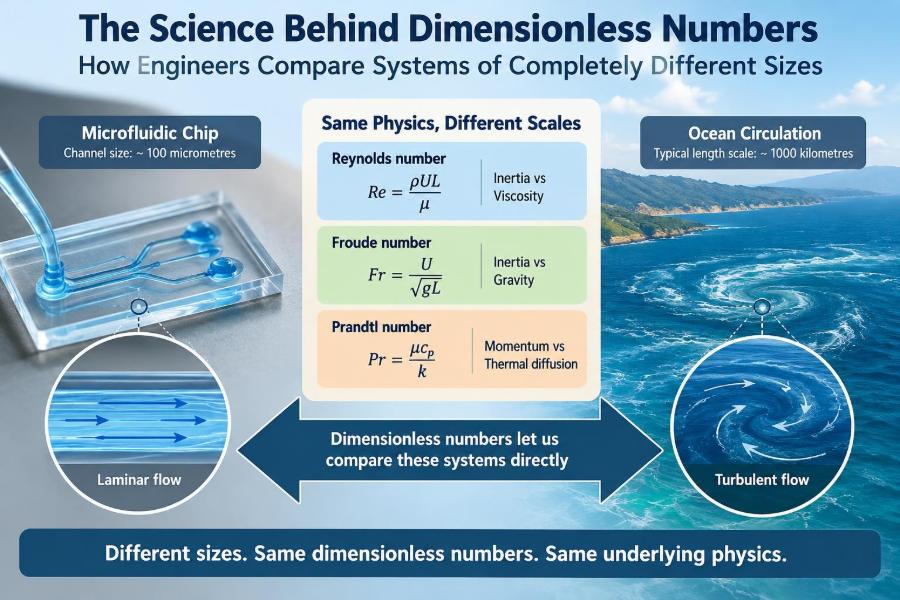

A raindrop falling through air, a cargo ship cutting through water, and blood moving through an artery seem to belong to different worlds. Their sizes, speeds, materials, and purposes are nothing alike.
Yet engineers can often describe a crucial part of all three situations with the same small set of numbers. Those numbers have no units: no metres, seconds, kilograms, or degrees attached.
That may sound like a mathematical trick, but it is one of engineering’s most useful habits. By removing units in a disciplined way, engineers reveal which physical effects are actually competing.
Dimensionless numbers make it possible to use a wind-tunnel model to learn about an aircraft, a laboratory pipe to study a chemical plant, or a scale model to investigate a bridge in flowing water. The comparison is never automatic, but the underlying method is remarkably powerful.
🧭 What a Dimensionless Number Is
A dimensionless number is a combination of physical quantities whose units cancel completely. It is not merely a measurement written without units; it is a ratio or product constructed so that it expresses a physical relationship.
For example, a length divided by another length is dimensionless. So is a speed divided by another speed. More sophisticated examples combine density, viscosity, velocity, gravity, temperature difference, and geometry.
The resulting value describes the relative strength of effects rather than an isolated property. That is why it can remain meaningful when a system is enlarged, reduced, or built from a different material.
📏 Dimensions Are Not Units
Units are labels such as metres, seconds, newtons, and pascals. Dimensions are the more fundamental categories behind them: length, time, mass, temperature, electric current, and others.
Velocity may be measured in metres per second or kilometres per hour, but its dimension is length divided by time. A valid dimensionless group must cancel dimensions regardless of which consistent unit system is used.
This distinction protects engineers from a common misunderstanding. Converting millimetres to metres changes a numerical value, but it should not change a properly calculated dimensionless number.
⚖️ Why Ratios Reveal More Than Raw Values
A velocity of 10 metres per second says something, but not enough to predict a flow pattern. Ten metres per second through a narrow syringe and ten metres per second around a ship produce very different behaviour.
A ratio gives the missing context. It may compare inertial forces with viscous forces, pressure forces with inertia, or heat carried by motion with heat spreading by conduction.
When one effect overwhelms another, the ratio makes that visible. When two effects are comparable, engineers know that both must be retained in the model or calculation.
🧩 The Basic Idea: Competing Physical Effects
Most dimensionless numbers can be read as a contest between mechanisms. In fluid flow, inertia tries to keep motion moving; viscosity resists relative motion between fluid layers.
In heat transfer, fluid motion transports energy from place to place, while thermal diffusion spreads energy through a material. In structural vibration, inertia and stiffness determine whether motion is slow and flexible or rapid and rigid.
The number itself is useful, but its physical interpretation is more useful. Engineers ask: which mechanism is dominant, and what behaviour follows from that balance?
🧮 How Units Cancel in Practice
Consider a simple speed ratio, Mach number:
Mach number = object speed / local speed of soundBoth numerator and denominator have dimensions of length per time, so the ratio has none. A value near 1 indicates that the object moves near the local speed of sound, where compressibility effects become especially significant.
The same cancellation occurs in more complicated groups. The algebra is not an optional final check; it is what ensures the number represents a relationship independent of the chosen units.
🔍 Buckingham Pi: Finding the Right Groups
The Buckingham Pi theorem offers a systematic route to dimensionless groups. If a physical problem involves a set of dimensional variables, the theorem indicates how many independent dimensionless combinations can describe it.
Suppose drag force depends on fluid density, viscosity, speed, object diameter, and the force itself. Rather than treating all variables separately, dimensional analysis can reduce the description to fewer dimensionless groups.
The theorem does not supply every piece of physics. It cannot decide whether a neglected effect, such as surface roughness or fluid compressibility, matters. It organizes the variables that have been chosen.
🗂️ Repeating Variables and a Careful Workflow
To apply Buckingham Pi, engineers list all relevant variables and write their dimensions. They then select repeating variables that collectively include the needed base dimensions and do not themselves form a dimensionless group.
Each remaining variable is combined with the repeating variables using unknown powers. Setting the dimensions of the product to zero produces equations for those powers.
A practical workflow is:
- State the physical outcome to be predicted.
- List variables that can plausibly affect it.
- Check dimensions and select repeating variables.
- Form independent groups.
- Use theory or experiments to determine the relationship among them.
Dimensional analysis reduces complexity; it does not replace engineering judgment about the variables.
🌊 Reynolds Number and Flow Regime
The Reynolds number compares inertial effects with viscous effects in a moving fluid:
Re = density × velocity × characteristic length / dynamic viscosityAt relatively low Reynolds number, viscosity strongly smooths disturbances. At higher values, inertia has greater influence, and flows may become unstable or turbulent depending on geometry and disturbances.
There is no single transition value for every situation. Flow in a carefully controlled pipe, flow around a rough vehicle, and flow through a complex valve can transition differently. Reynolds number is a guide to regime, not a universal switch.
🚰 A Pipe and an Ocean Liner Can Share Flow Physics
Water moving through a laboratory pipe may be physically similar to water moving around a much larger vessel if the relevant dimensionless conditions are matched closely enough. Their lengths and speeds need not be equal.
For example, reducing a length scale can be offset by changing velocity, fluid properties, or both. The aim is to preserve the ratio of inertia to viscosity, not to copy every dimensional quantity.
This is the central advantage of similarity: a manageable experiment can reveal patterns that would be expensive, slow, or unsafe to investigate at full scale.
🌀 Laminar, Transitional, and Turbulent Behaviour
Laminar flow has relatively orderly fluid motion, though it can still have complex velocity variations. Turbulent flow contains fluctuating, interacting eddies over many scales.
Reynolds number helps identify when viscosity is likely to dominate or when inertia makes turbulence plausible. However, inlet disturbances, bends, roughness, and vibrations can strongly influence what happens near transition.
For design, this distinction affects pressure loss, mixing, heat transfer, noise, erosion, and measurement accuracy. Treating a turbulent system as laminar can produce predictions that fail badly.
✈️ Mach Number and Compressibility
Mach number compares flow speed with the local speed of sound. It becomes essential when density changes caused by pressure disturbances can no longer be ignored.
At low Mach numbers, many air-flow calculations can reasonably treat air as nearly incompressible. As Mach number rises, pressure waves, density variation, and eventually shock waves can shape lift, drag, temperature, and engine performance.
“Local” matters because the speed of sound depends on the medium and its thermodynamic state. It is not a fixed universal speed in air.
🌡️ Prandtl Number Connects Momentum and Heat
The Prandtl number compares momentum diffusivity with thermal diffusivity. In plain language, it indicates whether velocity disturbances and temperature disturbances spread through a fluid at similar or very different rates.
In some fluids, heat spreads faster than momentum. In others, especially more viscous liquids, the thermal boundary layer and velocity boundary layer can have noticeably different thicknesses.
This matters near heated pipes, heat exchangers, and electronic cooling surfaces. A fluid’s ability to move heat is not determined by thermal conductivity alone; flow behaviour matters too.
🔥 Nusselt Number Measures Convective Heat Transfer
The Nusselt number compares heat transfer by convection with heat transfer by pure conduction across a fluid layer. A larger value generally indicates that fluid motion is enhancing heat transfer relative to conduction alone.
It is commonly related to Reynolds and Prandtl numbers through experimentally or theoretically derived correlations. The exact relationship changes with geometry, flow regime, surface condition, and thermal boundary conditions.
Using a correlation outside its stated range is risky. A formula developed for fully developed internal flow does not automatically apply to a short entrance region or an external cross-flow.
🌬️ Grashof and Rayleigh Numbers for Natural Convection
Not all fluid motion is driven by a pump or fan. Warm fluid often becomes less dense and rises under gravity, while cooler, denser fluid sinks. This is natural convection.
The Grashof number compares buoyancy effects with viscous effects. The Rayleigh number combines buoyancy, viscosity, and thermal diffusion, making it especially useful in heated enclosures and vertical gaps.
These groups help explain why a warm radiator creates circulation in a room and why spacing around a naturally cooled device can matter. Gravity, orientation, and temperature difference cannot be treated as afterthoughts in such systems.
🛶 Froude Number and Free-Surface Flows
The Froude number compares inertia with gravity effects, usually in flows where a free surface or waves matter. It is central to ship hydrodynamics, spillways, channels, harbours, and wave tanks.
Two boats with matched Reynolds number but very different Froude number can generate and interact with waves differently. For a ship model, matching gravity-wave behaviour may therefore take priority over matching viscous behaviour exactly.
This illustrates a recurring engineering compromise: not every influential dimensionless number can be matched simultaneously in a small-scale test.
🫧 Weber Number and the Importance of Surface Tension
The Weber number compares inertial effects with surface-tension effects. It becomes relevant when droplets break up, liquid jets atomize, bubbles form, or a liquid interface changes shape.
A fuel injector, spray nozzle, inkjet printhead, and rain splash all involve surface tension, but not necessarily in the same proportion to inertia. Matching size alone will not recreate the same droplet behaviour.
At larger scales, surface tension may be relatively unimportant; at small scales, it can dominate. This is one reason microscale devices cannot always be designed by simply shrinking a familiar large device.
🧪 Capillary Number in Coating and Microfluidics
The capillary number compares viscous forces with surface tension. It is useful when a liquid interface is pulled, coated, or displaced by flowing fluid.
In coating processes, the balance affects film thickness and the chance of unwanted patterns. In microfluidic channels, it helps describe how droplets, plugs, and interfaces move through narrow passages.
Unlike Weber number, which emphasizes inertia relative to surface tension, capillary number emphasizes viscosity. Choosing the correct group begins with identifying the forces likely to control the observed behaviour.
🪨 Euler Number and Pressure Effects
The Euler number compares pressure differences with inertial effects. It appears in descriptions of pressure drop across fittings, valves, ducts, and flow devices.
A useful related quantity is the pressure coefficient, which compares a local pressure difference with a dynamic-pressure scale. Such coefficients allow pressure patterns around bodies to be compared even when the actual velocities differ.
These numbers are particularly helpful when converting a measured pressure loss into a form suitable for equipment sizing or comparison between geometrically similar components.
🔧 Drag Coefficient Turns Force Into a Comparable Quantity
Drag force rises with size, speed, and fluid density, so raw force is a poor basis for comparing shapes. The drag coefficient scales drag force by dynamic pressure and a reference area.
Once nondimensionalized, it becomes easier to compare a smooth sphere, a rough sphere, a streamlined body, or a vehicle model at relevant flow conditions. The reference area must be stated because different conventions can produce different coefficient values.
Drag coefficient is not usually constant across all conditions. Reynolds number, surface roughness, orientation, and compressibility can all change it.
🏗️ Similarity Has Three Different Meanings
Scale-model work is clearest when three forms of similarity are separated:
- Geometric similarity: corresponding shapes and proportions match.
- Kinematic similarity: corresponding motions, velocities, and flow paths scale consistently.
- Dynamic similarity: corresponding force ratios, expressed through dimensionless numbers, match.
A visually accurate model has geometric similarity, but that alone does not guarantee the correct flow, load, temperature field, or vibration response.
📐 Geometric Similarity Is Necessary but Not Sufficient
A scale aircraft model may have the same outline, wing proportions, and surface angles as the full aircraft. If its surface is relatively rougher at model scale, however, the boundary layer may behave differently.
Small manufacturing details can become disproportionately large after scaling down. A tiny gap, seam, or support in a model may disturb the flow in ways that do not represent the full-size design.
Engineers therefore pay close attention to model finish, test-section interference, supports, and the definition of the characteristic length used in calculations.
🎯 Dynamic Similarity Is the Real Goal
Dynamic similarity means that the relevant force or transport ratios are the same in model and prototype. If gravity and inertia govern a wave problem, matching Froude number is usually essential.
If viscosity and inertia govern an internal pipe flow, Reynolds number may be the primary target. If both are important, a simple model using the same fluid may not permit both to match.
The solution may involve another fluid, a different test pressure, a larger model, a corrected empirical method, or numerical simulation. No option removes the need to understand what is being approximated.
🧱 Why One Scale Model Cannot Match Everything
Imagine reducing a ship to a small water-tank model. To preserve wave behaviour, the speed is adjusted to match Froude number. But the smaller length scale changes Reynolds number, so viscous drag may not scale perfectly.
This is not a failure of dimensionless analysis. It is precisely what the analysis reveals: gravity and viscosity cannot both be reproduced exactly under the available conditions.
Engineers handle this by separating resistance components, applying validated corrections where appropriate, or selecting test conditions that best serve the decision being made.
🧊 Scaling Heat Exchangers and Cooling Systems
A smaller heat exchanger has less surface area, shorter flow paths, and often different relative losses. Simply preserving its shape does not preserve its thermal performance.
Relevant groups may include Reynolds number, Prandtl number, Nusselt number, and sometimes Biot number, which compares internal conduction resistance within a solid to convection resistance at its surface.
For transient heating or cooling, the Fourier number compares elapsed diffusion time with the time scale required for heat to diffuse through a length. The appropriate set of numbers depends on whether the main question is steady performance, warm-up time, or temperature uniformity.
⚙️ Dimensionless Numbers Beyond Fluids
Dimensionless thinking extends far beyond flow and heat transfer. In vibrations, damping ratio compares actual damping with a critical reference level, while frequency ratios identify potential resonance.
In chemical reaction engineering, the Damköhler number compares reaction rate with transport or flow time scales. It helps indicate whether a reactor is limited more by chemistry or by delivery and mixing.
In mass transfer, the Schmidt and Sherwood numbers play roles analogous to Prandtl and Nusselt numbers. The pattern is consistent: compare transport mechanisms to understand which one controls the outcome.
🧠 Dimensionless Groups Reduce Experimental Work
Without dimensional analysis, an experimenter might vary every dimensional input independently: speed, diameter, density, viscosity, gravity, temperature, and more. The number of test combinations grows quickly.
Dimensionless groups reduce the problem to a relationship such as:
drag coefficient = function of Reynolds number and Mach numberThat does not eliminate experiments, but it organizes them. A well-designed test program can map the variables that truly govern behaviour instead of repeatedly testing equivalent cases expressed in different units.
📊 Correlations Are Useful, but They Have Boundaries
Engineering handbooks often provide correlations that connect dimensionless numbers, such as a heat-transfer relation involving Nusselt, Reynolds, and Prandtl numbers. These are practical tools, especially during preliminary design.
Every correlation has a context: a geometry, range of properties, flow regime, surface condition, and set of assumptions. Its apparent simplicity can hide substantial experimental detail.
Before using one, check the definitions, applicable ranges, boundary conditions, and property-evaluation temperature. If the system lies outside the intended range, a result may be an estimate rather than a reliable prediction.
⚠️ Common Mistake: Choosing the Wrong Characteristic Length
Many dimensionless numbers require a characteristic length, but the correct choice depends on the phenomenon. For flow inside a noncircular duct, hydraulic diameter is often more meaningful than its width alone.
For flow over a flat plate, distance from the leading edge may govern boundary-layer development. For a cylinder in cross-flow, diameter is the natural choice.
An incorrect length can make a calculation look polished while placing it in the wrong regime. State the chosen length explicitly, and connect it to the physical process being modelled.
🧾 Common Mistake: Mixing Properties and Temperatures
Density, viscosity, thermal conductivity, and specific heat may change substantially with temperature, especially for gases, oils, and fluids near phase changes. A dimensionless number calculated with inconsistent properties can be misleading.
Engineers commonly evaluate properties at a defined bulk, wall, film, or reference temperature according to the method being used. The chosen convention must match the correlation or governing model.
When temperature variation is large, a single representative property may be inadequate. Iteration, spatially varying properties, or a more detailed numerical model may be needed.
🧯 Common Mistake: Treating a Number as a Complete Answer
A Reynolds number does not directly give pressure drop. A Mach number does not fully determine shock structure. A Nusselt number does not select a heat-exchanger material or guarantee a safe wall temperature.
Dimensionless numbers classify, compare, and organize. They must be combined with governing equations, boundary conditions, geometry, material limits, uncertainty estimates, and engineering constraints.
Think of them as a map legend rather than the whole map. They tell you which features matter, but they do not remove the need to navigate the actual design.
💻 Numerical Simulation Still Needs Scaling Insight
Computational fluid dynamics and other simulations can calculate detailed fields of velocity, pressure, and temperature. Yet simulations still depend on dimensionless reasoning.
Mesh resolution must capture relevant scales, turbulence models have valid ranges, and boundary conditions must represent the governing physics. Reporting Reynolds, Mach, Prandtl, or other relevant numbers helps others interpret whether a simulation represents the intended regime.
Dimensionless groups also help compare simulation with experiment. A visually similar flow field at the wrong Reynolds number may not validate the model for the full-scale application.
🧰 A Practical Checklist Before Comparing Systems
Before claiming that two systems are comparable, ask a few direct questions:
- What outcome matters: force, pressure drop, mixing, heat transfer, waves, vibration, or reaction yield?
- Which mechanisms can influence that outcome?
- Which dimensionless numbers represent their competition?
- Can the relevant numbers be matched, or must some be prioritized?
- Are geometry, boundary conditions, roughness, and material properties comparable?
- What uncertainty follows from unavoidable mismatches?
This checklist applies equally to a benchtop experiment, a pilot plant, a wind-tunnel campaign, and a simulation plan.
🌍 Where Dimensionless Thinking Appears Every Day
You may not see the numbers written down, but they shape everyday engineering. They influence how spray bottles form droplets, why a coffee cools differently when stirred, how an inhaler disperses medicine, and how ventilation carries warm air through a room.
They also explain why very small devices can behave unexpectedly. At microscale, viscous and surface forces may dominate while inertia becomes less influential; familiar large-scale intuition can become unreliable.
That shift is not mysterious. It is a change in the ratios controlling the system.
🔑 The Core Principle: Compare Physics, Not Just Size
Dimensionless numbers let engineers compare systems of radically different scale because they preserve the relative importance of the mechanisms that govern behaviour. A small model can stand in for a large system only to the extent that those governing relationships are reproduced.
The method requires care: select relevant variables, choose meaningful characteristic scales, verify definitions, and acknowledge mismatches. It is not a license to assume that anything scaled down is automatically similar.
Used well, dimensionless analysis turns a complicated collection of measurements into a clearer question: which physical effects are competing, and in what proportion?
Engineers compare unlike systems successfully when they match the physics that matters, not when they merely match the shape or size. That is the quiet power of a number with no units. 📐🌊⚙️