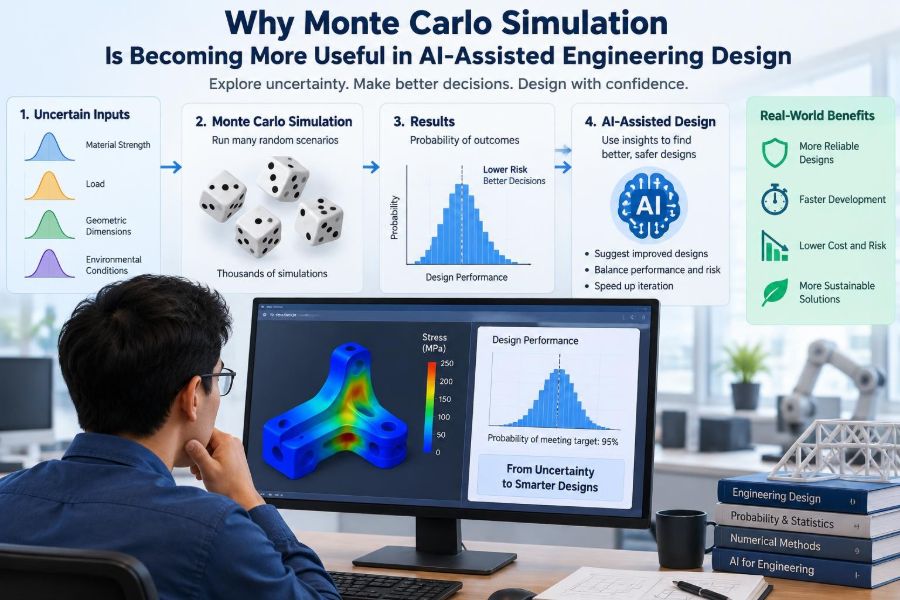

A design team is choosing the wall thickness of a pressure vessel. The nominal calculation says the design is safe, but the real vessel will see changing temperatures, material variation, uncertain loads, and manufacturing tolerances. A single “best estimate” cannot describe all of that.
The same problem appears in battery packs, wind-turbine blades, robot grippers, flood barriers, and electronic cooling systems. Engineers rarely need only an answer; they need to know how likely an answer is to remain acceptable when reality varies.
Monte Carlo simulation has long helped with this task by running a model repeatedly with different plausible inputs. What is changing is the surrounding design workflow: AI tools can now help engineers build faster surrogate models, search larger design spaces, interpret results, and automate repetitive analysis steps.
That does not make uncertainty disappear. It makes uncertainty easier to include earlier, more often, and more explicitly in engineering decisions.
🎲 Monte Carlo Simulation in Plain Language
Monte Carlo simulation estimates the behavior of a system by using many randomized trials. Instead of assigning one value to an uncertain input, the method draws many possible values from a chosen probability distribution and calculates an outcome for each trial.
For example, an engineer assessing a beam might vary its applied load, elastic modulus, cross-sectional dimensions, and support stiffness. The resulting collection of deflections shows not just one predicted deflection, but a range of plausible deflections.
The name refers to randomness, not gambling. Its engineering value comes from converting uncertain inputs into a structured picture of uncertain outcomes.
📐 Why a Single Deterministic Calculation Falls Short
Traditional deterministic analysis typically uses fixed inputs: one load, one material property, one geometry, and one operating condition. This is useful for understanding a baseline design, checking equations, and satisfying many routine calculations.
But fixed inputs can hide a critical distinction. A design can meet a requirement at nominal values while failing when several ordinary variations occur at the same time.
Monte Carlo methods ask a different question: given plausible variation, what distribution of performance should we expect? That question is often closer to the decision an engineer actually needs to make.
🌦️ Engineering Systems Operate in Variable Conditions
Uncertainty enters a design from many directions. Some variation is inherent in nature, while some comes from limited knowledge or imperfect control.
- Loads may change with users, wind, traffic, vibration, or duty cycle.
- Material properties vary across batches, temperatures, and service life.
- Dimensions vary because manufacturing is never perfectly exact.
- Boundary conditions may differ from simplified assumptions.
- Environmental conditions may include uncertain heat, moisture, corrosion, or contamination.
A useful simulation does not include every imaginable uncertainty. It identifies the uncertainties that could materially affect the engineering decision.
🎯 From Point Predictions to Probability Distributions
A point prediction might state that a motor reaches 78°C. A Monte Carlo result might show a distribution of temperatures, including the proportion of trials near or beyond a thermal limit.
This matters because an average can be acceptable while a high-end tail is not. If a small number of plausible operating combinations produce overheating, the team may need a larger heat sink, a revised control strategy, or clearer operating constraints.
Distribution-based thinking changes the language of design from “the result is 78” to “the result is usually near 78, with a spread that depends on these assumptions.”
🧩 The Basic Mathematical Structure
Let a model be written as Y = f(X), where X represents uncertain inputs and Y is an output such as stress, fatigue life, cost, or energy use. Monte Carlo simulation samples many input vectors X₁, X₂, …, Xₙ and evaluates the model for each one.
The output sample can then estimate quantities such as the mean, variability, percentiles, and probability of crossing a limit. If failure is defined by g(X) < 0, the fraction of simulated samples satisfying that condition estimates the failure probability under the assumed model.
Those assumptions matter. A polished histogram cannot compensate for unrealistic input distributions or an inadequate physical model.
🎲 Choosing Random Inputs Is an Engineering Judgment
Random sampling is only as credible as the distributions it uses. A normal distribution may be reasonable for some manufacturing dimensions, but it can be unsuitable for strictly positive quantities, bounded variables, or rare extreme loads.
Engineers may draw distributions from measured data, material certificates, test programs, supplier specifications, physical knowledge, or carefully documented expert judgment. When evidence is sparse, it is usually better to state uncertainty openly than to present an arbitrary distribution as fact.
Useful questions include: What values are physically possible? Is the variable skewed? Does it have hard limits? Are extreme values especially consequential?
🔗 Correlation Prevents Unrealistic Combinations
Inputs are often related. A high ambient temperature may occur alongside a high cooling load. Material density and stiffness can be associated within a production process. A larger component dimension may also increase mass.
Sampling every variable independently can create combinations that are physically implausible or distort risk estimates. Correlation describes how variables tend to move together, although it does not by itself establish causation.
When dependencies are uncertain, teams should test alternative plausible relationships. This is more informative than quietly assuming independence because it is convenient.
🧪 A Simple Beam Example
Consider a hypothetical cantilever beam in a small machine. Its tip deflection depends on applied force, length, elastic modulus, and second moment of area. Each may vary because of payload differences, assembly dimensions, material variability, and tolerance.
A deterministic calculation might use the maximum expected force and nominal geometry. A Monte Carlo model instead samples those quantities repeatedly and computes deflection for every sample.
The output can reveal whether the clearance requirement is violated only under exceptional combinations or under a substantial portion of plausible conditions. That difference guides whether a design change is justified.
🛡️ Reliability Is More Than a Safety Factor
A safety factor remains a valuable engineering tool, especially where codes, standards, or established practice prescribe it. It provides a straightforward margin between predicted demand and capacity.
Monte Carlo analysis adds context by showing how uncertain demand and capacity overlap. Two designs with the same nominal safety factor can have different reliability if one has much greater variability in loading or material strength.
This does not mean simulation should replace required safety procedures. It can help explain where margin is being consumed and where additional evidence, testing, or conservatism is warranted.
🤖 AI Changes the Cost of Repeated Analysis
Many high-fidelity engineering models are expensive to run. A detailed finite element, computational fluid dynamics, or multiphysics simulation may take minutes, hours, or longer. Thousands of random trials can therefore be impractical.
AI-assisted workflows are becoming useful because machine-learning models can approximate expensive simulations after being trained on carefully selected simulation or experimental data. These approximations are commonly called surrogate models or emulators.
Once validated within their intended range, a surrogate can evaluate many candidate cases quickly enough to support uncertainty analysis during iterative design.
⚡ Surrogate Models Make More Samples Feasible
A surrogate learns a relationship between inputs and outputs. For example, it may estimate peak stress from geometry, load direction, material parameters, and temperature without rerunning a full finite element model every time.
The workflow is not “replace physics with AI.” A stronger approach uses trusted physics-based simulations and experiments to generate training data, then uses the surrogate where speed is needed.
Surrogates are especially useful when the original model is accurate but slow. They are less trustworthy when asked to predict far outside the data on which they were trained.
🧠 AI Can Help Build Models, but Not Authorize Them
AI tools can assist with scripting, data cleaning, parameter extraction, experiment planning, visualization, and documentation. They can reduce friction in routine work and help engineers explore alternatives more quickly.
However, an AI-generated equation, code fragment, or distribution choice still requires engineering review. It may contain incorrect units, overlook a physical constraint, or use terminology convincingly without representing the actual system.
Accountability remains with the engineering team. Verification, validation, traceability, and independent checks are not optional simply because an automated tool was involved.
🔍 Sensitivity Analysis Identifies What Really Drives Risk
After running a simulation, engineers should ask which inputs most influence the outcome. Sensitivity analysis examines how changes in inputs affect output variation or the likelihood of crossing a limit.
If fatigue life is strongly driven by surface finish and load amplitude but barely affected by one secondary dimension, effort should focus on measuring, controlling, or redesigning the influential variables.
This prevents a common mistake: spending equal effort on every uncertainty. Good uncertainty management is selective because time, test capacity, and budget are limited.
📊 Percentiles Often Matter More Than Averages
Mean performance is useful for expected energy use, typical cycle time, or average cost. Yet engineering requirements frequently concern less typical outcomes: maximum temperature, minimum clearance, high stress, or low remaining capacity.
Percentiles summarize these regions. For instance, a high temperature percentile can be compared with a thermal limit, while a low strength percentile can inform a conservative capacity assessment.
A percentile is not magic proof of safety. Its meaning depends on the model, input distributions, sample size, and whether rare events have been represented credibly.
🌊 Rare Events Are Difficult by Definition
If an outcome is genuinely rare, ordinary random sampling may need a very large number of trials before enough occurrences appear to estimate it reliably. This is a fundamental limitation, not a software defect.
Methods such as importance sampling, subset simulation, or stratified sampling can direct computational effort toward important regions. These techniques require care because poor weighting or implementation can introduce bias.
For high-consequence systems, simulation is usually one part of a broader assurance case that may also include testing, conservative design rules, inspection, redundancy, and operational controls.
🧭 Design Space Exploration Becomes More Practical
AI-assisted optimization can propose many candidate geometries, materials, or control settings. Monte Carlo simulation can then evaluate whether each candidate is robust to uncertainty rather than merely excellent at nominal conditions.
A lightweight bracket, for example, may minimize mass under ideal loads yet be highly sensitive to a small manufacturing deviation. A slightly heavier alternative may produce more stable stress and fatigue behavior across plausible variations.
This shifts optimization from finding the mathematically best point to finding a design that remains good when assumptions are imperfect.
🏗️ Robust Design Is Not the Same as Overdesign
Robust design aims for acceptable performance across a reasonable range of variation. It does not automatically mean adding material, cost, or complexity everywhere.
Sometimes robustness comes from reducing sensitivity: changing geometry to avoid stress concentration, using a control algorithm that adapts to temperature, selecting a process with tighter variation, or redesigning an interface so assembly position matters less.
Monte Carlo results can expose these opportunities because they show not only whether a limit is crossed, but which combinations tend to cause the crossing.
🔄 Digital Twins Benefit from Uncertainty Awareness
A digital twin is a computational representation connected, to varying degrees, with a real asset or process. Sensor data can update its inputs or model state during operation.
Monte Carlo techniques can help a twin represent uncertain sensor readings, unknown degradation rates, changing environmental conditions, and future usage scenarios. The result is often more useful than a single forecast because operators can see a range of possible trajectories.
Still, a digital twin is not automatically a faithful replica. Its usefulness depends on calibration, data quality, model scope, and the decisions it is intended to support.
🔧 Manufacturing Tolerances Become Design Variables
Design and manufacturing are often treated as separate stages, but tolerance variation directly affects fit, stiffness, flow paths, contact pressure, and assembly performance. Monte Carlo simulation makes this connection explicit.
Suppose a housing, seal, and shaft each have dimensional variation. Sampling their combined dimensions can estimate the distribution of clearance or interference. That helps teams identify whether a functional problem is caused by a nominal design issue or a tolerance stack-up.
The practical response may be a different tolerance allocation, a process improvement, or a geometry change that is less sensitive to variation.
🔋 Battery and Thermal Design Need Scenario-Based Thinking
Thermal systems are sensitive to ambient temperature, airflow, component efficiency, contact resistance, aging, and usage patterns. Battery systems add uncertainty in cell capacity, internal resistance, state estimation, and duty cycle.
Monte Carlo analysis can test many plausible combinations of these factors. A surrogate model may be particularly helpful where electrothermal or cooling simulations are too slow for repeated evaluation.
Results should be interpreted with caution when degradation mechanisms or extreme operating conditions are poorly characterized. Fast prediction does not remove gaps in physical understanding.
🚗 Control Systems Need More Than Nominal Plant Models
A controller tuned for a nominal motor, vehicle, or robotic mechanism can perform differently when friction, payload, sensor noise, delay, or actuator response changes. Repeated randomized simulation can reveal instability, saturation, tracking error, or excessive energy use under variation.
AI may assist with policy search or model approximation, while Monte Carlo trials stress-test the proposed controller across scenarios. This is valuable before hardware testing, where unsafe cases may be expensive or difficult to reproduce.
Simulation cannot demonstrate every real-world interaction. Hardware-in-the-loop tests and carefully staged physical trials remain essential where consequences are significant.
🧱 Data Quality Can Limit the Entire Workflow
AI-assisted analysis can make a weak data problem look sophisticated. Missing metadata, inconsistent units, unrepresentative tests, sensor drift, and undocumented preprocessing can all damage the resulting model.
Input data should retain provenance: where it came from, under what conditions it was measured, how it was filtered, and which assumptions were added. This is particularly important when combining simulation data with test data.
A smaller, well-characterized dataset can be more valuable than a large dataset with unclear meaning.
✅ Verification and Validation Answer Different Questions
Verification asks whether the model has been implemented correctly: are equations, code, units, numerical settings, and sampling procedures working as intended? Validation asks whether the model adequately represents the real system for its intended purpose.
A Monte Carlo workflow needs both. It is possible to sample correctly from an incorrect physical model, or to have a sound model but corrupt results through a coding or data-handling error.
Useful checks include limiting-case tests, hand calculations, unit tests, comparison with known measurements, review of distributions, and examination of physically implausible outputs.
📈 Convergence Must Be Checked, Not Assumed
Every Monte Carlo estimate has sampling error. Running more trials generally improves stability, but the required number depends on the quantity being estimated. An average may settle quickly, while a tail probability may remain noisy.
Engineers should monitor estimates as samples accumulate. If a key percentile or failure estimate changes substantially when additional trials are added, the result is not yet numerically stable enough for a firm conclusion.
Repeating analyses with different random seeds is also a practical check. It helps distinguish a real design difference from random variation in the sampling process.
🗂️ Traceability Makes Results Defensible
A useful result should be reproducible by another qualified engineer. That requires recording model version, input distributions, dependencies, random seed where relevant, training data version, surrogate settings, acceptance criteria, and post-processing choices.
AI tools can improve documentation by organizing runs and generating summaries, but automated records still need review. The critical question is whether someone can trace a conclusion back to assumptions and evidence.
Traceability is especially valuable when designs evolve, teams change, or analysis supports formal reviews.
⚠️ Common Mistakes in AI-Assisted Monte Carlo Work
- Using convenient distributions: selecting a normal curve without checking whether negative or impossible values can be sampled.
- Ignoring dependence: treating linked environmental, geometric, or material variables as independent.
- Trusting extrapolation: allowing a surrogate model to judge designs outside its training domain.
- Reporting only a mean: hiding the spread and tail behavior that drive engineering limits.
- Confusing precision with accuracy: presenting many decimal places from a model with uncertain assumptions.
- Automating without review: accepting AI-produced code or summaries without technical verification.
These errors are not unique to AI. Faster workflows simply make it easier to repeat them at scale unless sound review practices are built in.
🪜 A Practical Workflow for Engineering Teams
- Define the decision, performance metric, and limit state clearly.
- Build or select a physics-based model appropriate to the decision.
- List uncertain inputs, their plausible ranges, distributions, and dependencies.
- Verify the implementation with simple cases and independent checks.
- Use a validated surrogate only if the original model is too slow for the required sampling.
- Run simulations, monitor convergence, and inspect the full output distribution.
- Perform sensitivity analysis and investigate failure-producing combinations.
- Compare design options using both nominal performance and robustness.
- Document assumptions, limitations, and the evidence supporting decisions.
This process scales from a spreadsheet-based tolerance study to a sophisticated multiphysics design platform.
🧑💻 Skills Engineers Need Alongside AI Tools
Useful skills include probability, statistics, numerical methods, mechanics or domain physics, programming, experimental design, and data visualization. None must be mastered perfectly before starting, but each helps engineers recognize misleading outputs.
The most valuable habit is asking disciplined questions: What does this distribution represent? What was excluded? Are these samples physically possible? Has the model been tested where the decision is sensitive?
AI can accelerate calculations and coding, but engineering judgment determines whether the result deserves trust.
⚖️ When Monte Carlo Is Not the Best First Tool
For a simple, well-bounded calculation with conservative inputs, a deterministic analysis may be faster and easier to audit. For early concept screening, a few bounding cases can reveal more than an elaborate probabilistic model built on guesses.
Monte Carlo is less helpful when the governing physics are unknown, the input assumptions have no defensible basis, or the output decision cannot tolerate ambiguity that simulation has not reduced.
The method should match the question. Complexity is justified when uncertainty affects a consequential choice and the analysis can meaningfully represent that uncertainty.
🌱 Where the Growing Value Really Comes From
Monte Carlo simulation is becoming more useful not because randomness is new, but because AI-assisted tools can reduce the time between a design idea and an uncertainty-aware assessment. Surrogate models, automated pipelines, and better data handling can bring probabilistic thinking into ordinary iteration cycles.
Its greatest value is not a colorful probability plot. It is the ability to identify fragile assumptions, compare robust alternatives, target measurement effort, and explain trade-offs honestly.
Used carefully, the combination lets engineering teams move from asking “Will this design work?” to asking “Under what conditions will it work, where could it fail, and what should we change?”
🔑 The Core Principle for AI-Assisted Design
AI can make simulation faster, broader, and easier to automate. Monte Carlo methods can make the resulting design conversation more realistic by representing variability instead of concealing it behind a single nominal case.
But no algorithm can supply missing physics, trustworthy data, or responsible judgment. A credible workflow combines physical models, defensible uncertainty assumptions, validation, convergence checks, and clear communication of limitations.
The goal is not to predict the future with false certainty. The goal is to make better engineering decisions while being explicit about what is known, what varies, and what remains uncertain.
Monte Carlo simulation becomes most powerful in AI-assisted engineering when speed is paired with disciplined uncertainty modeling, not when automation is mistaken for certainty. 🎲🤖📐