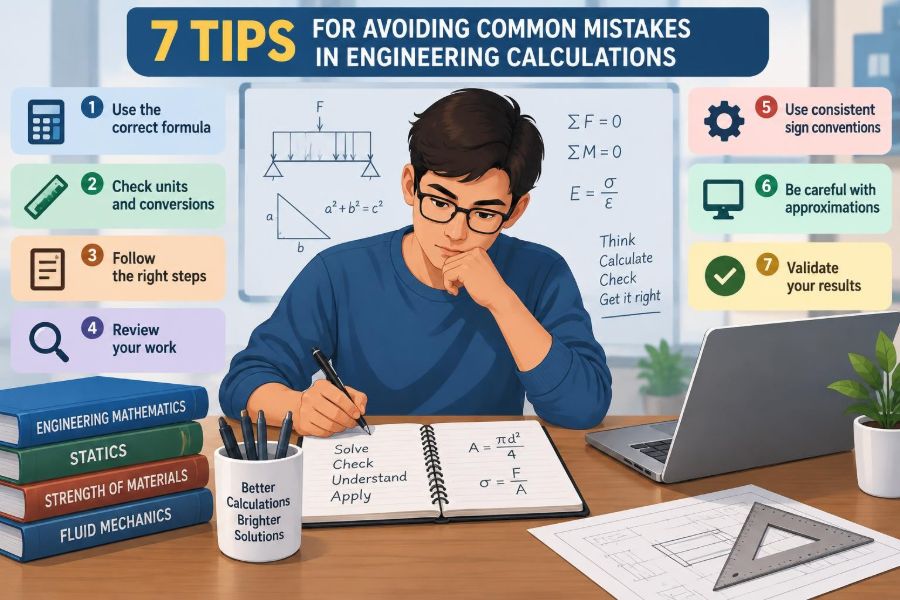

A calculation can look perfectly reasonable on a screen and still be wrong enough to waste material, delay a project, or send a design back for review. The danger is rarely a spectacular algebra mistake. More often, it is a quiet mismatch: millimetres entered where metres were assumed, a load case omitted, or a result copied into the wrong cell.
These errors affect students solving homework problems, technicians preparing a field estimate, and engineers checking a design model. Modern software calculates quickly, but it cannot decide whether the inputs represent the real system.
Good engineering calculation is therefore more than finding a number. It is a controlled process of defining a problem, preserving units, testing assumptions, and making the result easy for another person to inspect.
The seven tips below address the most common failure points. The supporting sections explain why they work and how to turn them into a reliable everyday workflow.
🧭 1. Define the Question Before Choosing a Formula
Start by writing what must be found, what system is being analysed, and what conditions apply. A formula is only useful after the engineering question is clear.
For example, “find the beam capacity” is incomplete. Does capacity mean bending resistance, shear resistance, deflection under service loading, or a particular limit state? Each interpretation can require different inputs and criteria.
- State the required output and its unit.
- Identify the component or boundary of the system.
- List the loading, operating, or environmental condition.
- Note the acceptance criterion before calculating.
This short definition prevents a common mistake: producing an accurate answer to the wrong problem.
🗺️ Turn Words into a Physical Model
Engineering mathematics begins with a model: a simplified representation of reality. A free-body diagram, circuit sketch, process flow diagram, or coordinate diagram makes that representation visible.
Suppose a bracket supports a hanging load. Before writing equilibrium equations, show the load direction, support reactions, dimensions, and chosen axes. Missing a moment arm becomes much less likely when the geometry is drawn.
Every model leaves something out. That is acceptable only when the omission is deliberate and appropriate. A model that treats a cable as weightless may be suitable for a first estimate, but not for a long span where self-weight changes the tension meaningfully.
📏 2. Make Units Part of Every Line
Unit errors are among the most preventable calculation failures because dimensional consistency can reveal them early. Do not treat units as decoration added after the arithmetic; carry them through the calculation.
If force is in newtons and area is in square millimetres, stress emerges in N/mm², which is numerically equivalent to MPa. If force is in newtons and area is in square metres, the result is in pascals. Both are valid, but mixing the area units mid-calculation is not.
Write conversions explicitly, especially when a value crosses a boundary between a drawing, a datasheet, a spreadsheet, and a simulation package.
250 mm = 0.250 m
3.5 kN = 3500 N
That extra line creates an audit trail and makes scale errors easier to catch.
🔄 Use a Consistent Unit System
Carrying units is essential; choosing a coherent system makes the work easier still. SI base units are often the clearest choice for calculations, while engineering-friendly combinations such as kN and mm may be convenient when used consistently.
The key is not that one system is universally superior. The key is that derived quantities follow correctly. A section modulus entered in mm³ cannot be used unchanged with stress expressed in Pa unless the conversion is handled.
| Quantity | Common consistent pairing | Frequent mismatch |
|---|---|---|
| Force and length | N and m, or kN and m | kN used with a formula expecting N |
| Stress and area | N/mm² with mm² | MPa combined with m² without conversion |
| Density and volume | kg/m³ with m³ | kg/m³ with dimensions left in mm |
🎯 3. Check the Order of Magnitude First
Before trusting a detailed result, ask whether its scale makes physical sense. This is an order-of-magnitude check: an approximate estimate used to expose values that are too large or too small by a factor of ten, a thousand, or more.
A steel member a few metres long should not appear to weigh several tonnes unless its cross-section supports that conclusion. A domestic electrical circuit should not show a current comparable to that of heavy industrial equipment without an obvious reason.
Estimate with rounded inputs before using a calculator. If the exact answer differs sharply from the estimate, revisit the units, exponents, geometry, and formula rather than assuming the estimate was unhelpful.
🧮 Estimate Before You Calculate Precisely
Approximation is not a substitute for analysis. It is an independent line of reasoning. Consider a rectangular tank: volume is roughly length times width times depth. That simple relation can immediately flag a spreadsheet result that is implausible.
Use bounding values when an exact estimate is awkward. If a load lies between 4 and 5 kN and a lever arm is close to 2 m, the moment should lie near 8 to 10 kN·m. A reported value of 0.09 kN·m requires explanation.
This habit is especially valuable when calculators and software make a wrong input look authoritative.
🧾 4. Record Assumptions Where They Can Be Seen
Every engineering calculation rests on assumptions. Common examples include steady-state operation, uniform material properties, negligible friction, small deflection, ideal supports, or a specified temperature range.
Write assumptions beside the calculation, not only in your head. A reviewer needs to know whether a load was treated as static, whether a pipe was assumed full, or whether a connection was modelled as pinned.
- Use assumptions that match the required accuracy.
- State values adopted from incomplete information.
- Identify assumptions likely to affect the result most.
- Revise the model when the assumptions no longer fit the case.
An assumption is not a weakness. An unstated assumption is difficult to test.
⚖️ Distinguish Known Data from Design Choices
Measured dimensions, manufacturer data, and stated loads are inputs with a source. Factors of safety, selected material grades, and chosen design allowances may be engineering decisions governed by a specification or design basis.
Mixing these categories hides judgment inside arithmetic. Label uncertain, estimated, and selected values clearly. If a result changes later, this makes it possible to identify whether new site data or a revised design decision caused the change.
🧩 5. Use the Formula Only Within Its Valid Range
A familiar equation can be applied incorrectly even when every number is typed accurately. Formulas contain conditions, sometimes explicit and sometimes buried in the derivation.
For instance, a simple beam-deflection expression depends on support conditions and load arrangement. Using a simply supported-beam formula for a cantilever does not become acceptable because the units work out.
Before applying an equation, identify what it assumes about geometry, material behaviour, loading, boundary conditions, and time dependence. If the real system departs materially from those conditions, choose a more suitable method or state the limitation.
📚 Verify Definitions, Not Just Symbols
Identical symbols can mean different things in different references. The letter k might represent a spring constant, thermal conductivity, a buckling factor, or a coefficient defined by a particular standard.
Likewise, “pressure” may mean gauge pressure or absolute pressure. Confusing the two is particularly risky in gas-law and vacuum-related calculations. Read the variable definition, reference conditions, and stated units every time a formula is taken from a new source.
Copying an equation without its definitions is one of the easiest ways to import an invisible mistake.
🧱 6. Break Complex Problems into Checkable Stages
Long calculations become safer when divided into meaningful intermediate steps. Instead of entering one dense expression into a calculator, compute geometry, loads, reactions, stresses, and acceptance checks separately.
Each stage should produce a quantity with a name and unit. In structural work, this might mean calculating tributary area, then load, then reaction, then bending moment. In fluid work, it might mean flow area, velocity, Reynolds number, and pressure loss.
A staged method makes errors local. If an output is wrong, you can inspect the relevant block rather than dismantling an entire chain of arithmetic.
🧷 Preserve Signs, Directions, and Reference Points
Sign conventions are not minor bookkeeping. They encode direction and physical meaning. Choose a convention for positive force, moment, current, voltage, displacement, or heat flow, then apply it consistently.
A negative result is often useful information. It may show that the actual reaction acts opposite to the direction assumed, not that the answer must be made positive to look tidy.
State reference points too. Elevation, datum pressure, ground, and electrical potential are all meaningful only relative to an identified baseline.
💻 7. Treat Software Output as a Result to Verify
Spreadsheets, symbolic tools, finite-element models, and calculators reduce repetitive work. They do not remove responsibility for modelling choices, input quality, or interpretation.
A spreadsheet formula can be copied one row too far, a cell reference can shift, and a hidden conversion can persist after a template is reused. A simulation can produce colourful contours for an unrealistic boundary condition.
Build a simple hand estimate or independent calculation for critical values. Check one or two known cases, inspect units in the input and output, and look at the shape of the result rather than only its maximum value.
🔍 Audit Spreadsheets for Quiet Errors
Spreadsheets deserve engineering controls because they are easy to edit and hard to inspect casually. Separate input cells from calculated cells, label units beside inputs, and avoid embedding unexplained constants in formulas.
Useful spreadsheet checks
- Use cell protection or visual formatting to distinguish inputs.
- Display formulae during review, not only results.
- Trace precedent cells for key outputs.
- Test limiting cases, such as zero load or zero length where meaningful.
- Give each revision a clear identifier and date.
For high-consequence decisions, an independent reviewer should understand the spreadsheet logic without needing to reconstruct it from scratch.
🧠 Separate Accuracy from Precision
Accuracy describes closeness to the true value; precision describes the fineness or repeatability of a stated value. A calculator may display many decimals even when the input data justify only a broad estimate.
If a length was measured to the nearest millimetre and a load is estimated, reporting stress to six decimal places implies confidence that the data do not provide. Excess digits can conceal uncertainty instead of reducing it.
Keep extra digits during intermediate work when necessary, then round the final result to a level that fits the input quality and decision being made.
📉 Understand How Errors Propagate
Some formulas amplify small input errors. In an area calculation, a small length error may have a modest effect. In a relationship involving a squared or cubed dimension, the same error can have a stronger influence.
This is why dimensions, material thicknesses, and measured diameters often deserve careful verification. A rough sensitivity check asks: if this input increases slightly, does the output change slightly or dramatically?
Focus checking effort where it changes decisions. There is little value in refining a minor coefficient while leaving a dominant load estimate uncertain.
🧪 Test Limiting and Extreme Cases
A sound formula should behave sensibly at meaningful limits. If a load becomes zero, the corresponding elastic deflection should normally tend toward zero. If a pipe diameter decreases while flow rate stays fixed, velocity should rise.
These tests do not prove a model is correct, but they can reveal reversed ratios, incorrect exponents, and misplaced parentheses. They are particularly powerful when reviewing equations assembled from several terms.
Choose limits that make physical sense; not every mathematically possible extreme is physically achievable.
🔁 Check Results by a Different Route
Repeating the same calculation in the same spreadsheet may reproduce the same error. A stronger check uses a different route: a hand estimate, an alternate formulation, a separate program, or a review by someone who starts from the problem statement.
For example, reactions found from a structural analysis can be checked against total vertical load. An electrical power result can be checked using both P = VI and a resistance-based relation when the conditions permit.
Independence matters more than complexity. A simple check that relies on different assumptions is often more valuable than a second elaborate model built from the same mistaken input.
🧱 Keep Geometry and Coordinates Explicit
Many calculation errors begin in geometry rather than mathematics. A centroid located from the wrong edge, an angle entered in degrees where radians are required, or an offset measured to the wrong reference line can alter every later result.
Label dimensions directly on a sketch and define coordinates before calculating distances or moments. When using trigonometry, confirm whether the software setting and the formula expect degrees or radians.
For three-dimensional systems, do not rely on an isometric sketch alone. Record axes and coordinate directions clearly.
🌡️ Include Operating Conditions That Change Properties
Material properties and fluid behaviour can depend on temperature, pressure, moisture, strain rate, frequency, or chemical exposure. A value taken from a table is only valid under the conditions attached to that table.
For a preliminary calculation, using a nominal property may be reasonable if the uncertainty is acknowledged. For a final design or safety-sensitive assessment, consult the applicable data source and design requirements.
The practical question is not “what is the material property?” but “what property applies under this component’s actual operating conditions?”
🛡️ Do Not Confuse Working Values with Failure Limits
Engineering calculations often distinguish between normal operating conditions, serviceability requirements, and ultimate or failure-related limits. These categories answer different questions.
A component may have sufficient strength yet deflect too much for its intended function. A pressure vessel may operate below a maximum pressure but still require consideration of fatigue, temperature, or transient conditions.
Use the correct criterion for the decision at hand. Applying a strength check where a serviceability check is required can create false reassurance.
📋 Follow the Applicable Method and Specification
In professional work, a calculation is often governed by a project specification, client requirement, code, standard, or established company method. These documents can define load combinations, material values, factors, rounding, and required documentation.
Do not substitute a remembered textbook formula for an applicable formal method without checking compatibility. Requirements vary by discipline, jurisdiction, project, and revision, and they should be verified by the responsible professional.
Where no formal requirement applies, document the chosen method and why it is suitable.
🗂️ Make Calculations Reviewable
A calculation should tell a reviewer what was analysed, where the inputs came from, what assumptions were used, and how the conclusion was reached. Clear presentation is a technical safety feature, not cosmetic polish.
Use descriptive variable names, line-by-line units, labelled diagrams, and a concise conclusion. Avoid a final page containing only a number with no traceable route back to the source data.
Good documentation also helps future you. Projects return months later, often after drawings, assumptions, or site conditions have changed.
👥 Ask for a Focused Peer Check
Peer review is most useful when the reviewer has a defined task. “Please check everything” can lead to a superficial read. “Please confirm the load path, units, and governing combination” gives the review a practical focus.
A reviewer may catch an ambiguity the original author can no longer see because familiarity makes the intended meaning feel obvious. For critical work, review depth should match consequence and organizational procedures.
Review does not transfer responsibility automatically, but it creates an additional opportunity to detect faults before a result is used.
⏱️ Manage Changes Instead of Patching Numbers
Late changes are normal: a dimension is revised, equipment weight changes, or a new site condition emerges. The risky response is to overwrite one visible number while leaving dependent calculations and notes unchanged.
Record the revision, identify affected inputs, rerun linked checks, and update the conclusion. If a change invalidates an assumption, revisit the model rather than merely refreshing the arithmetic.
Version control can be simple, but it must make clear which calculation is current and which information it used.
🚩 Recognize Results That Demand a Pause
Certain signals deserve investigation before proceeding: a negative value that has no physical interpretation, a result outside the expected scale, discontinuities between adjacent cases, or a governing condition that changes unexpectedly.
Also pause when an answer depends heavily on one poorly known input. The right action may be to obtain better data, widen the assessment, or communicate the uncertainty rather than forcing a precise-looking conclusion.
Engineering judgment includes knowing when calculation has reached the limit of available information.
🧰 Build a Reusable Calculation Checklist
A short checklist converts good intentions into repeatable practice. It is especially helpful under deadline pressure, when routine omissions become more likely.
- Define the required decision and acceptance criterion.
- Sketch the system and identify boundaries.
- List inputs, sources, units, and assumptions.
- Select a method valid for the conditions.
- Calculate in visible, checkable stages.
- Estimate scale and test physical behaviour.
- Review, document, and control revisions.
Adapt the list to your discipline. A thermal calculation, a circuit design, and a structural check will have different technical details, but the control sequence remains useful.
🎓 Practice the Habits on Small Problems
Reliable calculation habits are built before the stakes are high. When solving classroom exercises, do not skip diagrams, units, or assumption statements simply because the question appears familiar.
Compare your result with a rough estimate, then explain in one sentence what the number means physically. If you use software, reproduce a small case by hand. These practices make professional calculations more efficient because checking becomes automatic rather than an extra task.
✅ The Core Principle: Make Errors Visible Early
The seven tips work together because each exposes a different kind of hidden error. Clear problem definition catches misinterpretation; units catch dimensional mistakes; estimates catch scale failures; assumptions and valid methods protect the model; staged work and independent checks reveal arithmetic and software problems.
No process eliminates uncertainty entirely. Real projects involve incomplete data, idealisations, changing requirements, and professional judgment. The goal is to make those limitations visible, proportionately managed, and easy to review before a number becomes a decision.
The most dependable engineering calculation is not the one that looks most complicated; it is the one whose assumptions, units, logic, and checks can be understood and tested. 📐🔍✅