
At a metal heat-treatment plant, a furnace may need to hold a steel load within a narrow temperature band for hours. A few degrees of unwanted variation can change hardness, residual stress, grain structure, or the consistency of the final product.
At a ceramics line, a different furnace may follow a carefully shaped heating and cooling curve. Heating too quickly can crack a product; holding too cool can leave material transformations incomplete; cooling incorrectly can create internal defects.
These outcomes depend on more than a powerful burner or electric heater. They depend on a control system that continuously measures conditions, compares them with the intended process, and makes disciplined corrections.
Industrial furnace control is a practical meeting point for thermodynamics, instrumentation, feedback theory, and engineering judgement. Understanding it reveals why “keeping the temperature steady” is a much richer problem than simply switching heat on and off. 🔥
🔥 1. What Temperature Stability Really Means
Temperature stability means keeping a controlled process close to its required thermal condition over time. The requirement may be a single constant temperature, a permitted temperature range, or a changing temperature profile called a ramp or recipe.
Stability has both a time and a space dimension. The furnace should avoid large fluctuations at one measurement point, but the entire useful working zone should also be reasonably uniform.
- Temporal stability: how much temperature at a point changes with time.
- Spatial uniformity: how much temperature differs between locations.
- Repeatability: whether separate batches experience comparable thermal histories.
🏭 2. Why Furnaces Need Active Control
A furnace constantly loses energy through walls, openings, exhaust gases, conveyors, and product loading. Its heat demand also changes as cold material enters, as doors open, and as fuel properties or electrical supply conditions vary.
Without active control, a furnace will drift because the balance between heat input and heat loss is continually disturbed. A controller acts to restore that balance rather than assuming operating conditions remain fixed.
This matters in heat treatment, glass processing, chemical production, food processing, semiconductor fabrication, and many other thermal operations.
⚖️ 3. The Basic Energy Balance
The central physical idea is an energy balance. If heat enters the furnace faster than heat leaves it and is absorbed by the load, the temperature tends to rise. If losses and absorption exceed input, the temperature tends to fall.
A simplified lumped model can be written as:
C dT/dt = Q_in - Q_loss - Q_load
Here, C represents effective thermal capacitance, T is temperature, Q_in is supplied heat, Q_loss is environmental loss, and Q_load is heat absorbed by material. Real furnaces are more complex, but this relationship explains their behaviour.
🌡️ 4. The Controlled Variable
The controlled variable is the quantity the system tries to regulate. In a simple furnace loop, it is usually temperature measured at a selected location.
However, a thermocouple in the furnace atmosphere does not necessarily equal the temperature at the centre of a thick metal component. Engineers must decide whether the most useful controlled variable is chamber temperature, product temperature, wall temperature, or a combination of measurements.
Choosing the wrong variable can produce a beautifully stable reading and an unstable or poorly processed product.
🎯 5. Setpoint: The Intended Thermal Condition
The setpoint is the target value supplied to the controller. For a soak process, it may stay constant; for firing, curing, or annealing, it normally changes according to a programmed schedule.
A setpoint is not always a promise that every point inside the furnace has exactly that temperature. It is a command reference, interpreted through sensor location, process dynamics, and the furnace’s achievable uniformity.
Good recipes account for the fact that a physical load needs time to respond after the chamber reaches a new setpoint.
📏 6. Measuring Temperature with Sensors
Most high-temperature industrial furnaces use thermocouples. Two dissimilar metals generate a small voltage related to the temperature difference between their measuring junction and reference condition.
Other applications may use resistance temperature detectors, infrared pyrometers, or specialized probes. Each instrument has strengths and limitations involving temperature range, response speed, contamination, emissivity, durability, and installation.
- Thermocouples are robust and widely suitable for high temperatures.
- Resistance sensors can offer strong accuracy in lower-temperature applications.
- Pyrometers measure radiation and can be useful where contact sensing is difficult.
📍 7. Sensor Location Changes the Answer
A sensor near a burner can read hotter than the working zone. A sensor near a door may overreact whenever the door opens. A sensor behind a shield may be protected from direct radiation but respond more slowly.
Placement should represent the condition that matters to the process while avoiding misleading local effects. In larger furnaces, multiple sensors are often used for monitoring, zone control, high-limit protection, or temperature surveys.
Sensor position is therefore part of the control design, not a minor installation detail. 🧭
🔄 8. Feedback Closes the Loop
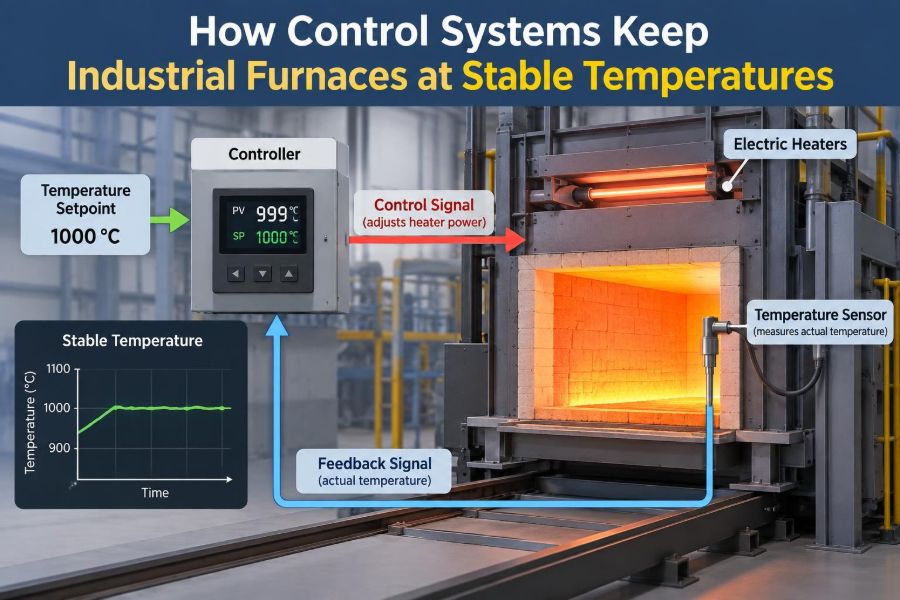
A closed-loop control system measures actual temperature, compares it with the setpoint, calculates an error, and changes heat input in response. This cycle repeats continuously.
The error is commonly expressed as:
error = setpoint - measured temperature
If measured temperature is below setpoint, the controller usually requests more heating. If it is above setpoint, it reduces heating or, in some systems, activates cooling or dilution.
🧩 9. The Main Parts of a Furnace Control Loop
A typical loop includes a measurement device, an input circuit, a controller, an output device, a heat source, and the thermal process itself. The furnace and its load are called the plant in control engineering.
| Element | Primary role | Typical example |
|---|---|---|
| Sensor | Measures process condition | Thermocouple |
| Controller | Calculates required response | PID temperature controller |
| Final control element | Changes energy input | Fuel valve, thyristor, contactor |
| Plant | Responds thermally | Furnace chamber and load |
| Disturbance | Pushes process away from target | Door opening or cold charge |
Every element introduces its own limitations, delays, uncertainty, and possible failure modes.
🧠 10. Why On-Off Control Is Sometimes Enough
The simplest controller turns heating fully on below a threshold and fully off above another. The gap between switching points is called hysteresis or differential.
On-off control is common in small or slow thermal systems because it is simple, inexpensive, and dependable. The temperature naturally cycles around the target rather than settling at one perfectly fixed value.
For processes that tolerate this cycling, simplicity can be an advantage. For tighter regulation, more graduated control is usually needed.
📉 11. Proportional Control Reduces Abrupt Switching
Proportional control makes the controller output depend on the size of the current error. A large temperature shortfall calls for strong heating; a small shortfall calls for less heat.
This reduces the all-or-nothing behaviour of on-off control. Yet proportional-only control often settles with a small remaining offset, because some error is needed to command enough heat to balance ongoing losses.
That remaining difference between setpoint and steady measured temperature is called steady-state error.
⏱️ 12. Integral Action Removes Persistent Offset
Integral action accumulates error over time. If a furnace remains slightly below setpoint for an extended period, the accumulated error gradually raises the output until the offset is removed.
This is valuable because heat losses exist even when the furnace appears steady. Integral action helps the controller supply the exact sustaining heat needed under current conditions.
But excessive integral action can keep pushing after the process has begun responding, contributing to overshoot. This problem is often described as integral windup.
🔮 13. Derivative Action Anticipates Movement
Derivative action responds to how quickly the measured condition is changing. If temperature is rising rapidly toward setpoint, derivative action can reduce output before a large overshoot develops.
In practice, derivative action is sensitive to noisy measurements. A noisy thermocouple signal can appear to be rapid temperature movement, causing unwanted output fluctuations.
For this reason, derivative action must be applied thoughtfully, often with filtering, and it is not automatically beneficial in every furnace loop.
🎛️ 14. PID Control Brings the Actions Together
A PID controller combines proportional, integral, and derivative actions. It is widely used because its three terms address present error, accumulated past error, and the rate of change.
u(t) = Kp e(t) + Ki integral(e(t)) dt + Kd de(t)/dt
The expression is a conceptual model of controller output u(t). Actual industrial controllers may use discrete-time calculations, output limits, filters, anti-windup methods, and configurable control forms.
PID is powerful, but it is not magic. Its success depends on sensible tuning, reliable measurements, adequate actuator capacity, and realistic process expectations.
🐢 15. Thermal Inertia Creates Delay
Furnaces are slow because refractory linings, fixtures, walls, air, and product all store energy. This stored-energy effect is called thermal inertia or thermal capacitance.
After heating power changes, the sensor may not show the full effect immediately. The furnace may continue rising after power is reduced because heat already stored in hot surfaces continues transferring to the measured zone.
Delayed response makes aggressive control risky. A controller that reacts as though the system were instantaneous tends to overshoot and oscillate.
📈 16. Overshoot, Oscillation, and Settling
Overshoot occurs when temperature rises beyond the setpoint after a change. Oscillation occurs when the process repeatedly swings above and below the target.
Some movement is normal, especially during heating transitions. The goal is not always to eliminate every fluctuation, but to keep deviations within process requirements and allow the system to settle in a suitable time.
- High gain can improve response but may increase oscillation.
- Too little gain can make correction sluggish.
- Long delays require especially conservative tuning.
🛠️ 17. Tuning Is Matching Control to the Process
Tuning means selecting controller parameters that give an acceptable compromise among speed, stability, overshoot, and disturbance rejection. There is no single best tuning for every furnace.
A lightweight electric furnace with exposed elements can respond differently from a large fuel-fired furnace with thick refractory. A furnace loaded with a heavy cold batch behaves differently again.
Commissioning may use controlled tests, historical trends, built-in autotuning functions, or model-based methods. Any tuning exercise must respect safe operating limits and process constraints.
⚡ 18. How Electric Furnaces Modulate Heat
Electric furnaces often control resistive heating elements by changing the fraction of time that power is applied or by modulating electrical power more smoothly. The appropriate method depends on element type, electrical design, load characteristics, and required control quality.
Time-proportioning control may switch a contactor or solid-state device within a control cycle. A larger controller demand produces a longer on-time fraction, increasing average power.
Fast switching hardware must be chosen appropriately, since repeated switching that is acceptable for a solid-state device may be unsuitable for a mechanical contactor.
🔥 19. How Fuel-Fired Furnaces Modulate Heat
Fuel-fired furnaces typically adjust burner firing rate through valves, regulators, dampers, or combustion-control equipment. The controller’s output may command a fuel flow, air flow, burner position, or staged burner arrangement.
Combustion must remain safe and stable across the operating range. Fuel and air generally need coordinated control so that changes in firing rate do not create poor combustion, unstable flames, or undesirable exhaust conditions.
Temperature control and combustion safety are related, but they are not the same function. Safety logic must always retain authority over normal temperature demand.
🌬️ 20. Airflow and Circulation Improve Uniformity
In many furnaces, fans circulate hot gases to reduce temperature differences between regions. Circulation improves convective heat transfer to the load and can shorten the time needed for products to approach chamber temperature.
Uniformity still depends on chamber geometry, load arrangement, burner or element location, baffles, fan performance, and airflow paths. A fan cannot fully overcome a badly obstructed or poorly loaded furnace.
For some high-temperature or sensitive processes, forced circulation may be impractical, so radiation and natural convection dominate instead.
📦 21. The Product Load Is Part of the System
Control performance changes when the furnace load changes. A cold, heavy batch absorbs large quantities of heat and can pull chamber temperature down sharply; a light load may allow fast temperature rise and greater overshoot risk.
Product shape also matters. Thin parts respond quickly, while thick sections develop internal temperature gradients. A chamber sensor may indicate that the recipe step is complete before the core of a large part has reached the intended temperature.
Recipes often include soak time to allow internal temperatures to equalize.
🚪 22. Disturbances Test the Controller
A disturbance is anything that changes the process without being commanded by the temperature loop. Opening a door, introducing a cold load, changing exhaust flow, or experiencing a supply variation are common examples.
A well-tuned loop rejects disturbances by adding or reducing heat without excessive deviation. However, no controller can instantly replace energy lost through a large open door or heat a massive cold load without physical delay.
Good operation reduces avoidable disturbances rather than expecting control software to compensate for every poor practice.
🗺️ 23. Multi-Zone Control Handles Large Furnaces
Large furnaces often divide the heating space into zones. Each zone has its own sensor, controller output, and heating equipment so that one area can be corrected without forcing the entire furnace to respond identically.
Zones interact because heat flows across internal boundaries. Raising one zone’s power can gradually warm its neighbour, so independent controllers may need careful tuning to avoid competing responses.
Multi-zone control improves flexibility, but uniformity also requires thoughtful mechanical design and balanced loading.
🧪 24. Temperature Profiles Matter More Than a Single Number
Many industrial processes need a sequence: ramp upward, hold, perhaps ramp again, then cool at a controlled rate. A profile controller follows these programmed segments automatically.
Ramp limits prevent the setpoint from changing faster than the product or furnace can safely follow. Soak segments hold a temperature long enough for reactions, transformations, or internal equalization to occur.
A profile should be based on material and process needs, not simply on the fastest heating rate the equipment can produce.
🧯 25. Control Loops Are Not Safety Systems
A normal controller can fail, be misconfigured, or receive a faulty signal. For that reason, industrial furnaces commonly use independent protective functions such as high-temperature limit devices, flame supervision where relevant, interlocks, emergency stops, and airflow or pressure checks.
A high-limit device is intended to place the system in a safe state if temperature rises beyond an acceptable threshold. It should not be used as the routine means of regulating an unstable process.
Safety design requires hazard analysis, appropriate hardware, testing, maintenance, and procedures suited to the particular furnace and jurisdiction.
🔍 26. Calibration and Maintenance Protect Accuracy
Control quality cannot exceed measurement quality. Thermocouples can drift, insulation can degrade, electrical connections can loosen, burners can foul, fans can lose performance, and actuators can stick.
Calibration compares instruments against suitable references and helps reveal measurement error. Maintenance also includes inspecting sensor protection tubes, checking wiring polarity, verifying output operation, and reviewing trends for gradual changes.
A stable display does not prove an accurate process temperature. Regular verification is essential. ✅
📊 27. Trends Turn Operation into Evidence
Recording temperature, setpoint, controller output, alarms, door events, and relevant process signals helps engineers understand real behaviour. A trend can show slow oscillation, repeated overshoot after loading, actuator saturation, or sensor anomalies that are difficult to see in a momentary display.
Useful questions include:
- Does the output remain near maximum while temperature falls?
- Does the temperature cycle widen after a change in loading?
- Does one zone consistently lag behind the others?
- Does a door event create a recovery pattern that suggests poor tuning or insufficient capacity?
Data does not replace engineering knowledge, but it makes diagnosis more objective.
🧭 28. The Core Principle: Balance, Measure, Correct
Industrial furnace temperature control works by continuously balancing heat input against heat storage and heat loss. Sensors provide evidence of the current state, the controller compares that state with the intended recipe, and actuators adjust energy delivery.
Reliable results require more than a PID setting. They depend on representative measurement, sensible sensor placement, suitable heating equipment, realistic recipes, process-aware tuning, uniform airflow or radiation, maintained instruments, and independent safety protection.
The core principle is simple: measure the temperature that matters, respond to error with appropriate energy, and respect the slow physical reality of heat transfer. When those elements work together, industrial furnaces can deliver repeatable thermal conditions instead of merely producing heat. 🌡️🔥⚙️