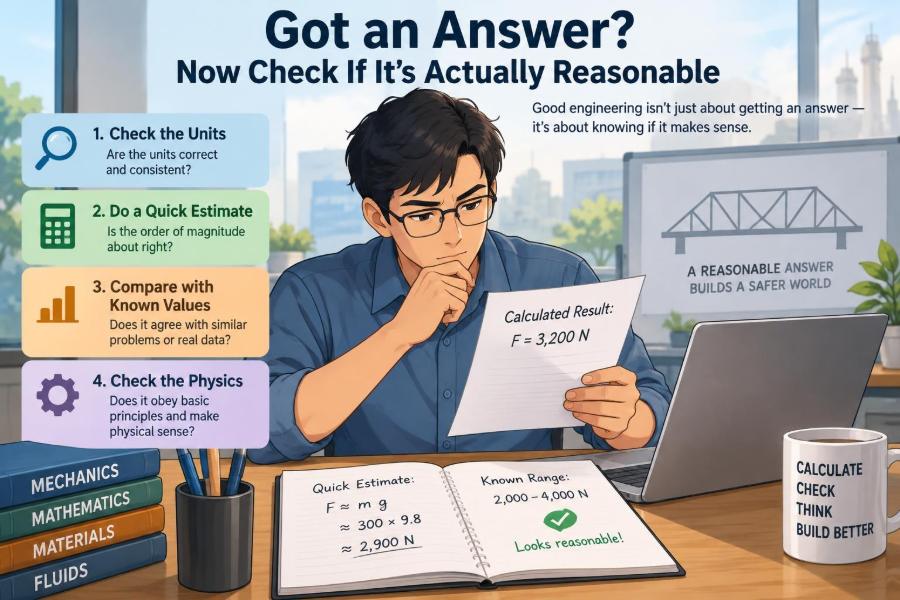

A spreadsheet returns 47,382.6. A calculator displays a negative flow rate. A simulation predicts that a small motor will lift a much larger load than expected. The arithmetic may be flawless, yet something about the answer feels wrong.
That feeling is not guesswork or a substitute for mathematics. It is the start of engineering judgement: the disciplined habit of asking whether a numerical result is compatible with the physical system it claims to describe.
Engineering calculations are built from assumptions, measurements, models, units, and software. An error can enter at any stage, often without producing an obvious warning message. A result that is numerically precise can still be physically impossible, based on the wrong interpretation, or too uncertain to use safely.
Checking reasonableness is therefore not an optional final ritual. It is how engineers turn a computed number into a decision they can explain, review, and trust.
🧭 A calculation is not yet an engineering answer
A calculation transforms inputs into an output according to a chosen model. An engineering answer adds context: what the output means, which conditions it applies to, how uncertain it is, and whether it makes physical sense.
For example, a beam-deflection equation can produce a displacement value. Before using it, an engineer must ask whether the beam is actually slender enough for that equation, whether the support conditions match the real structure, and whether the stated load is realistic.
The number is evidence, not a verdict. Reasonableness checks test whether that evidence survives contact with reality.
🔍 Begin with the question, not the formula
Many bad answers start with a formula that was applied to the wrong question. A request for “pressure” might mean gauge pressure, absolute pressure, pressure drop, or average pressure; each can lead to a different calculation.
Write the target quantity in words before writing symbols. State where it applies, at what time, under which operating condition, and for what purpose. “Maximum bolt stress during startup” is much clearer than “stress.”
This framing also reveals whether one number is enough. A pump selection, for instance, may require a flow range, a head range, fluid properties, and a duty cycle rather than a single nominal point.
📏 Check dimensions before checking digits
Dimensional analysis asks whether the units on both sides of an equation are compatible. It is one of the quickest and most powerful error checks because physical equations must be dimensionally consistent.
If velocity is calculated from distance divided by time, the result must reduce to length per time. If an alleged energy result has units of newtons, something is missing: a newton is force, while energy is force multiplied by distance.
Units cannot prove that a model is correct, but incompatible units prove that something is wrong. Perform this check while setting up the equation, not only after receiving a result.
🔄 Treat unit conversion as part of the model
Unit mistakes are often described as simple arithmetic slips. In practice, they can change the scale of a system so dramatically that every later decision is distorted.
Convert deliberately, showing conversion factors as ratios. For example, retain the relationship between millimetres and metres in the working rather than entering a converted decimal without explanation. This makes the direction and magnitude of the conversion visible.
Be especially cautious with quantities that are squared or cubed. Converting a length affects an area by the conversion factor squared and a volume by that factor cubed. Temperature scales, pressure conventions, and mass-versus-force distinctions also demand special care.
⚖️ Use a unit ledger for complex work
For multi-step calculations, track units beside each variable and intermediate result. This small “unit ledger” prevents a value copied from a datasheet, test report, or earlier workbook from silently changing meaning.
| Quantity | Common source of confusion | Useful check |
|---|---|---|
| Force | Mass in kilograms treated as force | Confirm whether gravitational acceleration is required |
| Pressure | Gauge and absolute values mixed | State the reference pressure explicitly |
| Power | Electrical input confused with mechanical output | Include efficiency where energy changes form |
| Temperature | Using Celsius directly in an absolute-temperature formula | Check whether the relation requires kelvin |
A ledger is particularly valuable in shared work, where the person reviewing a calculation did not choose the original data.
🔢 Estimate the order of magnitude first
An order-of-magnitude estimate asks whether a result is in roughly the correct power-of-ten range. It does not seek a polished answer; it seeks a fast warning.
Suppose a 2 kW heater runs for one hour. Even before detailed calculation, its energy use should be on the order of a few kilowatt-hours, not a few watt-hours or thousands of kilowatt-hours. That estimate catches misplaced prefixes and time conversions.
Round inputs aggressively and calculate mentally where possible. If the detailed answer differs from the estimate by a factor of one thousand, do not assume the detailed work is superior. Investigate the difference.
🧮 Make a back-of-the-envelope model
A rough independent model provides a second path to the answer. It may use a conservation law, a simple geometric approximation, or a familiar physical relationship rather than the full design method.
Consider estimating the mass of a solid steel plate. Volume is approximately length times width times thickness; multiplying by a typical material density gives a quick benchmark. The plate may have holes, coatings, and tolerances, but a detailed mass far outside the rough benchmark needs explanation.
The goal is not to replace the formal calculation. It is to create an independent reference that is unlikely to share the same mistake.
🌍 Ask what physics permits
Physical laws provide strong boundaries. A passive component should not create net energy. A heat flow should move from a hotter region to a colder one unless work is being supplied. A concentration cannot be negative.
These statements sound obvious, but checking them explicitly is valuable. A negative sign can be legitimate when it indicates direction relative to a chosen convention. It becomes a problem when it implies negative mass, an efficiency above a physically meaningful limit, or a temperature below an applicable absolute bound.
When a result seems surprising, identify the law or constraint it would challenge. That focuses the review better than saying only that it “looks odd.”
🧱 Compare against geometric limits
Geometry sets constraints before material properties or advanced analysis enter the picture. A calculated volume cannot exceed the enclosing volume. A component’s centre of mass must lie within a location consistent with its shape and attached masses.
For a circular pipe, the flow area should be smaller than the area of a larger pipe upstream if the diameters are correctly interpreted. Confusing radius with diameter changes area by a factor of four, which is common enough to deserve a deliberate check.
Sketching the system to scale, even roughly, often exposes impossible dimensions or overlooked clearances.
⚡ Check conservation balances
Balance equations are the backbone of many engineering checks. In a steady process, mass entering minus mass leaving must match accumulation; if nothing is accumulating, inflow and outflow must balance. Similar reasoning applies to energy, electric charge, and momentum.
A tank model that shows more liquid leaving than entering can be valid only if stored liquid is decreasing. If the model assumes constant level at the same time, the statements conflict.
Balances are useful because they do not depend on knowing every internal detail. They ask whether the system’s overall accounting closes.
📈 Look for the expected direction of change
Many systems have an expected trend even when their exact behaviour is complicated. Increasing a resistor in a simple fixed-voltage circuit should reduce current. Increasing a beam’s second moment of area should generally reduce bending deflection under the same load.
Change one input slightly and observe the result. If doubling a pipe diameter appears to increase pressure loss under otherwise identical conditions, examine the equation, variable definitions, and software settings.
This is called a trend check. It is especially helpful when the exact answer is unfamiliar but the direction of influence is well understood.
📉 Test limiting cases
A limiting case pushes an input toward an extreme that has an obvious physical interpretation. It tests whether the model behaves sensibly at the edges of its intended range.
If the applied load approaches zero, predicted elastic stress and deflection should approach zero. If insulation thickness increases substantially, conductive heat transfer through that layer should generally fall, subject to the full geometry and heat-transfer conditions.
Limiting-case checks can reveal equations entered backward, denominators misplaced, or variables assigned to the wrong field. They also show where a model stops being trustworthy rather than merely where it produces a number.
🧪 Vary one input at a time
A basic sensitivity check changes one uncertain input while holding the others fixed. It reveals which assumptions truly control the answer.
Imagine a pressure-drop estimate depending on pipe length, internal diameter, flow rate, roughness, and fluid viscosity. A modest diameter uncertainty may matter far more than a similar percentage uncertainty in length. That tells the engineer where a better measurement is worth the effort.
Sensitivity is not only about error detection. It guides testing, tolerancing, monitoring, and design improvement.
🎯 Separate precision from accuracy
A calculator may return 12.483726. That display does not mean the real system is known to six decimal places. Precision describes how finely a value is stated or repeated; accuracy describes closeness to the actual value.
If a flow meter is uncertain, a pipe diameter is nominal rather than measured, and the friction model is approximate, reporting many decimal places suggests confidence that the inputs do not support.
Round final results to a level that matches the decision. Keep extra digits internally when needed to avoid cumulative rounding, but do not mistake stored digits for knowledge.
🌫️ Identify uncertainty rather than hiding it
Every engineering result has uncertainty, arising from measurements, manufacturing variation, environmental changes, simplified models, and incomplete knowledge. The useful question is not whether uncertainty exists but whether it is small enough for the intended decision.
For an early feasibility estimate, a broad range may be appropriate. For a safety-critical fit or a tightly controlled process, the same range may be unacceptable. The required confidence depends on the consequence of being wrong.
State material uncertainty plainly: “This result assumes the fluid remains within the specified temperature range” is more useful than presenting a conditional result as universal.
🧩 Audit assumptions one by one
Most formulas are not laws that apply everywhere. They are models with conditions: steady state, linear elasticity, fully developed flow, uniform temperature, small deflection, or ideal gas behaviour, for example.
List the assumptions beside the result and ask whether each is plausible. A steady-state thermal calculation may be unsuitable during a rapid startup. A linear model may be questionable when deformation is large enough to change the geometry substantially.
Assumptions are not flaws. Unexamined assumptions are the risk.
🗺️ Confirm boundary and initial conditions
Boundary conditions describe what happens at the edges of a system: a fixed support, a prescribed temperature, an applied voltage, or an outlet pressure. Initial conditions describe the starting state in time-dependent problems.
They often dominate the answer. A beam treated as fixed at both ends behaves very differently from one simply supported at both ends. A thermal model with a convection boundary behaves differently from one with a fixed surface temperature.
When reviewing a result, compare every boundary condition to the actual physical arrangement, not to what would make the calculation easier.
🧷 Check signs, directions, and reference points
Sign conventions are a frequent source of apparently strange results. A negative bending moment, heat rate, or voltage can be meaningful if the sign communicates direction relative to an agreed convention.
The check is not “must this number be positive?” It is “does this sign correspond to the direction I defined?” Draw arrows, axes, and reference nodes. Label compression versus tension and inflow versus outflow.
Changing conventions halfway through a calculation can produce answers that look numerical but have no coherent physical interpretation.
💻 Do not let software become a black box
Spreadsheets, symbolic tools, finite-element packages, and simulation software perform calculations rapidly, but they cannot determine whether the chosen inputs and modelling decisions represent the real system.
Inspect units, defaults, mesh settings, material definitions, coordinate systems, and output locations. A colourful contour plot can hide a load applied to the wrong face, a restraint that over-constrains a component, or a result reported in an unexpected unit system.
Use a simple hand calculation to benchmark at least one feature of an important model: total reaction, approximate stress, expected voltage drop, or total heat rate.
🧠 Make an independent calculation path
Repeating the same equation in a second spreadsheet is not truly independent if the same wrong assumption, copied input, or cell reference remains in place. Better independence comes from changing method or representation.
Compare a numerical result with a hand estimate, an energy balance, a graph, a manufacturer’s operating envelope, or a simplified analytic solution. Each approach sees different classes of mistakes.
For high-consequence work, independent review by another engineer is valuable because a fresh reader may question an assumption the original analyst has stopped noticing.
📊 Plot the result instead of reading only a cell
Graphs make patterns visible that a table of numbers can conceal. Plotting pressure along a pipe, temperature over time, or stress across a section can reveal discontinuities, impossible oscillations, and unexpected peaks.
Look for shapes consistent with the governing physics. A sudden jump may be real at a valve, contact interface, or applied load, but it should correspond to a real feature of the model.
Also inspect scales. A truncated vertical axis can make negligible variation appear dramatic, while an oversized range can hide a meaningful change.
🧱 Check local peaks separately from global behaviour
A model can have a sensible total load, energy balance, or average temperature while still hiding a damaging local condition. Conversely, a sharp local numerical peak may be caused by an idealised point load or perfectly sharp corner rather than a physically meaningful stress level.
Review both levels. Global checks ask whether the whole system balances; local checks ask whether particular joints, interfaces, constraints, or regions meet their limits.
When a peak governs a decision, investigate whether the model represents the real geometry and load distribution adequately before treating the maximum displayed value as a literal prediction.
🔧 Compare with known equipment behaviour
Real components have practical operating ranges. A motor, pump, heat exchanger, battery, or structural connection is not defined solely by one theoretical equation.
Use datasheets, calibrated test data, previous validated designs, and measured operating trends as reference points where appropriate. A calculated pump operating point far outside the available curve is not automatically impossible, but it signals that the system curve, fluid assumptions, or interpretation deserves review.
Reference data must match the relevant configuration and conditions. A familiar component at a different temperature, speed, material grade, or installation arrangement may behave differently.
🧱 Respect model validity limits
Every model trades detail for usability. A simple formula may be excellent within its intended range and misleading outside it. This is not a failure of mathematics; it is a limitation of the assumptions used to derive or calibrate the model.
Check whether the relevant regime applies: laminar or turbulent flow, elastic or plastic response, static or dynamic loading, low or high temperature, short-term or long-term behaviour. The regime determines which effects can be neglected.
When conditions sit near a boundary between regimes, treat the result with added caution and consider a more suitable model or test.
🚧 Include safety and design margins consciously
A reasonable physical prediction is not automatically an acceptable design. Design decisions account for uncertainty, variation, degradation, manufacturing tolerance, misuse, and the consequences of failure.
Margins, factors, and allowable limits should not be applied mechanically or double-counted without understanding. A material property may already include a particular basis, while a design code or organisational procedure may specify additional checks.
Where standards, contracts, or regulated requirements apply, follow the relevant approved method and have qualified work reviewed. A general plausibility check supports formal design verification; it does not replace it.
📝 Keep a calculation trail someone else can follow
A result is easier to trust when another person can reproduce its logic. Record the problem statement, inputs and sources, units, assumptions, equations or software settings, intermediate checks, and final interpretation.
Good documentation is not bureaucracy for its own sake. It makes future updates safer when a dimension changes, an operating condition shifts, or a colleague must investigate an unexpected field result.
Brief notes explaining why a value was selected are often more valuable than the value alone.
👥 Use review as a technical tool
Peer review works because people notice different things. One reviewer may spot a unit conversion; another may question an unrealistically rigid support; another may know that the specified instrument cannot measure the required range.
Present a calculation so the reviewer can first understand the system, then inspect the governing assumptions, and finally trace the arithmetic. Asking “What would make this result wrong?” invites a more useful review than asking only for approval.
Review should be proportionate. A quick estimate may need a self-check, while a decision with major safety, cost, or operational consequences may need formal independent verification.
🚩 Recognise warning signs that deserve a pause
Some results are not necessarily wrong, but they should trigger investigation. Common warning signs include:
- an answer with an unexpected sign or direction;
- a result far from a rough estimate or prior experience;
- extreme sensitivity to a poorly known input;
- many reported digits from uncertain data;
- a discontinuity with no corresponding physical feature;
- a value outside a component’s expected operating range; or
- a conclusion that depends entirely on one unverified assumption.
Do not “correct” a strange result by changing inputs until it looks familiar. First determine whether the surprise reveals an error, an unusual but real condition, or an inadequate model.
🛠️ A practical sequence for checking any result
A repeatable sequence reduces the chance that a check is skipped when deadlines are tight. It can be scaled from a classroom problem to a design calculation.
- Restate the required quantity, operating condition, and decision it will support.
- Check units, conversions, signs, and reference points.
- Estimate the order of magnitude independently.
- Test physical constraints, balances, trends, and limiting cases.
- Review assumptions, boundary conditions, and model validity.
- Assess sensitivity and uncertainty in the inputs that matter most.
- Compare with known behaviour, data, or an alternative method.
- Document the result, its limits, and any required review.
Not every calculation needs every check in equal depth. The consequence of error should determine the effort.
🎓 Build judgement through deliberate practice
Engineering judgement develops by connecting equations to real scales and behaviours. After solving a problem, pause to predict the answer before looking at the final number. Then explain why the result rises, falls, or reaches a particular range.
Keep a personal collection of useful reference scales: typical room temperatures, familiar electrical loads, approximate densities, ordinary vehicle speeds, common pipe sizes, and the feel of forces or volumes in your field. These are not substitutes for data; they are anchors for detecting nonsense.
When a checked calculation is later compared with measurement, study the difference. That feedback teaches which assumptions matter most in real systems.
✅ The core principle: test the number against reality
Reasonableness checking combines mathematical discipline with physical understanding. Units test the language of the equation. Estimates test scale. Conservation laws and geometry test feasibility. Sensitivity and uncertainty tests reveal how much confidence the result deserves.
No single check catches every error. A dimensionally correct equation can use the wrong boundary condition; a plausible estimate can conceal a local failure; software can solve the wrong model perfectly. Confidence comes from several independent checks pointing in the same direction.
The strongest engineering answer is not merely a number with a formula beneath it. It is a result whose meaning, limits, and physical plausibility have been examined carefully enough to support action.
After getting an answer, the engineer’s next job is to ask whether the real world would recognise it. That question turns calculation into dependable engineering. 📐🔍✅