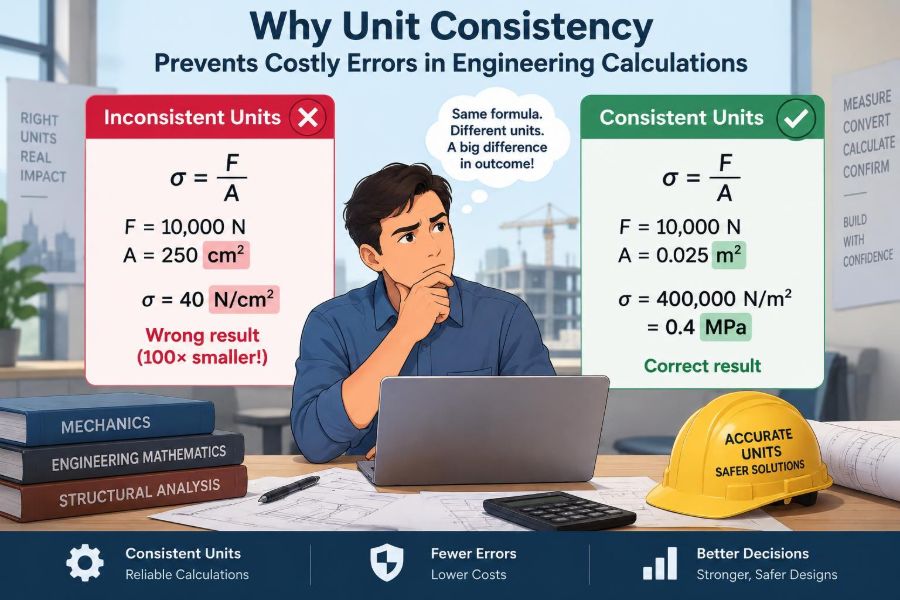

A pump is selected for a process line, the drawings are approved, and installation begins. Then someone notices that the flow rate was entered in litres per minute while the calculation treated it as cubic metres per second. The numerical result looked reasonable, but the physical system was never going to perform as expected.
Situations like this occur in structural design, manufacturing, electronics, energy systems, surveying, software, and laboratory work. A calculation can use correct equations and careful arithmetic yet still be wrong because the quantities do not belong together.
Unit consistency is the discipline of ensuring that every quantity in an equation uses compatible units and that the final answer has the unit the engineering question requires. It is a simple habit with unusually broad consequences.
For students, it makes equations easier to understand and check. For working professionals, it provides a practical defence against incorrect designs, rework, unsafe operating conditions, and decisions based on misleading data. 📐
🧭 1. Unit consistency is a physical check
Units are not labels added after a calculation. They describe what a number means physically: length, mass, time, force, energy, temperature, electrical charge, or another measurable property.
When units are consistent, algebra preserves physical meaning. When they are inconsistent, a calculator may still return a number, but that number cannot reliably describe the system.
🔢 2. A number without a unit is incomplete
Consider the value 25. It could represent 25 metres, 25 millimetres, 25 kilograms, 25 degrees Celsius, or 25 seconds. Each interpretation leads to a very different engineering decision.
Record quantities as a number and a unit together: 25 mm, 25 kg, or 25 s. This practice is especially important when values move between spreadsheets, drawings, reports, and software tools.
🧮 3. Dimensions reveal what an equation can mean
A dimension is the underlying physical type of a quantity. Common base dimensions include length L, mass M, time T, electric current I, and thermodynamic temperature Θ.
For example, velocity has dimensions L/T, acceleration has L/T², and force has dimensions M·L/T². Metres per second and kilometres per hour are different units, but both represent velocity.
⚖️ 4. Dimensional consistency is not the same as equal units
Terms can be combined when they have the same dimensions, even if they are initially expressed in different units. Before adding 2 m and 30 cm, convert one quantity so both use a common unit.
By contrast, adding 2 m to 30 s has no physical interpretation in an ordinary engineering equation. Their dimensions differ, so conversion cannot make the addition valid.
➕ 5. Addition and subtraction demand like quantities
Addition and subtraction are the strictest operations in unit work. Every term must represent the same physical kind of quantity and use compatible units.
1.25 m + 420 mm
= 1.25 m + 0.420 m
= 1.670 m
The conversion must happen before the values are added. Adding the raw numbers, 1.25 + 420, would hide a large error behind correct arithmetic.
✖️ 6. Multiplication creates derived units
Multiplication combines dimensions. Length multiplied by length produces area, while force multiplied by distance produces work or energy.
m × m = m²for aream² × m = m³for volumeN × m = Jfor energykg/m³ × m³ = kgfor mass
Derived units are not complications to ignore; they show the physical result produced by the operation.
➗ 7. Division explains rates and intensities
Division often expresses “per unit” relationships. Flow rate is volume per time, density is mass per volume, and stress is force per area.
If a result intended to be stress ends in N/m rather than N/m², the calculation has lost an area term or used one incorrectly. The units expose the problem immediately.
🧱 8. Powers magnify conversion mistakes
Linear conversion factors must be raised when a quantity is squared or cubed. Since 1 m = 1000 mm, it follows that 1 m² = 1,000,000 mm², not 1000 mm².
Similarly, 1 m³ = 1,000,000,000 mm³. Errors involving area, volume, second moments of area, and pressure frequently arise when a linear conversion factor is applied only once.
🌡️ 9. Temperature needs special care
Absolute temperature scales such as kelvin are essential in equations involving ratios, thermodynamic state relationships, and many material or gas-property calculations. A value in degrees Celsius cannot simply replace kelvin in those expressions.
Temperature differences behave differently. A change of one degree Celsius has the same magnitude as a change of one kelvin, but the zero points of the scales are different. Always identify whether an equation needs an absolute temperature or a temperature change.
🧷 10. Prefixes are compact but consequential
Metric prefixes make values convenient to write, but each prefix carries a power of ten. Confusing milli, micro, nano, kilo, and mega can change a result dramatically.
| Prefix | Symbol | Factor | Example |
|---|---|---|---|
| kilo | k | 10³ | 1 kW = 1000 W |
| milli | m | 10⁻³ | 1 mm = 0.001 m |
| micro | μ | 10⁻⁶ | 1 μF = 0.000001 F |
| mega | M | 10⁶ | 1 MPa = 1,000,000 Pa |
Note that symbols are case-sensitive: m means milli, while M means mega. In electrical work, this distinction is particularly important.
🔄 11. Conversion factors should behave like the number one
A conversion factor is a ratio of equivalent quantities. For example, because 1000 mm = 1 m, either 1000 mm / 1 m or 1 m / 1000 mm has a numerical value of one.
Choose the orientation that cancels the unwanted unit. This turns conversion into visible algebra rather than a memorised decimal operation.
450 mm × (1 m / 1000 mm) = 0.450 m
🧾 12. Write units through every line
Keeping units in intermediate steps may feel slower at first, but it reduces ambiguity and makes review easier. It also shows whether terms cancel in the way the equation requires.
Do not write units only at the beginning and end of a long calculation. A missing conversion several lines earlier is much harder to find once the units have disappeared.
🏗️ 13. Structural calculations depend on scale discipline
Structural formulas commonly combine loads, lengths, areas, elastic moduli, and section properties. These quantities may appear in N, kN, mm, m, MPa, GPa, mm², and m⁴ within the same task.
A sound approach is to choose a coherent working set before substitution. For example, using N, mm, and MPa can be convenient because 1 MPa = 1 N/mm². The important point is not a universal choice of units; it is maintaining one choice throughout the calculation.
💧 14. Fluid systems mix several unit families
Fluid engineering often combines pressure, head, density, viscosity, flow rate, pipe diameter, and elevation. A flow rate in litres per minute may need conversion before use with a pipe area in square metres and a velocity desired in metres per second.
Pressure can be expressed in pascals, kilopascals, bars, or other units, while pressure head is a length. They are related through fluid density and gravity, but they are not interchangeable labels.
⚡ 15. Electrical calculations require symbol awareness
Voltage, current, resistance, capacitance, inductance, charge, and power have distinct units that act as a useful check on circuit equations. In P = VI, volts multiplied by amperes must give watts.
Prefix errors are a frequent risk in component values. A resistance written in kilohms and a current written in milliamperes may be used conveniently together only when the resulting power and voltage units are tracked consciously.
🔥 16. Thermal problems distinguish energy from power
Energy is measured in joules, while power is energy per unit time and is measured in watts. Since 1 W = 1 J/s, multiplying power by time produces energy.
Confusing these concepts can cause errors in equipment sizing and energy estimates. A heater rating tells you the rate at which it can transfer energy, not the total energy delivered unless operating time is included.
⚙️ 17. Mechanical systems connect force, torque, and energy
Force and torque are often reported with units containing newtons, but they are not the same physical quantity. Force is measured in N, while torque is measured in N·m.
Energy also has units equivalent to N·m, yet torque and energy should not be casually treated as interchangeable. Their dimensions may match in a formal sense, but their physical roles in equations and engineering interpretation are different.
🧪 18. Material properties only work in matching units
Material data sheets may report elastic modulus, yield strength, thermal expansion, density, conductivity, and other properties in different unit systems. Copying a value without its unit is a common route to misuse.
For instance, stress and elastic modulus must be expressed in compatible pressure units in a relation such as strain = stress / modulus. The resulting strain should be dimensionless, which provides an immediate check.
📐 19. Geometry is a hidden source of errors
Engineering formulas often depend on geometric properties obtained from drawings or CAD models. A dimension in millimetres entered into a formula that assumes metres changes more than just length when that dimension is squared, cubed, or raised to the fourth power.
Check the units of area, volume, centroid location, section modulus, and second moment of area before using them. Geometric quantities carry dimensions even when software displays only a number.
🗺️ 20. Surveying and mapping require datum awareness
Coordinates have units, but their meaning also depends on the coordinate system, projection, and reference datum. Two values expressed in metres may still be unsuitable for direct comparison if they refer to different coordinate definitions.
This is a broader lesson: unit consistency is necessary, but it is not always sufficient. Engineers must also confirm the physical reference, direction convention, and definition attached to a value.
💻 21. Software does not automatically guarantee correctness
Some engineering tools store dimensions and perform conversions internally; others assume that the user supplies values in a specified unit set. A polished output report can therefore contain a perfectly calculated result based on an incorrectly entered input.
Verify project settings, input labels, imported data, and output units. Treat software as a calculation partner that needs unambiguous instructions, not as a replacement for engineering judgement.
📊 22. Spreadsheets need explicit unit design
Spreadsheets are powerful because they make repeated calculations fast, but ordinary cells usually do not understand physical dimensions. A column of numbers can silently combine metres, millimetres, and inches unless the model design prevents it.
Useful spreadsheet practices
- Place units in clearly labelled headers.
- Convert raw data into one declared working unit near the input stage.
- Keep conversion constants visible rather than burying them inside long formulas.
- Use separate input, conversion, calculation, and output areas.
- Test the sheet with a hand-calculated sample case.
Formatting cells to display a unit can improve readability, but display formatting alone does not convert a value.
📥 23. Imported data deserves a unit audit
Data from instruments, suppliers, laboratory systems, legacy files, and international teams may use different conventions. The source may be reliable while still being incompatible with the receiving model.
Before use, identify the quantity, unit, reference condition, sign convention, measurement basis, and precision. A value labelled simply “pressure” is incomplete if the calculation needs to know whether it is absolute or gauge pressure.
🧠 24. Dimensional analysis catches equation mistakes
Dimensional analysis checks whether the units on both sides of an equation agree. It cannot prove that an equation models every physical effect correctly, but it can expose many missing factors and invalid rearrangements.
Suppose a proposed velocity expression produces units of m²/s. That is not velocity, so either the formula, an exponent, or an input definition needs review. This check is fast and independent of the numerical values used.
🔍 25. Estimate magnitude as well as dimensions
Correct dimensions do not guarantee a sensible answer. A result can carry the proper unit while being implausibly large or small because of a decimal-place error, unrealistic assumption, or wrong parameter.
Use a rough estimate alongside unit checks. Ask whether a length is credible at the scale of the object, whether a power demand is plausible for the equipment, and whether a predicted temperature change fits the energy involved. 🤔
📝 26. State assumptions and chosen units clearly
Calculations become more dependable when the unit system is stated near the beginning. A brief note such as “use SI units throughout” or “use N, mm, and MPa consistently” tells reviewers how to interpret every substitution.
Also document assumptions that affect meaning: standard versus actual flow conditions, gauge versus absolute pressure, reference temperature, gravitational acceleration convention, or whether a load is nominal, factored, static, or dynamic.
🤝 27. Reviews work better when units are visible
A reviewer should be able to trace inputs, conversions, formulas, and outputs without guessing. Visible units make peer review faster because discrepancies can be found before anyone repeats the entire calculation.
When handing work to another engineer, include source units and converted working values. This is more reliable than saying that the data were “converted already,” especially when files are revised over time.
✅ 28. The core principle: make every equation physically coherent
The central rule is straightforward: convert compatible quantities into a consistent unit set before combining them, carry units through the calculation, and verify that the output unit matches the quantity requested.
This rule supports sound arithmetic, clearer communication, more effective reviews, and better decisions. It applies whether the task is a short classroom problem or a multi-disciplinary design model.
- Identify every quantity and its unit.
- Choose a coherent working unit system.
- Convert before adding or subtracting.
- Track powers of length carefully.
- Use dimensional analysis and magnitude estimates as independent checks.
- Document units, assumptions, and references for the next reader.
In engineering, unit consistency is not administrative detail; it is one of the most accessible ways to protect a calculation from becoming an expensive real-world mistake. 📏✅🛠️