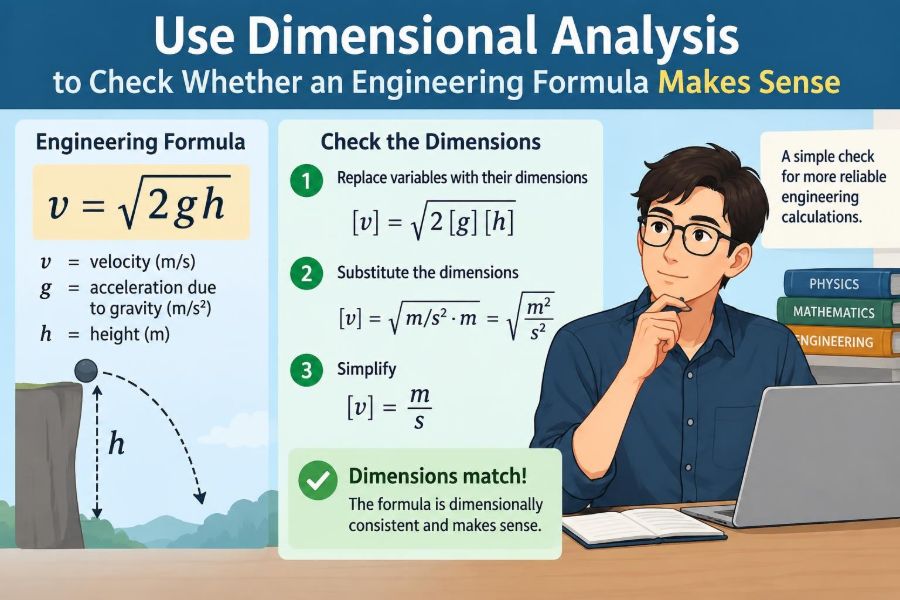

A calculation can look perfectly tidy and still be wrong. You may have typed every number carefully into a spreadsheet, used the correct calculator functions, and obtained a result with several impressive decimal places—only to discover that the result is measured in kilograms when the problem asked for a pressure.
This is where dimensional analysis earns its place in everyday engineering. It is a fast way to ask whether the quantities in an equation can possibly fit together before a flawed formula reaches a drawing, report, simulation, or site decision.
It does not replace mechanics, thermodynamics, circuit theory, or experimental validation. But it can expose a missing length, a misplaced exponent, or an incompatible unit conversion in seconds.
The central habit is simple: treat units as algebraic quantities, not labels attached at the end. Once that habit becomes automatic, many engineering formulas become easier to understand as well as easier to check.
🧭 What dimensional analysis actually checks
Dimensional analysis tests the dimensions of physical quantities in an equation. Dimensions describe the physical type of a quantity: mass, length, time, electric current, temperature, amount of substance, or luminous intensity.
If an equation represents a physical relationship, both sides must have the same dimensions. Likewise, terms being added or subtracted must share dimensions. A mismatch means the equation is incomplete, mistyped, wrongly rearranged, or being applied outside its intended meaning.
This is a plausibility test, not a proof that an equation is physically correct. A dimensionally consistent formula may still have the wrong coefficient, sign, mechanism, or range of validity.
📦 Units and dimensions are related but different
A unit is an agreed measurement standard, such as metre (m), second (s), kilogram (kg), or newton (N). A dimension is the underlying physical character expressed using base symbols such as length L, mass M, and time T.
For example, speed can be measured in m/s, km/h, or ft/s. Those units differ, but its dimension remains LT-1. Keeping this distinction clear prevents a common confusion: changing units does not change the dimension of the quantity.
🔤 The base dimensions engineers use most
Many engineering checks can be done with three base dimensions: mass M, length L, and time T. Electrical, thermal, chemical, and optical work often requires additional base dimensions.
| Quantity | Common symbol | Dimension |
|---|---|---|
| Length | m | L |
| Mass | kg | M |
| Time | s | T |
| Electric current | A | I |
| Thermodynamic temperature | K | Θ |
| Amount of substance | mol | N |
Luminous intensity is also an SI base dimension, but it appears less often in general engineering formula checks. Use only the dimensions needed for the problem; the purpose is clarity, not an elaborate notation exercise.
🧱 Derived quantities are built from base dimensions
Most quantities used in design work are derived quantities. They are combinations of base dimensions created through multiplication and division.
Velocity is distance divided by time, so [v] = LT-1. Acceleration is velocity divided by time, so [a] = LT-2. Area is L2, and volume is L3.
Write square brackets around a symbol when referring to its dimensions. Thus [F] means “the dimensions of force,” not a numerical value of force.
⚖️ Force is not mass
One of the most damaging unit confusions is treating mass and force as interchangeable. Mass has dimension M. Force has dimension MLT-2.
From Newton’s second law, F = ma. Since acceleration has dimensions LT-2, force must be M × LT-2. In SI units, that combination is called a newton: 1 N = 1 kg·m/s2.
Weight is a force caused by gravity, commonly represented by W = mg. A mass of 10 kg is not “10 N”; its weight near Earth is approximately 98 N, subject to the local gravitational acceleration.
🧮 The first rule: both sides must match
Consider the familiar kinematic relation s = ut + ½at2. The left side, displacement s, has dimension L.
On the right, ut has dimensions (LT-1)(T) = L. The second term has dimensions (LT-2)(T2) = L. Every term is a length, so the equation passes a dimensional check.
The factor ½ has no dimensions. Numerical constants can change magnitude but cannot repair a dimensional mismatch.
➕ Addition and subtraction require like dimensions
Quantities may be added or subtracted only when they describe the same dimensional kind of thing. Adding 3 metres to 4 seconds is meaningless, regardless of the numerical values.
This rule applies inside longer formulas. In Q = A + B, quantities Q, A, and B must all have identical dimensions. A formula can fail before you even compare its left and right sides.
For instance, a proposed expression v = u + at + x fails if x is a displacement: the first two terms are velocity, while the last is length.
✖️ Multiplication, division, and powers change dimensions
Dimensions behave like algebraic exponents. Multiply quantities and add exponents; divide them and subtract exponents; raise a quantity to a power and multiply the exponents.
If density is mass per volume, then [ρ] = ML-3. If pressure is force per area, then [p] = (MLT-2)/L2 = ML-1T-2.
This bookkeeping is why dimensions are more useful than memorizing isolated unit names. They reveal how a quantity must scale when a length, time, or mass scale changes.
🚫 What must be dimensionless
The input to many mathematical functions must be dimensionless: it has no remaining base dimensions. This matters for logarithms, exponentials, trigonometric functions, and many series expansions.
- In sin(θ), the angle is expressed in radians, treated as dimensionless in SI dimensional analysis.
- In e-t/τ, the ratio t/τ must be dimensionless; both quantities are times.
- In ln(p/p0), pressure must be divided by a reference pressure before taking a logarithm.
An expression such as e-3t is incomplete unless the coefficient 3 carries dimensions of inverse time, or unless t has already been nondimensionalized.
📐 Angles deserve careful interpretation
Radians are defined as arc length divided by radius, so the ratio is dimensionless. That is why formulas such as s = rθ work when θ is in radians: [rθ] = L.
Degrees are a valid unit for reporting an angle, but they are not directly interchangeable with radians inside calculus-based formulas. Before applying sin, differentiation rules, or small-angle approximations, convert degrees to radians when the formula assumes radians.
Dimensional analysis will not catch every degree-versus-radian error, because both represent angles. This is an example of a check’s useful but limited scope.
🔍 A repeatable formula-checking workflow
Use the same short procedure whenever you encounter a new equation or derive one under time pressure.
- Write the equation clearly, including every exponent and subscript that affects meaning.
- Assign dimensions to each variable from definitions, not guesses.
- Replace variables with dimensional symbols.
- Simplify each term separately.
- Check terms joined by plus or minus signs, then compare both sides.
- Investigate every mismatch before substituting numbers.
This procedure is especially valuable after rearranging equations. Algebraic rearrangement preserves dimensions only when it has been performed correctly.
🚗 Example: checking a stopping-distance relation
Suppose a proposed braking-distance expression is d = v2/(2a). Velocity has dimensions LT-1, so v2 has dimensions L2T-2.
Dividing by acceleration, LT-2, gives L. The result is a length, which is consistent with distance.
Now compare the hypothetical mistake d = v/(2a). Its dimensions are (LT-1)/(LT-2) = T. It produces time, not distance. No realistic numerical result can rescue that formula.
🪨 Example: checking energy and work
Work is force acting through a distance: W = Fd when force is aligned with motion. Its dimensions are (MLT-2)(L) = ML2T-2.
Kinetic energy, Ek = ½mv2, has dimensions M(LT-1)2 = ML2T-2. The match supports the idea that work can change kinetic energy.
It also helps distinguish energy from power. Power is energy per time, so it has dimensions ML2T-3, not the dimensions of energy.
🌊 Example: pressure at depth
For a static fluid, the pressure increase with depth is often written Δp = ρgh. Density is ML-3, gravitational acceleration is LT-2, and height is L.
The product becomes ML-3 × LT-2 × L = ML-1T-2. That is exactly the dimension of pressure: force divided by area.
The check also explains the structure. Density supplies mass per volume, gravity turns mass into force, and multiplying by depth converts the geometric scaling into force per area.
🔌 Example: electrical power
Electrical power is commonly expressed as P = VI, where voltage V is electric potential difference and I is current. A volt is joule per coulomb, while an ampere is coulomb per second.
Multiplying gives joules per second, which is power. In base dimensions, electrical relationships introduce current as a base dimension, so it is often clearer to retain electrical units while checking circuit formulas.
For a resistor, P = I2R and P = V2/R also pass if resistance is expressed as volts per ampere. These relations are valid only under the assumptions behind the resistance model; dimensional consistency does not establish those assumptions.
🌡️ Temperature differences are not always temperatures
Temperature handling deserves extra care. A temperature difference of 10 K has the same interval size as 10 °C, but absolute temperatures in kelvin and Celsius have different zero points.
In a relation such as heat transfer Q = mcΔT, the relevant term is a temperature difference. In contrast, an ideal-gas relation uses absolute temperature, so substituting a Celsius value directly is physically wrong even though a basic dimensional check may not reveal it.
Dimensional analysis identifies temperature as a required kind of quantity; engineering judgment must still select the correct temperature scale and reference state.
🧪 Dimensionless groups reveal governing balances
A dimensionless group is a combination of variables whose dimensions cancel. Such groups are valuable because they compare competing effects without depending on a particular unit system.
For example, the Reynolds number combines density, velocity, characteristic length, and dynamic viscosity. It is dimensionless and helps characterize the relative influence of inertial and viscous effects in fluid flow.
You do not need to memorize every named group to use the principle. When variables can be combined to eliminate dimensions, the resulting ratio often reveals a meaningful physical balance.
🧩 Buckingham Pi theorem in practical terms
The Buckingham Pi theorem provides a systematic way to form dimensionless groups. If a problem involves a set of dimensional variables built from a smaller number of independent base dimensions, the variables can be reorganized into a set of independent dimensionless products.
This approach supports model testing, correlation building, and scaling. Rather than testing every possible pipe diameter, velocity, and fluid property separately, engineers seek the dimensionless combinations that govern the behavior.
The theorem organizes variables; it does not by itself supply the unknown functional relationship. Experiments, theory, or simulation are still needed to determine that relationship.
🛠️ Use dimensions to reconstruct a missing exponent
Suppose you know that an oscillation period T depends on a length L and gravitational acceleration g, and you propose T ∝ Lagb. The left side has dimension T.
The right side has dimension La(LT-2)b = La+bT-2b. Matching time exponents gives -2b = 1, hence b = -½. Matching length exponents gives a + b = 0, hence a = ½.
Dimensions therefore suggest T ∝ √(L/g). They cannot determine the dimensionless constant multiplying this expression; that constant comes from a fuller model or measurement.
📏 Scaling checks catch implausible trends
Dimensional structure often predicts how an output changes when an input scale changes. For a geometrically similar object, volume scales with length cubed, while surface area scales with length squared.
That difference matters in heat transfer, structural weight, and fluid effects. If all dimensions of an object double, its volume becomes eight times larger but its surface area only four times larger.
A result that claims a volume scales linearly with characteristic length should immediately trigger a check. Scaling is not a replacement for detailed analysis, but it is an excellent sanity filter.
🔄 Unit conversion is dimensional algebra in action
Conversion factors work because they equal one when written correctly. For example, multiplying a speed in km/h by 1000 m / 1 km and 1 h / 3600 s changes its units without changing the physical speed.
Write conversions as fractions and cancel units visibly. This is safer than memorizing a decimal multiplier, especially in multi-step calculations involving areas, volumes, densities, or rates.
Remember to convert powers too. A length conversion factor must be squared for area and cubed for volume. Missing this step can create errors far larger than ordinary rounding differences.
🧷 Constants carry dimensions too
Symbols such as g, R, k, μ, and E are not automatically dimensionless merely because they are called constants. Their dimensions are essential to the equations they appear in.
A spring constant in F = kx must have dimensions of force per length. A heat-transfer coefficient, a material modulus, and a gravitational constant each require their own dimensional treatment.
When a formula seems inconsistent, inspect its constants first. A copied expression may have omitted a parameter whose dimensions make the equation work.
🗂️ A compact reference for common quantities
| Quantity | Typical relation | Dimensions |
|---|---|---|
| Momentum | mass × velocity | MLT-1 |
| Force | mass × acceleration | MLT-2 |
| Energy | force × distance | ML2T-2 |
| Power | energy / time | ML2T-3 |
| Pressure | force / area | ML-1T-2 |
| Dynamic viscosity | shear stress / velocity gradient | ML-1T-1 |
Build a personal reference like this for the quantities in your discipline. It is more useful to understand a few definitions deeply than to memorize a long disconnected list.
🧠 Dimensional consistency is necessary, not sufficient
Two expressions can have the same dimensions and still represent different physics. Energy and torque, for example, both have dimensions ML2T-2, yet they are not interchangeable concepts.
Likewise, F = mv2/L is dimensionally a force, but that fact alone does not make it the correct force law for a situation. It might arise in a specific model, or it might be physically irrelevant.
Use dimensional analysis to reject impossibilities. Then use governing laws, boundary conditions, material behavior, and evidence to choose among the remaining possibilities.
⚠️ Common mistakes that defeat the check
- Checking only the final units: incompatible terms may have been added within the formula.
- Dropping exponents: confusing m/s2 with m/s changes the physical quantity.
- Assuming named units explain themselves: reduce unfamiliar units to definitions when uncertain.
- Ignoring reference quantities: logarithms and exponential arguments need dimensionless inputs.
- Mixing unit systems: a correct equation can yield a wrong number when SI and customary units are combined carelessly.
The cure is usually not more complicated mathematics. It is slower notation at the point where quantities are defined and converted.
💻 How to use the method in spreadsheets and code
Spreadsheets and programming environments calculate numbers faithfully; they do not automatically understand the physical meaning of a number unless a unit-aware system has been deliberately used. A column labelled “pressure” can quietly contain values in incompatible units.
Use clear variable names, record units next to inputs and outputs, and create test cases with known order of magnitude. In code, unit libraries can add safeguards, but they do not replace reviewing the model and the chosen conventions.
For critical calculations, include a short dimensional check in the calculation note or code documentation. It makes assumptions visible to the next person—and to your future self.
📝 Make dimensional checks part of derivations
Do not wait until the final line of a derivation. Check dimensions after every major substitution or rearrangement, particularly when differentiating, integrating, or introducing a constitutive relation.
Integration with respect to time adds a factor with dimensions of time; differentiation with respect to distance divides by length. Tracking this as you work makes it easier to catch a missing differential or an incorrectly defined rate.
A short margin note such as [term] = ML-1T-2 may prevent a long chain of algebra built on an early mistake.
🏗️ Apply it carefully in real engineering work
Real projects involve conventions, empirical correlations, tabulated properties, and software outputs. Dimensional analysis is particularly useful at the interfaces between these elements, where data may be copied across documents or converted between systems.
It is not a safety sign-off method. Design decisions still require applicable standards, verified inputs, suitable factors of safety, qualified review, and discipline-specific analysis. A dimensionally correct load calculation can still omit a load case or use an unsuitable model.
Think of the method as a low-cost quality-control layer: fast enough to use constantly, but not broad enough to use alone.
🎯 A fast checklist before trusting a result
Before reporting a calculation, pause for a brief physical audit.
- Does the output have the quantity type requested?
- Do all added or subtracted terms share dimensions?
- Are powers, roots, logarithms, and trigonometric inputs dimensionally valid?
- Have conversion factors been applied to squared or cubed quantities?
- Do the magnitude and scaling direction make physical sense?
- Does the formula rely on assumptions that apply to this situation?
These questions turn dimensional analysis from a classroom topic into a dependable professional habit.
✅ The core principle: equations must describe compatible quantities
Dimensional analysis works because physical equations cannot equate unlike physical quantities. Length, time, force, energy, and current may be connected by laws, but they must be connected through combinations that preserve dimensional consistency.
Start from definitions, reduce uncertain quantities to base dimensions, and check every additive term as well as the two sides of the equation. Use the result to find clear errors, infer sensible scaling, and organize variables into meaningful ratios.
Most importantly, keep its boundary in mind: passing a dimensional check means an expression is possible in form, not established as true. That combination of confidence and caution is precisely what makes the technique valuable.
When units are treated as algebra throughout a calculation, dimensional analysis becomes one of the quickest ways to catch engineering mistakes before they become real-world problems. 📐⚙️✅