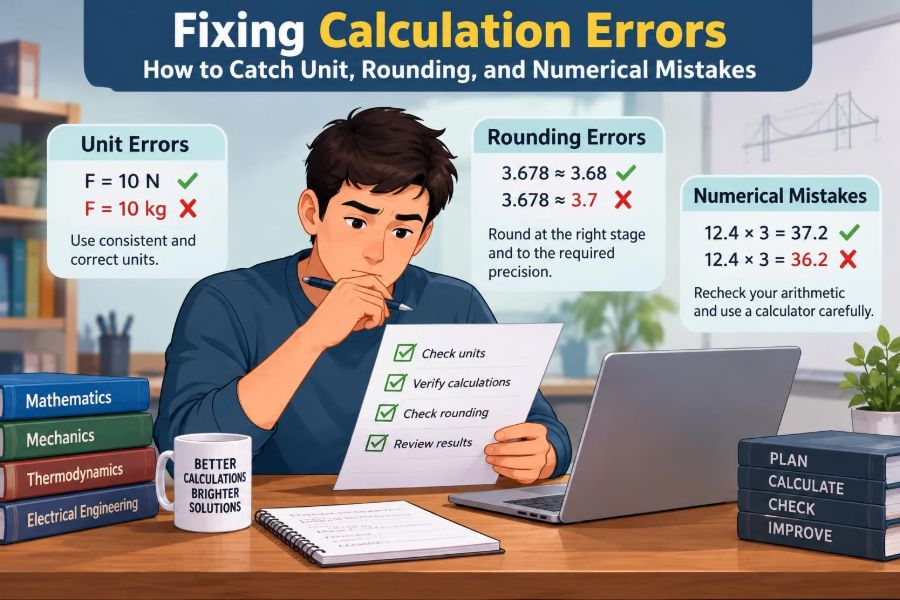

A pump-sizing spreadsheet produces a flow rate that looks perfectly plausible—until someone notices that one pressure value was entered in bar while the formula expected pascals. The arithmetic may be flawless. The answer is still wrong by orders of magnitude.
Smaller errors are just as familiar. A calculator displays 2.675, a result is rounded too early, and a final estimate drifts enough to change a material order. Or a negative sign disappears during a rearrangement, turning a predicted cooling effect into heating.
These mistakes happen to students solving textbook problems and to professionals working with models, specifications, drawings, code, and reports. They are rarely caused by a lack of mathematical ability. More often, they arise because calculations move quickly from a physical situation to symbols, software, and final numbers.
Reliable engineering mathematics is therefore not merely about getting an answer. It is about building a process that makes incorrect answers difficult to produce and easier to detect.
🎯 What a Calculation Error Really Means
A calculation error is any flaw that makes a result unsuitable for its intended decision. It may be an arithmetic slip, but it can also be a wrong unit, an omitted conversion, an incorrect formula, a misplaced decimal point, or a number reported with unjustified precision.
This broader definition matters because a calculator can only evaluate the expression it receives. It cannot determine whether the expression represents the intended physical system.
A useful distinction is between an error in computation and an error in modelling. Computing 12 × 4 incorrectly is a computation error. Using an area where a volume is required is a modelling error. Both require checking, but they leave different clues.
🧭 Start with the Physical Question
Before choosing equations, state what the result should represent. Is it a force, a maximum temperature, an average speed, an energy consumption, or a safety margin? A named quantity gives the calculation a physical target.
Write a brief sentence such as: “Find the pressure drop across the pipe at the specified flow rate.” This simple habit helps reveal formulas that calculate a related but different quantity.
Also identify the system boundary. For example, heat loss from a room depends on whether ventilation, walls, windows, and internal heat sources are inside the model. A correct equation applied to an unclear boundary can still mislead.
📋 Build a Known-Values List
Collect given data before substituting values into equations. Record each value with its unit, source, and any condition attached to it, such as temperature, material grade, or operating state.
A compact known-values list prevents a common problem: copying a number without its unit or using a value intended for a different case.
- Length: 2.4 m
- Diameter: 35 mm = 0.035 m
- Density: 998 kg/m³ at the stated condition
- Flow rate: 0.80 L/s = 8.0 × 10⁻⁴ m³/s
When data comes from several places, distinguish inputs from assumptions. A measured dimension is not the same as an estimated roughness value.
📏 Treat Units as Part of Every Number
A number without a unit is usually incomplete in engineering. Writing 25 instead of 25 kN hides a factor of one thousand and makes later checking far harder.
Keep units visible throughout the calculation rather than attaching them only to the final result. This turns units into active algebraic information. If the units do not combine into the expected result, something in the setup deserves attention.
For example, if force is calculated from mass and acceleration, the unit path should be kg × m/s², which is a newton. A final unit of kg·m/s is a warning that velocity was used where acceleration was needed.
🔄 Convert Units Before Substitution
Choose one coherent unit system for the calculation, often SI units, and convert inputs before entering them into a formula. Mixing millimetres, metres, litres, and cubic metres inside a single line is an invitation to lose conversion factors.
Use conversion factors as fractions so units visibly cancel. For instance, 35 mm can be converted as 35 mm × (1 m / 1000 mm) = 0.035 m. The cancellation demonstrates why the conversion is valid.
Do not assume a unit label guarantees consistency. A drawing dimension in mm and a software input field labelled “length” can coexist without any automatic protection.
⚖️ Watch Squared and Cubed Conversions
Length conversions are straightforward, but area and volume conversions are frequent sources of large discrepancies. If 1 m = 1000 mm, then 1 m² = 1,000,000 mm² and 1 m³ = 1,000,000,000 mm³.
The exponent applies to the conversion factor as well as the unit. A pipe diameter converted incorrectly can become especially damaging because area depends on diameter squared.
For example, converting 50 mm² directly to 0.05 m² is incorrect. Since 1 mm² = 10-6 m², 50 mm² = 50 × 10-6 m².
🌡️ Handle Temperature Scales Carefully
Temperature requires special care because an absolute temperature and a temperature difference behave differently. Kelvin and degrees Celsius have equal-sized intervals, so a change of 10 K equals a change of 10 °C.
However, 20 °C is not 20 K. Equations involving absolute temperature, such as many gas-law and radiation relationships, require a temperature scale with a meaningful zero, normally kelvin.
Ask whether an equation needs the actual thermodynamic temperature or merely a difference between two temperatures. This one question prevents a surprisingly common category of error.
🧮 Use Dimensional Analysis as a Diagnostic
Dimensional analysis checks the dimensions of an equation independently of numerical values. It cannot prove that a model is correct, but it can quickly expose impossible formulas.
Suppose a proposed time is written as distance divided by acceleration. Its dimensions are m ÷ (m/s²) = s², not s. The formula cannot represent time without additional terms or an operation such as a square root.
Use dimensional checks at three points: when selecting an equation, after algebraic rearrangement, and when interpreting the final result. It is one of the fastest checks available because it needs no second calculation.
🔢 Preserve Significant Figures During Working
Significant figures communicate the resolution or certainty supported by the inputs. They are not a decoration added after calculation.
Keep extra digits in intermediate steps, then round sensibly near the end. If a calculation uses 3.14159 internally and reports 3.14, that is usually reasonable. Replacing it with 3.1 early in a multi-step calculation can create avoidable drift.
The reported precision should also match the application. A preliminary hand estimate and a calibrated laboratory measurement should not imply the same confidence.
✂️ Separate Rounding from Truncation
Rounding chooses the nearest permitted value. Truncation simply discards digits. These operations are not interchangeable.
For a positive value of 4.789, rounding to two decimal places gives 4.79, while truncation gives 4.78. In repetitive computations, systematic truncation can bias results downward; for negative values, the direction of the effect needs even more care.
When software displays fewer digits than it stores, do not assume the hidden digits were discarded. Check the software setting and document any deliberate rounding rule used for reporting.
🪜 Avoid Rounding at Every Step
Multi-stage calculations amplify early rounding. Consider calculating a flow area, then velocity, then a Reynolds number, then a friction factor, and finally pressure loss. A small change in an early quantity can travel through powers, products, or nonlinear functions.
Carry guard digits—more digits than the final answer needs—until the final stage. This does not create more accuracy than the input data supports; it simply avoids introducing additional numerical error.
Round intermediate values only when a process requires it, such as a contractual billing rule, a discrete manufacturing increment, or a stated reporting convention.
🧠 Distinguish Accuracy from Precision
Accuracy describes closeness to the true value. Precision describes repeatability or numerical detail. A result shown as 17.48362 is precise in appearance, but it may not be accurate if the input measurement was only known to the nearest millimetre.
False precision can make weak information look authoritative. Conversely, excessive rounding can hide a meaningful difference between alternatives.
A practical approach is to retain sufficient internal precision, then present the result with a number of digits appropriate to the least reliable input and the decision being made.
🧪 Estimate the Expected Magnitude First
Before trusting a calculated answer, make an order-of-magnitude estimate. This is a rough prediction of the scale: millimetres or metres, watts or megawatts, seconds or days.
If a person walks 100 m at roughly 1 m/s, the travel time should be around 100 s, not 0.1 s or 100,000 s. The estimate need not be exact to catch a misplaced prefix or exponent.
Engineering judgment grows from repeatedly connecting equations to familiar scales. Estimate before calculating when possible, and compare after calculating every time.
📈 Check Whether the Direction Makes Sense
A useful result should respond sensibly to changing inputs. If resistance rises, current should fall for a fixed voltage in a simple resistive circuit. If a beam span increases while load and section stay unchanged, deflection should increase.
This is called a trend check. Change one input mentally or in a quick test and ask whether the output moves in the expected direction.
A result with plausible units and magnitude can still fail this check. Trend checks are particularly valuable for spreadsheets, where a cell reference can point to the wrong variable yet still produce a tidy number.
➕ Protect Signs, Brackets, and Exponents
Many numerical mistakes are tiny transcription changes with large consequences: a missing minus sign, an exponent applied to only one term, or a denominator entered without brackets.
Write ambiguous expressions explicitly. Entering a/(b+c) is safer than relying on visual memory of a handwritten fraction. Similarly, write (-3)^2 when that is intended; -3^2 is commonly interpreted as -(3²).
After rearranging an equation, substitute symbols rather than numbers for a moment. This makes sign and exponent errors easier to see than a dense line of digits does.
🧩 Rearrange Equations Before Adding Numbers
Algebraic rearrangement is often safer when done symbolically. Isolate the desired variable first, then substitute values once the equation has a clear structure.
For example, from V = IR, solving for resistance gives R = V/I. Writing the rearranged form before inserting numbers reduces the chance of dividing the wrong way around.
It also makes dimensional checking easier. If the required result is resistance, volts divided by amperes should reduce to ohms.
🧷 Keep Track of Reference Conditions
Material properties and environmental values often apply only under stated conditions. Density, viscosity, electrical resistance, and strength-related parameters may vary with temperature, composition, moisture, loading rate, or direction.
A value copied from a table without its reference condition can be numerically correct yet physically inappropriate. Label values as, for example, “viscosity at 20 °C” rather than merely “viscosity.”
When the operating condition differs substantially from the reference condition, investigate whether a correction, interpolation, or more suitable source is needed. Do not silently treat a condition-dependent property as universal.
🗂️ Maintain a Clear Calculation Trail
A calculation should be reviewable by someone else—and by you a week later. Show the governing equation, variable definitions, units, substitutions, assumptions, and final rounding decision.
Readable working is not bureaucracy. It localizes mistakes. A reviewer can identify whether an issue began in the input, conversion, formula, substitution, or arithmetic.
- State the objective and known values.
- Write the equation in symbols.
- Show unit conversions separately.
- Substitute values with units visible.
- Record checks and the final reported value.
This trail is equally useful in a notebook, calculation package, spreadsheet notes, or commented program.
💻 Use Calculators and Spreadsheets Deliberately
Digital tools reduce repetitive arithmetic, but they can conceal setup errors. A spreadsheet may propagate one incorrect conversion across hundreds of rows faster than manual work ever could.
Use named variables, consistent unit columns, and separate input cells from formulas. Avoid burying constants such as 1000 or 3600 inside long expressions without a label explaining the conversion.
For critical work, test a few cells by hand and inspect formulas rather than only outputs. A copied formula may have shifted a reference, and a correct-looking value does not demonstrate that the reference is correct.
🔍 Audit Formula Logic, Not Just Results
When checking a spreadsheet or script, examine the calculation path. Does the formula use the intended input? Are all rows treated consistently? Are conditions handled correctly at boundaries such as zero flow, negative values, or missing data?
Simple test cases are powerful. If a formula calculates cost as quantity times unit price, setting quantity to zero should produce zero. Setting all inputs to the same known value can expose inconsistent references.
Build visible checks into larger models: totals that reconcile, unit flags, warning cells for implausible ranges, and comparison values calculated independently.
🔁 Calculate Independently When Stakes Are High
Repeating the same keystrokes is not a fully independent check. A stronger verification uses a different path: another formula form, another tool, a hand estimate, or a second person who starts from the problem statement.
For example, a volume can be calculated from geometric dimensions and compared with a mass divided by density when both measurements are available. Agreement does not guarantee correctness, but disagreement prompts investigation.
The level of checking should match the consequence of error. A practice exercise may need one careful review; work affecting safety, cost, compliance, or operational reliability often needs a formal independent check.
🧱 Recognize Common Conversion Traps
Some pairs of units look familiar enough to invite assumptions but differ in meaning. Mass and force are a classic example: kilograms measure mass, while newtons measure force. Under ordinary gravity, a mass has a weight, but the numerical values are not interchangeable.
Other traps include gauge versus absolute pressure, revolutions per minute versus radians per second, and power versus energy. The labels may be short, but the quantities describe different concepts.
| Potential confusion | Question to ask |
|---|---|
| kW and kWh | Is this a rate of energy transfer or an amount of energy? |
| °C and K | Does the equation need an absolute temperature or a temperature difference? |
| kg and N | Is the quantity mass or force? |
| bar and Pa | Has the scale factor been converted explicitly? |
| Gauge and absolute pressure | What is the pressure reference? |
🛑 Do Not Force a Result to Look Reasonable
When a result feels surprising, it is tempting to adjust an input, choose a preferred rounding direction, or discard a digit until the answer matches expectation. That replaces checking with wishful correction.
Instead, treat surprise as evidence to investigate. Revisit the model assumptions, source data, unit system, equation domain, and numerical entry. Sometimes the unexpected result is the valid one and reveals a mistaken intuition or overlooked condition.
A reliable process allows conclusions to challenge expectations, while requiring those conclusions to survive transparent checks.
📉 Understand Error Propagation
Inputs with uncertainty produce outputs with uncertainty. A small measurement error may have little effect in a simple sum but a larger effect when an input is squared, cubed, or used near a sensitive threshold.
For a hypothetical circular area, A = πd²/4. Because diameter is squared, a fractional change in diameter produces roughly twice that fractional change in area for small changes. This does not replace formal uncertainty analysis, but it highlights sensitive measurements.
Identify variables with strong influence before spending effort refining every input equally. A value that barely affects the outcome does not deserve the same measurement effort as a value that dominates it.
⚠️ Respect Formula Limits and Assumptions
An equation is not a universal machine. It was derived or fitted under assumptions: steady conditions, small deformation, ideal behaviour, a particular geometry, or a limited range of data.
Applying a formula outside its domain can create an answer with correct units and perfect arithmetic but poor physical validity. For example, a simplified linear relation may be useful over a narrow range and misleading when pushed far beyond it.
Record the key assumptions beside important calculations. This makes later review possible when conditions change or a result is reused in a new context.
🧑🤝🧑 Make Peer Review Specific
“Can you check this?” is less effective than a focused request. Ask a reviewer to verify the unit conversion, confirm the governing equation, inspect a particular spreadsheet range, or challenge the assumptions.
Reviewers should receive enough context to reconstruct the purpose of the calculation. A bare final number offers little chance of detecting a conceptual mismatch.
Good review is not about finding fault. It is a deliberate barrier against shared blind spots, especially when the original author has spent a long time looking at the same working.
🧾 Use a Final Pre-Submission Checklist
A short final check catches many preventable errors when attention is fading. It is most useful when performed slowly and separately from the original solving process.
- Does the result answer the stated question?
- Are all inputs in compatible units?
- Do the final units match the required quantity?
- Is the magnitude plausible?
- Are signs, brackets, powers, and decimal places correct?
- Was rounding delayed and reported sensibly?
- Are assumptions and reference conditions stated?
- Has an independent or alternative check been performed where appropriate?
A checklist does not replace understanding. It ensures that routine details receive attention even when the problem feels familiar.
🛠️ Build Error-Resistant Habits
The best checking method is the one you can apply consistently. Start with a small routine: write units on every input, estimate the scale, keep guard digits, and perform one independent check.
As problems become more complex, add structure rather than relying on memory. Use templates for calculations, validated spreadsheet blocks, standard unit conventions, and review points tied to project risk.
Speed often improves after these habits become automatic. Time spent preventing a hidden error is usually less than time spent tracing it after it has influenced a design, report, purchase, or decision.
🏁 The Core Principle: Make Answers Earn Trust
A numerical answer earns trust through evidence: coherent units, sensible scale, valid assumptions, clear working, appropriate precision, and checks that do not merely repeat the same mistake.
No individual safeguard is perfect. Dimensional analysis cannot detect every wrong model, an estimate can be biased by intuition, and software tests can miss an untested path. Together, however, these methods create overlapping defenses.
The goal is not to eliminate all uncertainty or to turn every routine calculation into a lengthy audit. It is to apply enough disciplined checking that the result is fit for the decision it supports.
Strong engineering calculations combine correct mathematics with visible units, realistic judgment, and independent verification. Treat every result as a claim that should be checked—not just a number that appeared on a screen. 📐🔍✅