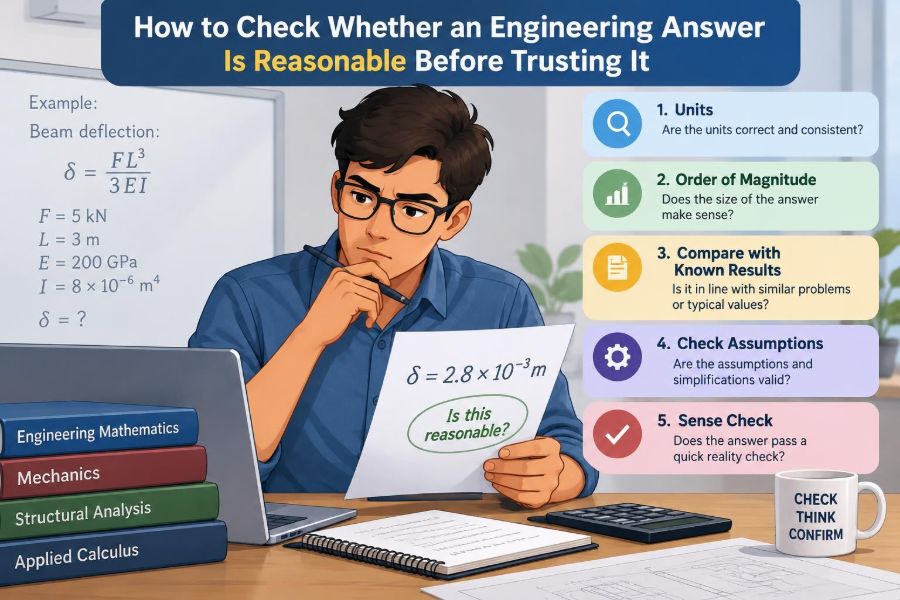

You finish a calculation, press equals, and the screen returns a number with six decimal places. It looks precise. That does not mean it is believable.
Perhaps a beam deflection comes out as 14 metres, a pump requires negative power, or a vehicle’s stopping distance is shorter than the distance it travels in a blink. These results can appear in otherwise tidy workings, especially when a calculator, spreadsheet, or simulation has hidden the route from equation to answer.
Engineering is not only the ability to calculate. It is the ability to decide whether a calculation describes a possible physical situation. A reasonable-answer check is the bridge between mathematical manipulation and engineering judgment.
That bridge need not be slow or elaborate. A few deliberate tests—units, signs, scale, limits, and physical behaviour—can catch many errors before they become a drawing, a purchase order, or a safety problem.
🧭 Reasonableness Is a Physical Question
A reasonable answer is one that is consistent with the model, the given conditions, and the real-world scale of the problem. It is not necessarily exact: all engineering models make assumptions and use imperfect input data.
Think of reasonableness as a screening process. Ask: could this result plausibly happen under these conditions? A result can be algebraically correct yet physically inappropriate because the wrong equation, unit system, boundary condition, or assumption was used.
🔍 Separate Calculation Errors from Model Errors
Calculation errors include mistyped values, arithmetic slips, and incorrect rearrangement. Model errors are deeper: applying a steady-flow equation to a rapidly changing process, treating a flexible support as fixed, or neglecting heat loss where it dominates.
A calculator can help find arithmetic mistakes, but it cannot decide whether the chosen model represents the situation. Check both layers. First verify that the mathematics was executed correctly; then verify that the mathematics was worth executing.
📏 Begin with Units Before Numbers
Dimensional analysis is often the fastest credibility test available. Every term added or subtracted in an equation must have the same dimensions. If one term is energy and another is power, the expression is invalid even if a spreadsheet accepts it.
For example, kinetic energy is mv²/2, with units of kilogram metre squared per second squared, or joules. If a supposed energy answer is reported in newtons, something has been lost—usually a distance factor.
🔄 Use One Consistent Unit System
Mixed units create answers that can be wrong by factors of 10, 1,000, or more while still looking numerically ordinary. Common traps include millimetres entered into metre-based formulas, minutes mixed with seconds, and pressure values handled as though all were in the same scale.
Convert quantities early, label them clearly, and retain units through intermediate steps. In structural work, choosing N and mm can be perfectly valid; choosing N, m, and mm indiscriminately is not. Consistency matters more than which coherent system you choose.
🧪 Check Dimensions of the Final Quantity
The final unit should match what the question asks for. A heat-transfer coefficient has units involving power, area, and temperature difference; a moment has force-distance units; a natural frequency has inverse-time units.
This test also reveals mistaken formulas. If a formula intended to calculate pressure produces metres, do not continue by converting the final number. Return to the governing relationship and identify why the dimensions do not close.
➕ Treat Signs as Engineering Information
Negative does not automatically mean wrong. It may indicate direction, compression instead of tension, heat leaving a system, or a reaction acting opposite to the assumed positive direction.
But the sign must have meaning under a declared convention. If you calculate a negative absolute temperature, negative mass, or negative dissipated energy in a passive device, investigate immediately. Write the convention before solving, especially for shear force, bending moment, current, torque, and heat flow.
🧱 Ask Whether the Magnitude Fits the Object
Scale is often more revealing than decimal accuracy. A domestic water pipe carrying a flow rate suitable for a river, or a hand-held motor delivering power comparable to industrial machinery, should make you pause.
Build intuition from familiar anchors: a room is measured in metres, a sheet thickness in millimetres, human walking speed in metres per second, and atmospheric pressure is on the order of one hundred kilopascals. These are not substitutes for calculation; they are reference points for detecting absurd scale.
🧮 Estimate an Order of Magnitude First
Before using detailed numbers, round inputs to convenient values and estimate the answer’s order of magnitude. If a tank is roughly 2 m by 1 m by 1 m, its volume should be around a few cubic metres, not a few litres.
Scientific notation makes this easier. Multiplying quantities near 10³ and 10⁻² should produce something near 10¹. A detailed answer of 10⁶ signals that an exponent, prefix, or conversion deserves attention.
⚖️ Compare with a Simple Limiting Case
A limiting case asks what the answer should do when a variable becomes extremely small, extremely large, or takes a special value. It tests the structure of an equation without needing another full calculation.
For a cantilever beam, deflection should approach zero as the load approaches zero. For electrical resistance, current should decrease as resistance grows when voltage is fixed. If your formula predicts the opposite, the relationship has likely been inverted or misapplied.
🚧 Test the Boundary Conditions
Boundary conditions specify what happens at supports, surfaces, inlets, outlets, or interfaces. They determine how a mathematical solution connects to the actual engineered system.
A simply supported beam should have zero deflection at its supports. A no-slip fluid boundary means fluid velocity at a stationary solid wall is zero in the standard continuum model. If the solution violates a required boundary condition, it cannot represent that setup.
📈 Check the Direction of Change
You often know the trend before you know the number. Increasing cross-sectional area generally lowers stress for the same axial force. Increasing a conductor’s length generally raises its resistance when material and area are unchanged.
Change one input mentally and observe whether the result moves in the expected direction. This sensitivity check catches errors such as using area in a numerator where it belongs in a denominator.
🧠 Use Proportional Reasoning
Many engineering relationships follow simple proportional patterns. In the elastic range, axial extension is proportional to force and length, and inversely proportional to area and Young’s modulus: δ = FL/(AE).
If force doubles, extension should double. If diameter doubles, area becomes four times larger, so extension should fall to one quarter for the same material and loading. This reasoning is quicker than reworking the whole expression and far more informative than checking digits alone.
📉 Identify Quantities That Cannot Exceed a Limit
Physical constraints set useful bounds. Efficiency for an ordinary energy-conversion device cannot exceed 1 when expressed as a fraction, and a mass fraction cannot be greater than 1 or less than 0. A probability must remain between 0 and 1.
Other bounds are contextual. A pipe velocity may be mathematically possible but unacceptable because of noise, erosion, pressure loss, or cavitation risk. A result can be physically possible and still unsuitable for the design requirement.
🌡️ Distinguish Absolute and Relative Scales
Some scales have a meaningful zero; others use a chosen reference. Kelvin is an absolute temperature scale, while Celsius has a shifted zero. Pressure may be absolute or gauge pressure, and electrical potential is always measured relative to a reference.
This distinction matters in equations involving ratios, gas laws, and thermodynamic properties. Temperature differences can be expressed in kelvins or degrees Celsius with the same numerical size, but temperature ratios require an absolute scale.
🧰 Inspect the Assumptions Behind the Formula
Every familiar equation arrives with conditions. The basic bending formulas assume particular material behaviour and deformation conditions. Ideal-gas relations assume behaviour that becomes less reliable in some pressure and temperature ranges. Circuit formulas may assume steady state.
List the assumptions that matter most:
- Is the material approximately linear elastic?
- Is the process steady or changing with time?
- Are friction, heat loss, or air resistance negligible?
- Is the geometry simple enough for the formula?
- Are deformations small compared with dimensions?
An answer may be reasonable only within those assumptions.
🪵 Match Material Behaviour to the Load
Materials are not defined by strength alone. Stiffness, ductility, fatigue response, temperature sensitivity, corrosion resistance, and manufacturing variation can all affect whether a result is useful.
For instance, calculating elastic strain beyond the range where a material remains elastic gives a number, but not a valid prediction of actual response. When stress approaches a relevant material limit, the model may need plasticity, fracture, creep, buckling, or fatigue considerations rather than a simple linear relation.
🏗️ Remember Geometry Can Change the Failure Mode
A member with ample compressive material strength can still fail by buckling if it is slender. A plate may yield locally, deflect excessively, vibrate, or fatigue before it reaches a simple nominal stress limit.
Reasonableness therefore includes asking what failure mode governs. If a calculation says a long, thin column safely carries a large compression because σ = F/A is below yield stress, check stability. The stress calculation alone has not answered the engineering question.
💧 Check Conservation Laws
Conservation of mass, energy, charge, and momentum provides powerful independent checks. At a steady junction with no accumulation, mass flow entering must equal mass flow leaving. In a circuit, charge does not disappear at a node.
Apply the balance to the boundary you have chosen. If a thermal calculation suggests more energy leaves a system than enters plus what is generated or stored, either a sign, unit, reference state, or missing term needs review.
🔌 Follow Energy from Source to Destination
Energy accounting can expose implausible performance claims. Mechanical output power cannot exceed the electrical input power of a motor unless another energy source is included. A pump’s hydraulic power must be compatible with the pressure rise and flow rate.
Losses matter as well. Friction, resistance, heat transfer, and imperfect conversion usually reduce useful output. Do not insert arbitrary “loss factors,” but do ask whether the calculation has assumed an ideal device where the task concerns a real one.
🧯 Compare with a Second Method
An independent calculation is one of the strongest checks because it does not repeat the same chain of reasoning. Calculate pipe flow from velocity times area, then compare it with how quickly a known tank volume would empty. Estimate a beam’s reaction from symmetry, then verify equilibrium.
The second method can be rough. Its value is not identical digits; it is agreement on scale, direction, and physical interpretation. Large disagreement is evidence to investigate, not something to average away.
🗺️ Draw a Sketch Before You Trust Symbols
A labelled sketch forces you to place forces, dimensions, flows, coordinate directions, and known conditions in space. It is particularly valuable when formulas use similar symbols for different quantities.
For a free-body diagram, include only the body being analysed and every external force or moment acting on it. For a control volume in fluid or thermal work, mark what crosses the boundary. A correct diagram often prevents an incorrect equation.
📊 Use Graphs to Reveal Impossible Behaviour
Plotting a relationship can reveal discontinuities, unexpected turning points, or values outside sensible ranges. A spreadsheet plot of deflection against load should usually show a smooth trend for a linear model.
Graphs are especially useful when a parameter varies across many cases. Watch for abrupt jumps caused by a formula reference error, and for curves that leave the region where the model’s assumptions apply. Visual checks do not prove correctness, but they make suspicious patterns hard to ignore.
💻 Do Not Confuse Software Output with Validation
Finite-element software, symbolic tools, and spreadsheets can solve large systems quickly. They can also produce polished plots from incorrect units, unconstrained geometry, unsuitable mesh settings, or mistaken loads.
Before accepting a digital result, check the inputs, restraints, load paths, units, and output quantity. Then compare with a hand estimate or a simplified analytical model. Software is most useful when it extends engineering judgment rather than replacing it.
🧩 Check Whether the Answer Is Over-Precise
Reporting 12.483917 mm suggests knowledge that the measurements and model may not support. Input dimensions may be rounded, loads may vary, and material properties may be representative rather than exact.
Keep extra digits during calculation to avoid rounding accumulation, then report an appropriate precision. The required precision depends on the decision: a preliminary estimate, a manufacturing tolerance, and a safety assessment do not demand the same presentation.
🎯 Examine Input Sensitivity
Some outputs barely change when an input changes; others are highly sensitive. If a small uncertainty in thickness produces a large change in buckling load, measure thickness carefully and communicate that sensitivity.
A practical test is to vary one uncertain input by a plausible amount and observe the result. This is not a complete uncertainty analysis, but it identifies which assumptions deserve effort. Do not spend hours refining an input that has negligible effect while ignoring one that dominates the outcome.
🧾 Keep a Short Audit Trail
Reasonableness checks are easier to repeat when assumptions, conversions, formulas, and key intermediate values are visible. A clear calculation sheet lets another person—and your future self—see why the result was accepted.
Useful notes include the chosen unit system, sign convention, source of major inputs, stated approximations, and one or two independent checks. Documentation is not bureaucracy; it makes errors easier to locate before a result is used.
🚩 Recognise Common Warning Signs
Certain outputs deserve an immediate pause. They are not all necessarily wrong, but each requires an explanation.
| Warning sign | Likely issue to investigate |
|---|---|
| Result differs wildly from an estimate | Unit conversion, exponent, or formula selection |
| Unexpected negative value | Sign convention, direction, or an invalid physical state |
| Infinite or undefined result | Division by a limiting quantity or model breakdown |
| Output changes drastically after tiny input change | Sensitivity, numerical instability, or proximity to a limit |
| Highly precise output from rough inputs | False precision in reporting |
🛠️ Use a Repeatable Five-Minute Check
For routine work, a short sequence is more reliable than waiting for intuition to appear. Use this after completing a calculation and before communicating the answer.
- State what the answer represents and its expected unit.
- Check unit consistency and sign convention.
- Make an order-of-magnitude estimate.
- Test one limit, trend, or boundary condition.
- Compare with a second route, known case, or conservation balance.
- Review assumptions and report sensible precision.
For safety-critical, high-cost, or unfamiliar work, this routine is only a first filter. Formal review, applicable standards, testing, and qualified professional judgment may also be required.
🤝 Know When to Escalate the Check
Not every homework estimate needs the same scrutiny as a pressure vessel, lifting arrangement, medical device, or public structure. The consequences of being wrong should determine the depth of verification.
Escalate when results are near a limit, inputs are uncertain, behaviour is nonlinear, loads are dynamic, failure could harm people, or the model is outside your experience. Asking for a peer review is not a weakness; it is a practical control against unnoticed assumptions.
✅ The Core Habit: Make the Result Explain Itself
A trustworthy engineering answer has a story. Its units fit, its sign has meaning, its magnitude matches the object, its trend follows physics, and its assumptions are visible. You should be able to explain why it is plausible without pointing only to a calculator display.
Reasonableness checking does not eliminate uncertainty, nor does it replace detailed design procedures. It does something equally valuable: it catches avoidable mistakes early and reveals when a familiar-looking number rests on an unfamiliar or unsuitable model.
Before trusting an engineering answer, ask whether the physics, units, scale, assumptions, and consequences all support the same conclusion. That small pause is one of the most practical forms of engineering judgment. 📐🔎⚙️