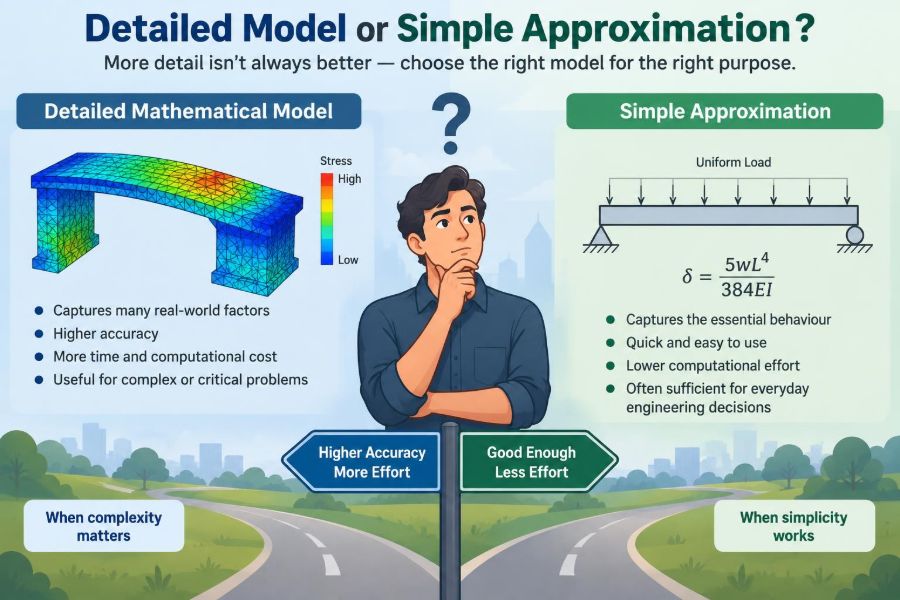

A production line is running behind schedule. Someone proposes a detailed simulation of every machine, queue, failure mode, and operator decision. Another engineer reaches for a simple throughput calculation on the back of a worksheet. Both want a better decision. Their disagreement is really about the level of model needed.
This situation appears far beyond factories. A civil engineer estimates a beam deflection, a data analyst forecasts demand, a controls engineer tunes a response, and a project manager estimates completion time. In each case, a simpler model may be fast and useful—or dangerously incomplete.
Mathematical modelling is not a contest in which the most equations win. It is a disciplined way to represent a real system well enough to answer a particular question. The word enough carries most of the engineering judgement.
The useful question is not “Can we build a detailed model?” It is “Will the additional detail change a decision, reduce a meaningful risk, or reveal behaviour that a simpler approximation cannot?”
🧭 Start With the Decision, Not the Model
A model has a job. Before selecting equations, state the decision it will support: choose a pipe diameter, set a maintenance interval, assess a safety margin, or decide whether to run a field test.
A detailed model is justified when it provides information that affects that decision. If every plausible model leads to the same action, additional sophistication may consume time without adding practical value.
For example, if a preliminary load estimate is far below a component’s allowable capacity, a conservative hand calculation may be sufficient to reject an oversized design. If the estimate lies close to the limit, assumptions deserve closer examination.
🎯 Define What “Works” Actually Means
A simple approximation “works” only relative to a stated purpose. It might predict average energy use adequately while failing to predict the short power peaks that determine equipment sizing.
Useful success criteria can include:
- the required accuracy of an output;
- the range of operating conditions covered;
- the consequences of a wrong decision;
- the time available to act; and
- the ability to explain and audit the result.
Without criteria, teams often argue about elegance rather than usefulness. A model cannot be judged in the abstract; it must be judged against an intended use.
🪜 Models Exist on a Ladder of Fidelity
Model fidelity is the degree to which a representation captures relevant features of a real system. It is not simply the number of variables, equations, or lines of software code.
A rough order-of-magnitude estimate may sit at one end of the ladder. At the other may be a high-resolution simulation with coupled physical processes, uncertain inputs, and calibration data. Between them lie analytical formulae, lumped-parameter models, empirical correlations, and reduced-order simulations.
Moving upward can capture more mechanisms, but it also introduces more assumptions, input requirements, computation, and opportunities for error.
⚖️ The Simplest Model Should Be the Starting Point
A sound workflow usually begins with the simplest model that could plausibly answer the question. This is not anti-detail. It is a way to establish scale, identify dominant effects, and create a baseline against which a richer model can be tested.
For heat transfer through a wall, a one-dimensional steady conduction calculation may show whether insulation thickness is even the dominant design lever. Only then might transient weather effects, thermal bridges, and airflow deserve more detailed treatment.
Simple models are especially valuable because their assumptions are visible. That visibility makes them easier to challenge.
🔍 Every Model Is an Approximation
No engineering model reproduces reality in full. A detailed finite-element model still chooses material laws, mesh resolution, boundary conditions, contact definitions, and loading histories. A data-driven forecast still depends on which variables were measured and which patterns were present in historical data.
The distinction is therefore not between an “approximate” model and an “exact” model. It is between approximations whose limitations are understood and approximations whose limitations are hidden.
More detail can reduce one source of error while increasing another. A model with finely resolved geometry is not automatically reliable if its material properties or constraints are poorly known.
🧮 Know the Assumptions Behind the Shortcut
Simple formulae often rest on assumptions such as linear behaviour, steady conditions, uniform properties, independence between events, or negligible edge effects. These assumptions are not flaws by default; they define the conditions in which the approximation is useful.
Consider the familiar relation F = ma. It is extremely useful for many mechanical systems, but a real design may also require friction, drag, compliance, rotating inertia, or changing mass. The question is whether omitted terms materially affect the quantity being decided.
Write assumptions beside the result. A calculation with visible assumptions is more valuable than a polished output whose limits are unknown.
📏 Compare Error With the Decision Margin
Model error matters relative to the margin in the decision. Suppose a simple calculation estimates a temperature of 62°C, with uncertainty that could reasonably shift the result by several degrees. That may be acceptable for a component rated comfortably above that range, but inadequate when a threshold sits near 60°C.
The same principle applies to cost, reliability, scheduling, and performance. An approximation may be perfectly adequate for screening options and inadequate for final approval.
A practical question is: Could a credible error in this model reverse the decision? If yes, improve the model, improve the data, or alter the design to create more margin.
🚦 Consequences Set the Required Level of Detail
Not all modelling errors have equal consequences. A rough estimate may be suitable for choosing between two low-cost prototype layouts. It is less suitable when a result influences public safety, structural integrity, environmental release, or a high-cost irreversible commitment.
Higher consequence does not always mean a single enormous simulation. It may mean independent checks, conservative assumptions, physical testing, monitoring, or a combination of methods.
In safety-critical work, governing codes, regulations, organizational procedures, and qualified review may prescribe methods that go beyond what appears efficient in a narrow calculation.
⏱️ Time Has Engineering Value
A detailed model takes time to formulate, obtain inputs, verify, run, interpret, and communicate. In a rapidly evolving incident, a transparent estimate available now can be more useful than a refined answer available after the decision window closes.
This is common in troubleshooting. A first-principles estimate can quickly distinguish between a sensor issue, an obvious capacity constraint, and a phenomenon requiring specialist analysis.
Speed is not an excuse for carelessness. It is a reason to maintain validated quick methods before an urgent situation occurs.
💰 Account for the Full Cost of Complexity
Software licenses and computing time are only part of the cost. Complex models require specialist expertise, data preparation, version control, quality assurance, and explanation to people who must act on the result.
There is also an opportunity cost. Time spent refining a minor mechanism may not be available for inspecting equipment, collecting better measurements, or evaluating an alternative design.
A useful model earns its complexity by changing the quality of the decision more than it increases the burden of producing it.
🧱 Detail Cannot Repair Missing Input Data
A common mistake is to build an elaborate model around uncertain inputs. If a system’s load profile, material condition, boundary condition, or demand distribution is not known, extra mathematical detail can create a false impression of precision.
For instance, modelling fluid flow through a detailed pipe network does not overcome uncertainty about actual valve positions or pump curves. Better measurements may improve the decision more than a more advanced solver.
Separate model uncertainty, caused by imperfect representations, from input uncertainty, caused by incomplete or variable data. Both can dominate the final answer.
📊 Sensitivity Analysis Reveals What Deserves Attention
Sensitivity analysis asks how much an output changes when an input or assumption changes. It converts vague concern about uncertainty into a practical ranking of what matters.
If varying an input over a credible range barely changes the result, improving that input is unlikely to be worthwhile. If a small change shifts the recommendation, that variable deserves better data, a more realistic model, or a more conservative decision.
Even a simple one-at-a-time sensitivity check is often revealing. More advanced analyses can examine interacting uncertainties, but the central idea remains the same: focus effort where the outcome is sensitive.
🌊 Dominant Physics Often Makes Simplicity Possible
Many systems contain numerous effects, but only a few dominate under a given set of conditions. A model becomes efficient when it retains these dominant mechanisms and omits effects that are small relative to the desired accuracy.
Dimensional analysis and scale analysis help make this judgement. They compare the relative size of terms in governing equations rather than relying purely on intuition.
For a slowly changing thermal system, stored heat may be negligible compared with steady heat loss. During a rapid start-up, the same stored heat can become central. Dominance depends on the operating regime.
🔄 Regime Changes Are Where Shortcuts Often Fail
Approximations are frequently reliable within one regime and unreliable near a transition. Examples include laminar flow becoming turbulent, elastic deformation approaching yielding, a queue approaching capacity, or a stable control system nearing an oscillatory limit.
Near these boundaries, small changes in inputs can produce disproportionately large changes in behaviour. A simple linear model may miss the transition entirely.
Ask whether the proposed operating range crosses a known threshold. If it does, a model built around one regime should not be extrapolated casually into another.
📈 Nonlinearity Changes the Value of Detail
In linear systems, doubling an input often doubles an output, and effects can be combined predictably. In nonlinear systems, response may depend strongly on operating point, interactions, saturation, thresholds, or feedback.
A simple average can then mislead. Average traffic flow, for example, may conceal stop-and-go congestion; average heat generation may conceal a short thermal peak.
Detailed modelling is often most valuable not because the system looks complicated, but because nonlinear behaviour makes intuitive extrapolation unsafe.
🎲 Randomness May Matter More Than the Average
Some decisions depend on variability rather than mean performance. A manufacturing process can meet its average output target while still missing delivery commitments because failures and arrivals occur in clusters.
When variation, rare events, or tail outcomes matter, deterministic averages may be insufficient. Stochastic models represent uncertainty explicitly, often by using probability distributions or repeated simulation runs.
This does not mean every variable needs a distribution. It means variability should be represented when it could change a decision about capacity, resilience, risk, or service level.
🧪 Validation Is Different From Verification
Verification asks whether the model has been implemented correctly: are the equations solved as intended, units consistent, code free of known logic errors, and numerical settings appropriate?
Validation asks whether the model represents the real system adequately for its intended use. A verified model can still be invalid if it omits an important physical effect or uses unrepresentative data.
Both are necessary. Checking that software runs without errors is not evidence that its predictions are credible.
🔗 Use Independent Checks to Build Confidence
Confidence rises when different methods point in the same direction. A hand calculation, a detailed simulation, a prototype test, and operating data will not match perfectly, but major disagreement is informative.
Independent checks are powerful because they tend not to share every assumption. A simplified analytical solution may expose a boundary-condition mistake buried in a large numerical model.
When methods disagree, do not simply select the preferred result. Trace the disagreement to assumptions, inputs, definitions, or numerical choices.
🛠️ A Detailed Model Needs Its Own Quality Plan
Complexity creates failure modes that simple calculations may avoid: incorrect meshing, unstable time steps, unphysical parameter combinations, hidden default settings, and difficult-to-review code paths.
For a detailed model, plan for:
- unit and dimensional checks;
- documented inputs and sources;
- version-controlled files or scripts;
- test cases with known or expected behaviour;
- peer review focused on assumptions as well as mathematics; and
- clear records of calibration and limitations.
Without this discipline, a complicated model can be less trustworthy than a transparent approximation.
🧠 Beware of False Precision
A result displayed as 17.4836 does not imply knowledge to four decimal places. Numerical output precision often reflects computer arithmetic, not physical certainty.
Report results with precision that matches the inputs, assumptions, and purpose. Ranges, scenarios, and rounded values can be more honest and more useful than long decimal strings.
False precision is especially risky in discussions with non-specialists because it can make an uncertain forecast look settled.
🗣️ Explainability Is an Engineering Requirement
Decision-makers need to understand what drives a recommendation. They do not need every derivation, but they should know the main assumptions, the evidence supporting them, the uncertainty range, and what would change the conclusion.
Simple models are often easier to explain. Detailed models can still be explainable if their outputs are connected to physical mechanisms rather than presented as unexplained plots.
If a team cannot articulate why the model predicts a result, it is not ready to use that result as the sole basis for a major decision.
🏗️ Example: Sizing a Pumping System
Consider a hypothetical water-transfer project. An initial calculation using estimated flow rate, elevation change, and friction losses may quickly identify a plausible pump head and motor range. This is an appropriate early model because it supports option screening.
More detail becomes justified if the system includes long variable-speed operation, branching networks, transient pressure effects, uncertain demand patterns, or equipment sensitive to cavitation. Those features can alter pump selection and pipe protection requirements.
The early estimate is not discarded. It becomes a check on the later network or transient model, helping engineers notice implausible results.
🏭 Example: Improving a Production Process
A simple capacity calculation divides available operating time by average cycle time. It is useful for identifying an obvious bottleneck and setting a first target.
But average cycle time may not predict actual throughput when changeovers, rework loops, machine failures, buffer limits, and variable arrivals interact. A discrete-event simulation, which represents individual jobs moving through events over time, can then reveal queues and downtime patterns hidden by averages.
The additional model earns its place if it changes the improvement strategy: perhaps a small buffer or maintenance change outperforms an expensive machine purchase.
🌉 Example: Structural Analysis at Different Stages
A beam formula can provide an early estimate of bending stress and deflection under an idealized load. It is fast, interpretable, and often sufficient for preliminary sizing of a regular member.
A more detailed finite-element model may be warranted for irregular geometry, connections, local stress concentrations, nonlinear contact, complex supports, or dynamic loading. Yet it still requires careful material properties and realistic boundary conditions.
For final structural work, applicable design standards and qualified review determine what analyses and checks are required. Modelling judgement operates within those professional obligations.
🧩 Reduced-Order Models Offer a Middle Path
The choice is rarely limited to a hand calculation or a full simulation. A reduced-order model keeps the behaviours most relevant to the question while replacing unnecessary detail with simpler relationships.
A thermal network with a few heat capacities and resistances, for instance, can capture important transient behaviour without resolving every geometric feature. A surrogate model can approximate a costly simulation across a design space after it has been trained or fitted using carefully selected cases.
These approaches are valuable when repeated evaluation is needed for control, optimization, uncertainty analysis, or rapid design exploration.
🔁 Build Models Progressively
Progressive modelling reduces wasted effort. Begin with a clear baseline, compare it against observations where possible, then add detail only to address a recognized mismatch or decision-relevant uncertainty.
A practical sequence is:
- state the decision and required output;
- construct a simple, transparent model;
- test assumptions with data, bounds, or sensitivity checks;
- identify the mechanism most likely to alter the decision;
- add only the detail needed to represent that mechanism; and
- compare the new result with the baseline.
This creates a traceable argument for complexity rather than treating complexity as a default.
🚫 Common Reasons Teams Overmodel
Overmodelling can arise from admirable motives—thoroughness, intellectual curiosity, or a desire to use capable software. It can also arise from less helpful pressures, such as mistaking visual sophistication for rigor.
Warning signs include modelling variables that no decision will use, spending more effort on detail than on input quality, or continuing refinement after the recommendation has become robust.
Complexity is not wasted when it improves understanding. It is wasted when it cannot change action, confidence, or risk management.
⚠️ Common Reasons Teams Undermodel
Undermodelling often follows tight schedules, limited access to tools, familiarity with a convenient formula, or overconfidence in historical rules of thumb. These pressures are understandable, but they can hide important interactions.
Warning signs include extrapolating beyond a model’s tested range, using average values where peaks drive failure, ignoring feedback or variability, and relying on a single unvalidated spreadsheet for a consequential choice.
The remedy is not automatically a giant simulation. It may be a bounding calculation, targeted measurement, prototype test, or expert review.
🧾 Choose Evidence, Not Just Equations
A modelling strategy can combine calculation with observation. Field measurements may narrow uncertain inputs; experiments may test a mechanism; inspections may establish actual condition; and operational monitoring may reveal whether a prediction remains valid.
Sometimes the best investment is not a better model but a better measurement. Sometimes a model is essential for interpreting measurements that cannot cover every condition.
Think of modelling as part of an evidence system. Equations, data, physical insight, and professional judgement each compensate for limits in the others.
✅ A Practical Decision Checklist
Before escalating from a simple approximation to a detailed mathematical model, ask the following:
- What specific decision will the result change?
- What accuracy, range, and response time does that decision require?
- Could the simple model’s credible error reverse the recommendation?
- Are important thresholds, nonlinearities, interactions, or random effects involved?
- Do we have reliable inputs for a more detailed representation?
- Would measurement or testing reduce uncertainty more effectively?
- Can the detailed model be verified, validated, reviewed, and explained?
- What does the applicable safety, quality, or design process require?
If the answers point toward detail, build it deliberately. If they do not, a simple model may be the more professional choice.
🏁 The Core Principle: Fit the Model to the Decision
The best model is not the simplest possible model, nor the most detailed model available. It is the model whose assumptions, uncertainty, effort, and evidence are appropriate for the decision at hand.
Simple approximations are powerful when they expose dominant behaviour, support robust choices, and remain inside their valid range. Detailed models are valuable when omitted mechanisms, uncertainty, or consequences could change the answer.
Engineering maturity lies in knowing the difference—and in being able to show why the chosen level of detail is justified.
Build enough model to make a sound decision, then spend the remaining effort on checking assumptions, improving evidence, and managing the uncertainty that still matters. 📐🔎⚙️