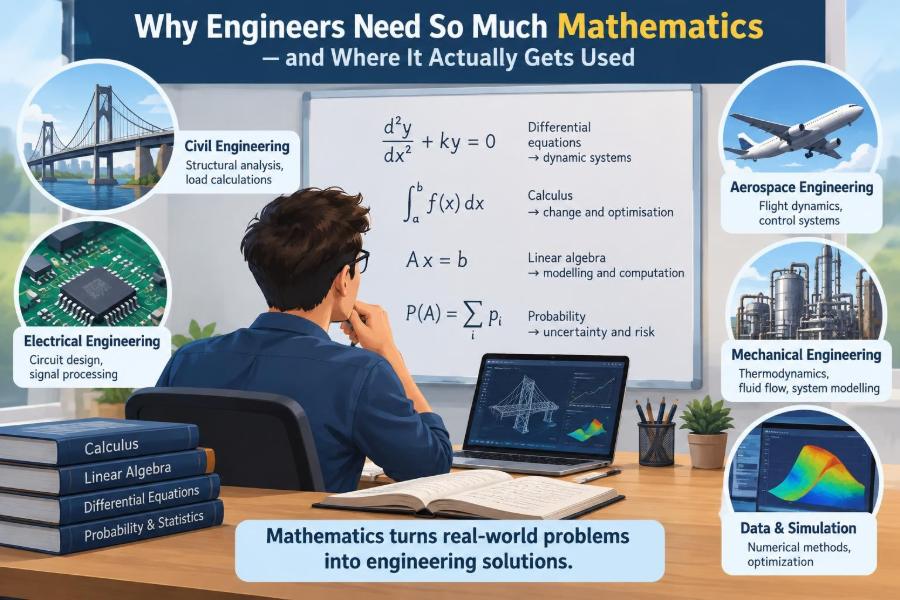

A lift accelerates smoothly, a phone finds its location, a bridge carries traffic through wind and rain, and an electric vehicle manages power between its battery and motor. Most people experience the finished result, not the calculations beneath it.
For an engineer, mathematics is the language used to describe those systems before they are built. It turns a rough question—Will it hold? Will it overheat? Will it arrive accurately?—into quantities that can be estimated, tested, and improved.
That does not mean every engineer spends every day solving long equations by hand. Modern software handles much of the arithmetic. The engineer’s job is still mathematical: choosing an appropriate model, supplying sensible inputs, judging assumptions, and recognizing an answer that cannot be true.
The real value of engineering mathematics is not memorizing formulas. It is learning how to connect physical behaviour, uncertainty, data, and design decisions.
🧭 Mathematics Is a Design Language
Engineering designs must be communicated precisely. A statement such as “make the beam strong enough” is not yet a design requirement. Mathematics converts it into loads, dimensions, material properties, deflection limits, and safety margins.
A mathematical model is a deliberately simplified description of a real system. Its purpose is not to reproduce every detail; it is to capture the details that affect the decision at hand.
🔍 The Question Comes Before the Equation
Useful calculation begins with a question. Is the concern maximum stress, energy use, vibration, manufacturing variation, or cost? Different questions require different mathematics.
Starting with a familiar equation before defining the problem is a common error. A correct formula applied to the wrong quantity can produce a neat, confident, and useless result.
📏 Algebra Keeps Relationships Visible
Algebra appears whenever engineers rearrange relationships to solve for an unknown. If voltage, current, and resistance are related, algebra lets a designer determine which parameter must change to meet a target.
More importantly, symbolic expressions expose trade-offs. If a quantity is proportional to the square of speed, doubling speed has a much larger consequence than a simple linear intuition suggests.
📐 Geometry Turns Shape Into Performance
Shape is rarely decorative in engineering. The cross-section of a beam affects bending resistance; the curvature of a road affects vehicle motion; the area of a heat sink affects cooling.
Geometry also defines fit. Mechanical parts must assemble despite tolerances, buildings must accommodate clearance, and antennas must be positioned relative to wavelength. Coordinates, angles, areas, volumes, and spatial transformations make those requirements testable.
🧮 Trigonometry Resolves Direction
Forces, velocities, and fields have magnitude and direction. Trigonometry resolves an angled force into horizontal and vertical components, allowing each direction to be analyzed separately.
On a sloped conveyor, for example, gravity has one component pulling an item downhill and another pressing it into the belt. Those components guide motor sizing and friction estimates.
➡️ Vectors Describe More Than Arrows
A vector combines size and direction. Engineers use vectors for force, acceleration, fluid velocity, electric fields, and position in three-dimensional space.
Vector operations prevent directional mistakes. Adding two forces as ordinary positive numbers ignores whether they oppose each other; vector addition retains that physical information.
⚖️ Statics Explains Structures at Rest
Statics studies systems in equilibrium: the net force and net turning effect are zero. It is fundamental to early structural, mechanical, and civil design.
Consider a shelf fixed to a wall. Engineers calculate not only the shelf’s total load but where that load acts. A load farther from a support creates a larger moment, or turning tendency, which may govern the bracket design.
🏗️ Strength of Materials Connects Load to Failure
Strength calculations ask how materials respond when loaded. Stress describes internal force spread over an area; strain describes relative deformation.
A part can be strong enough not to fracture yet still be unsuitable if it bends too much, buckles, fatigues after repeated loading, or yields permanently. Material models and test data help engineers examine these distinct failure modes.
⏱️ Calculus Captures Change
Calculus becomes necessary when quantities change continuously. A derivative measures a rate of change, while an integral accumulates many small contributions.
Velocity is the rate of change of position; acceleration is the rate of change of velocity. In fluid flow, heat transfer, and motion control, the system’s behaviour depends on these changing quantities rather than one fixed value.
🚗 Motion Models Make Machines Predictable
Mechanical engineers model moving components such as robotic arms, gear trains, suspension systems, and vehicles. Newton’s laws connect force, mass, and acceleration, while calculus describes how the motion develops over time.
A hypothetical automated door illustrates the point. It must open quickly enough to be useful but not accelerate so sharply that components wear rapidly or users feel unsafe. The design is a balance between motion, force, power, and control.
🌊 Differential Equations Describe Dynamic Systems
A differential equation relates a quantity to its rate of change. It is often the natural form of an engineering law: a cooling object loses heat according to temperature difference, and a vibrating mass responds according to displacement and velocity.
Many real systems cannot be understood from one instant alone. Differential equations help predict their trajectory, including whether a response fades away, oscillates, or grows dangerously.
🎵 Vibrations Reveal Hidden Risks
Every structure and machine has natural frequencies at which it prefers to vibrate. If repeated forcing occurs near one of them, the response can become much larger; this is resonance.
Engineers use mathematics to estimate natural frequencies and damping, then change mass, stiffness, operating speed, or isolation where needed. The aim is not always to eliminate vibration, but to keep it within acceptable limits.
🌡️ Heat Transfer Is an Energy Balance
Electronics, engines, buildings, and chemical plants all require thermal analysis. Heat moves by conduction through materials, convection into moving fluids, and radiation between surfaces.
A compact device may function electrically but fail in service if heat cannot escape. Thermal mathematics links power dissipation, material conductivity, airflow, surface area, and temperature limits.
⚡ Circuits Use Equations to Track Energy and Signals
Electrical engineers use algebra, complex numbers, differential equations, and matrices to analyze circuits. Basic laws express conservation of charge and energy; more advanced methods predict filtering, timing, noise, and signal behaviour.
In alternating-current analysis, sinusoidal voltages and currents continually change direction. Complex numbers provide a compact way to track their magnitude and phase shift without repeatedly expanding trigonometric expressions.
📡 Signals Become Useful Through Fourier Ideas
A signal can be viewed in time—how it changes moment by moment—or in frequency—what repeating components it contains. Fourier analysis connects these views.
This is used in communications, audio, medical instruments, radar, vibration monitoring, and digital filters. A sensor recording may contain the desired pattern plus unwanted frequencies; frequency-domain analysis helps separate them.
💧 Fluid Mechanics Models Flow and Pressure
Water through pipes, air over a wing, and oil through a hydraulic system all involve fluid mechanics. Flow rates, pressure losses, viscosity, turbulence, and boundary conditions determine whether a simple model is adequate.
Real flows can be difficult, especially when turbulent. Engineers often combine governing equations, experimental correlations, and computational simulation rather than assume one elegant formula applies everywhere.
🧪 Chemical Engineering Uses Balances
Mass and energy balances are core tools in process engineering. They account for what enters, leaves, accumulates, reacts, or transfers energy within a system.
For a mixing tank, the concentration at the outlet depends on inlet flow, tank volume, mixing quality, and reaction rate. The mathematics supports equipment sizing, process control, and safe operating limits.
🧱 Matrices Organize Interconnected Systems
A matrix is a structured grid of numbers that represents many linked equations. It becomes essential when a system has numerous unknowns, such as temperatures at many points in a component or forces throughout a structural frame.
Computers solve these systems rapidly, but engineers must still understand what each row and variable represents. A matrix solution is only meaningful when the underlying physical model is meaningful.
🕸️ Finite Element Analysis Breaks Big Problems Apart
Finite element analysis, often called FEA, divides a complicated object into many small elements. The behaviour of each piece is approximated, then assembled into a larger solution.
FEA can estimate stress, deformation, temperature, or electromagnetic fields in shapes too complex for hand calculations. It is powerful, but results depend heavily on material properties, constraints, contact assumptions, and mesh quality.
🖥️ Simulation Is Evidence, Not an Oracle
A colorful simulation plot can look authoritative while hiding a poor setup. Incorrect boundary conditions, unrealistic loads, or an overly coarse mesh can yield misleading results with impressive graphics.
Good practice includes checking units, comparing simplified cases with hand calculations, refining the model where gradients are sharp, and comparing predictions with tests where practical. Verification asks whether the equations were solved correctly; validation asks whether the equations represent reality well enough.
📊 Statistics Deals With Variation
Measurements vary because materials, machines, environments, and instruments vary. Statistics helps engineers separate ordinary variation from a meaningful shift, estimate uncertainty, and make decisions from limited data.
In manufacturing, repeated measurements of a dimension can reveal whether a process is centered on its target and whether its spread risks producing parts outside tolerance. One measurement alone tells very little.
🎯 Probability Supports Reliability Decisions
Probability models uncertain events: a component’s lifetime, a load that may occur, or a sensor’s false alarm. They help engineers consider not just what can fail, but how likely different conditions are.
Such models require care. Historical data may not represent a new design or environment, and rare events are difficult to estimate. Probability informs judgment; it does not remove the need for conservative design and testing.
🛡️ Safety Factors Handle What Models Miss
Loads are uncertain, material properties vary, and models simplify reality. Engineers commonly apply safety factors or design margins to account for these uncertainties, particularly where failure consequences are serious.
A larger margin is not automatically better. Excess material can add cost, weight, energy use, or new failure mechanisms. Appropriate margins depend on the application, standards, evidence, inspection, and consequences of failure.
📐 Optimization Finds Better Trade-Offs
Engineering rarely has a single “best” answer. A lighter aircraft part may cost more to manufacture; a larger battery may increase range while reducing payload; a quieter machine may need more space or damping.
Optimization formalizes these trade-offs. It selects design variables to improve an objective, such as cost or efficiency, while satisfying constraints such as strength, temperature, manufacturability, and regulations.
🤖 Control Theory Makes Systems Respond Well
Control systems compare a measured output with a desired target and adjust an input. Cruise control changes throttle to maintain speed; a thermostat changes heating or cooling to maintain temperature.
Mathematics predicts whether a controller will be stable, sluggish, noisy, or prone to oscillation. A controller tuned only for fast response can overshoot repeatedly; one tuned too cautiously may respond too slowly to disturbances.
🧭 Numerical Methods Solve What Has No Neat Formula
Many engineering equations cannot be solved exactly in a convenient form. Numerical methods approximate answers through repeated calculations, often using computers.
Approximation introduces its own risks: round-off error, unstable algorithms, and solutions that depend on step size or initial guesses. Engineers check convergence—whether the answer settles as the calculation is refined—rather than trusting a single run.
🔢 Units Are a Mathematical Error Check
Units give equations physical meaning. Adding metres to seconds is meaningless, and an answer with unexpected units often exposes an incorrect formula or conversion.
Dimensional analysis is one of the simplest checks available. Before accepting a result, ask: do its units match the quantity being calculated, and is its magnitude plausible for the situation?
🧠 Estimation Builds Engineering Judgment
Order-of-magnitude estimates are fast, rough calculations used before detailed analysis. They help identify impossible assumptions and focus effort where it matters.
If a hand estimate suggests a small motor cannot possibly lift a large load at the requested speed, there is no reason to wait for a detailed simulation to challenge the requirement. Estimation is not a replacement for analysis; it is a filter for better analysis.
🧰 Software Changes the Work, Not the Need for Maths
Spreadsheets, symbolic tools, CAD packages, simulation software, and programming languages automate repetitive work. They let engineers study more cases and solve more complex problems than manual methods allow.
But software cannot decide whether a model omits friction, uses the wrong material, or applies a load in the wrong direction. Mathematical understanding is what allows an engineer to set up, inspect, and challenge digital results.
🗣️ Clear Communication Is Part of the Calculation
A calculation that nobody can review is difficult to trust. Engineers document assumptions, diagrams, units, inputs, methods, results, and limitations so another person can follow the reasoning.
The audience matters. A specialist may need equations and model settings; a project manager may need the decision, risk, and sensitivity to key assumptions. Both need an honest account of uncertainty.
⚠️ Common Mathematical Mistakes in Engineering
- False precision: reporting many decimal places when input measurements are uncertain.
- Unit inconsistency: mixing unit systems or overlooking a conversion.
- Unstated assumptions: treating a simplified model as if it were the physical system.
- Ignoring boundary conditions: modeling a part without representing how it is supported, cooled, or connected.
- Trusting one result: failing to compare a model with estimates, alternative methods, or test data.
These errors are not signs that mathematics has failed. They show why engineering mathematics includes interpretation and checking, not just calculation.
📚 Learning Mathematics for Engineering Practice
Students often encounter mathematics as separate subjects, then wonder where it fits. The connection becomes clearer when every technique is tied to a physical quantity: rate of change to velocity, integration to accumulated energy, matrices to connected components.
For working professionals, the most valuable habit is to revisit fundamentals when a model feels opaque. Learn the assumptions behind a tool, build small test cases, and ask what measurement could confirm the result.
🔗 The Core Principle: Model, Check, Decide
Engineers need substantial mathematics because engineering deals with systems that must work under constraints, variation, and uncertainty. Mathematics provides a disciplined route from observation to prediction and from prediction to a defensible decision.
The strongest workflow is simple in concept: define the question, choose a model suited to it, calculate carefully, check the result against physical reality, and revise when evidence disagrees. Equations are not separate from practical engineering; they are one of its main ways of thinking.
Engineers need mathematics not to make every problem look abstract, but to make real-world decisions visible, testable, and safer. 📐🔧📊