
Many real-world problems are too complicated to solve with a single neat equation. Financial markets fluctuate unpredictably, engineering components experience uncertain loads, weather systems depend on countless interacting variables, and project schedules can be delayed by events that are impossible to predict precisely.
One powerful way to analyze such uncertainty is Monte Carlo simulation. 🎯
Monte Carlo simulation is a computational method that uses random sampling to explore many possible outcomes. Instead of trying to calculate one exact answer, it runs a model repeatedly with different randomly generated inputs and observes what happens.
After thousands, millions, or even billions of trials, patterns begin to emerge.
The technique can estimate probabilities, expected values, risks, ranges of possible outcomes, and the likelihood of rare events.
The surprising idea is simple:
Randomness can be used to produce reliable numerical answers.
🎰 Why Is It Called “Monte Carlo”?
The name comes from Monte Carlo, the famous district of Monaco associated with casinos and games of chance.
Casinos rely heavily on randomness, probability, dice, cards, and roulette wheels.
Monte Carlo methods also use random outcomes—although instead of gambling, computers use randomness to solve mathematical and practical problems. 🎲
The technique became especially important during the 1940s, when scientists working on complex physics calculations began using random sampling with early computers.
Since then, Monte Carlo simulation has become an essential tool in science, engineering, finance, statistics, artificial intelligence, and many other fields.
🧠 The Basic Idea Behind Monte Carlo Simulation
Imagine you are trying to predict how long a construction project will take.
Some tasks may take:
- 5 to 7 days
- Others 10 to 20 days
- Some may be delayed by weather
- Equipment could fail
- Deliveries might arrive early or late
Trying to assign one exact duration to the entire project would ignore uncertainty.
A Monte Carlo simulation takes a different approach.
Instead of saying:
“Task A will take exactly 6 days.”
you might define a probability distribution describing the realistic range of possible durations.
The computer then randomly chooses one possible duration for each task and calculates the total project time.
That is one simulation.
Then it does it again.
And again.
After perhaps 100,000 simulations, you could discover something like:
- 25% of simulations finish within 90 days
- 60% finish within 100 days
- 90% finish within 115 days
This gives decision-makers much more information than a single estimate. 📊
🔄 The Four Main Steps
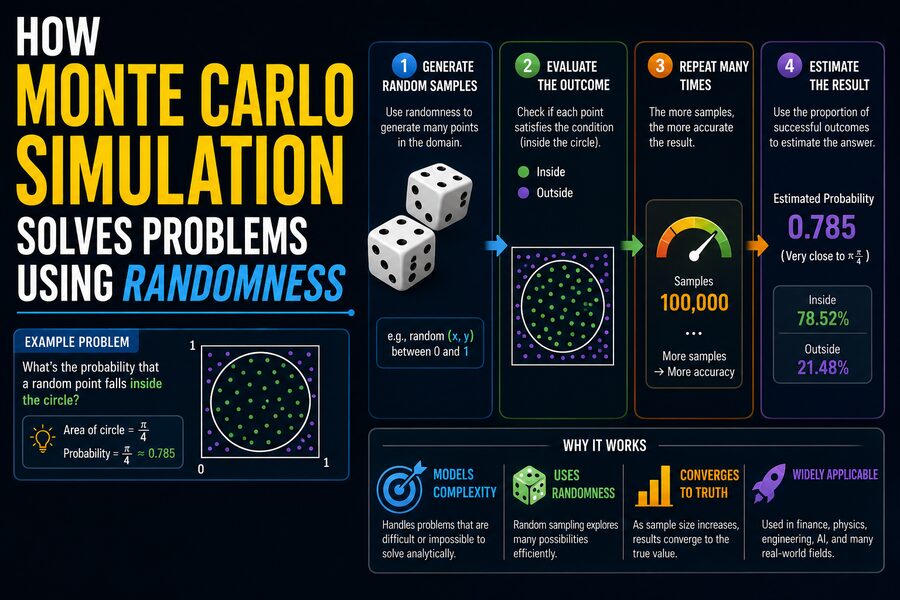
A typical Monte Carlo simulation follows a straightforward process.
First, create a mathematical or logical model of the system.
Second, identify uncertain inputs and describe them using probability distributions.
Third, randomly sample values from those distributions and run the model.
Fourth, repeat the process many times and analyze the resulting outputs.
The general workflow is:
Define → Sample → Calculate → Repeat → Analyze
The power comes from repetition.
One random trial may tell you very little.
A million trials can reveal a remarkably stable statistical picture.
🎯 A Simple Example: Estimating Pi
One of the most famous demonstrations of Monte Carlo simulation is estimating the value of π (pi).
Imagine drawing a square with a circle perfectly inscribed inside it.
Now randomly scatter points throughout the square.
Some points fall inside the circle.
Others fall outside the circle but remain inside the square.
The ratio of points inside the circle to the total number of points is related to the ratio of the circle’s area to the square’s area.
For a circle with radius r:
Area of circle = πr²
The surrounding square has side length 2r, so:
Area of square = 4r²
Therefore:
Circle area / Square area = π/4
If 78.5% of randomly generated points fall inside the circle, then:
π ≈ 4 × 0.785 = 3.14
With enough random points, the estimate tends to approach the true value of π. 🎯
This example shows how random sampling can solve a mathematical problem without directly evaluating a complicated integral.
🎲 Where Does the Randomness Come From?
Computers usually generate values using pseudorandom number generators, or PRNGs.
These algorithms produce sequences of numbers that appear random for practical purposes.
Technically, the numbers are generated deterministically from an initial value called a seed.
If you use the same algorithm and the same seed, you can reproduce the same sequence of “random” numbers.
That feature is extremely useful in scientific computing because researchers can repeat experiments and verify results.
For specialized applications—particularly cryptography or some physical experiments—true physical sources of randomness may be used instead.
But ordinary Monte Carlo simulations usually rely on high-quality pseudorandom generators. 💻
📈 Probability Distributions Are the Heart of the Model
Not every uncertain input should be modeled with the same kind of randomness.
Suppose a factory machine produces parts whose dimensions vary slightly.
Measurements might cluster around an average value.
A normal distribution could be appropriate.
A project activity might have a minimum possible duration, a most likely duration, and a maximum duration.
A triangular distribution might make sense.
A customer may have a 5% probability of canceling an order.
That could be modeled using a simple binary probability.
Other commonly used distributions include:
- Uniform distribution
- Normal distribution
- Lognormal distribution
- Exponential distribution
- Poisson distribution
- Beta distribution
Choosing realistic distributions is critical.
A simulation can only be as useful as the assumptions built into its model. 🧮
⚡ Why Random Sampling Works
At first glance, using random numbers might seem like a poor way to obtain an accurate answer.
But probability theory explains why it works.
As the number of independent samples increases, the average behavior tends to stabilize.
This idea is closely related to the law of large numbers.
Suppose you flip a fair coin 10 times.
You might get 8 heads.
That does not mean the true probability of heads is 80%.
But if you flip the coin 10 million times, the fraction of heads will probably be much closer to 50%.
Monte Carlo simulation relies on the same principle.
The more representative trials you perform, the more stable many estimated quantities become. 📉
🏦 Monte Carlo Simulation in Finance
Finance is one of the most common areas where Monte Carlo simulation is used.
Investment returns are uncertain.
Interest rates change.
Stock prices fluctuate.
Exchange rates move unpredictably.
A financial analyst might simulate thousands of possible future paths for a portfolio.
Each simulation could vary assumptions such as:
- Asset returns
- Market volatility
- Interest rates
- Inflation
- Currency movements
The results might help answer questions such as:
What is the probability the portfolio loses more than 20%?
How much money might be available at retirement?
What range of future asset values is plausible?
Monte Carlo methods are also used in derivatives pricing, risk management, and capital planning. 💰
🏗️ Project Management and Scheduling
Project managers often face uncertain task durations.
Suppose a project contains 50 activities.
Traditional planning might assign one fixed duration to every activity.
But real projects rarely behave so predictably.
A Monte Carlo schedule simulation can assign probability distributions to task durations.
The system then generates thousands of possible project timelines.
Instead of saying:
“The project will finish on October 10.”
the analysis might say:
“There is a 50% chance of finishing by October 10 and an 85% chance of finishing by October 25.”
This gives managers a clearer view of schedule risk and helps them set more realistic deadlines. 📅
🏭 Engineering Reliability
Engineers frequently use Monte Carlo simulation to estimate whether products and systems will survive real operating conditions.
Consider an aircraft component.
Its strength may vary slightly between manufactured units.
The load applied during service may also vary.
Temperature, vibration, material properties, and dimensions may all be uncertain.
A Monte Carlo simulation can randomly generate combinations of these factors and calculate whether failure occurs.
After a million trials, engineers might estimate the probability of failure under expected conditions.
This approach is especially valuable when many uncertain variables interact in complicated ways. ⚙️
🚗 Automotive Design
Automotive engineers can use Monte Carlo techniques for:
- Crash analysis
- Component durability
- Battery performance
- Fuel consumption
- Manufacturing tolerances
- Vehicle reliability
Suppose a braking system contains several components whose dimensions vary slightly because of manufacturing tolerances.
A simulation can generate thousands of hypothetical vehicles, each with slightly different component dimensions.
Engineers can then determine whether the braking system continues to operate safely across the full expected range of manufacturing variation. 🚘
🩺 Medicine and Healthcare
Healthcare researchers also use Monte Carlo models.
Examples include evaluating treatment strategies, estimating radiation doses, simulating disease progression, and modeling health-system costs.
Radiation therapy is a particularly important application.
When high-energy particles or photons travel through human tissue, their interactions can be probabilistic.
Monte Carlo particle-transport simulations can model enormous numbers of individual interactions to estimate how radiation energy is deposited throughout the body.
This can help improve treatment planning and protect healthy tissue. 🏥
☢️ Nuclear and Particle Physics
Monte Carlo methods have deep roots in nuclear physics.
Particles such as neutrons and photons may undergo random interactions as they travel through matter.
A neutron might:
- Scatter
- Be absorbed
- Trigger another nuclear reaction
- Escape from the system
Exactly what happens to one particle is uncertain.
But scientists can assign probabilities to each interaction.
By simulating huge numbers of particles, they can estimate overall reactor behavior, radiation transport, shielding effectiveness, and detector responses.
In such systems, random sampling closely mirrors the fundamentally probabilistic nature of the physical processes themselves. ⚛️
🌦️ Weather and Climate Modeling
Weather prediction is extraordinarily complex.
Temperature, atmospheric pressure, humidity, wind, clouds, and ocean conditions interact across enormous scales.
Modern forecasting systems can run ensembles of simulations with slightly different initial conditions or model assumptions.
Although ensemble weather forecasting is broader than a simple textbook Monte Carlo simulation, it relies on a closely related concept: examine many plausible futures rather than trusting a single prediction.
If nearly all simulations predict rain, confidence is relatively high.
If half predict rain and half predict clear skies, uncertainty is much larger. 🌧️☀️
📦 Supply Chain Planning
Supply chains contain many uncertain factors:
- Customer demand
- Delivery times
- Transportation delays
- Supplier reliability
- Production failures
- Inventory shortages
A business might simulate thousands of possible weeks of operation.
Some simulations contain high demand.
Others contain shipping delays.
Some combine several problems simultaneously.
The company can then estimate questions such as:
How likely are we to run out of inventory?
How much safety stock should we hold?
What happens if a major supplier is unavailable for two weeks?
These insights can help balance resilience against cost. 🚚
🎮 Monte Carlo Methods in Games and Artificial Intelligence
Monte Carlo techniques are also used in artificial intelligence.
One famous example is Monte Carlo Tree Search, or MCTS.
Instead of trying to analyze every possible future move in a complex game, an AI system can simulate many possible continuations.
Moves that repeatedly lead to strong outcomes receive more attention.
This strategy became especially important in advanced game-playing systems.
Monte Carlo methods can also be used in reinforcement learning, robotics, planning, and probabilistic inference. 🤖
🧮 Monte Carlo Integration
Monte Carlo simulation can estimate integrals that are difficult to calculate analytically.
In low-dimensional problems, traditional numerical integration techniques may be more efficient.
But when a problem contains many dimensions, ordinary grids can become computationally enormous.
Suppose an integral depends on 20 independent variables.
Dividing each variable into only 10 possible values would create:
10²⁰ combinations
That is an astronomical number.
Monte Carlo methods can instead sample random points from the 20-dimensional space.
This often makes them extremely useful in high-dimensional mathematics and physics.
📉 The Error Shrinks Slowly but Predictably
Monte Carlo simulation has an important limitation.
The statistical error usually decreases approximately in proportion to:
1 / √N
where N is the number of independent samples.
This means that to reduce the random sampling error by a factor of 10, you may need roughly 100 times more simulations.
For example:
10,000 trials might provide a certain level of precision.
To achieve approximately ten times smaller sampling error, you might need around 1,000,000 trials.
This relatively slow convergence can make highly precise simulations computationally expensive. 🖥️
🚀 Variance Reduction Techniques
Because simply adding more simulations can be costly, researchers use methods called variance reduction techniques.
These aim to obtain more accurate estimates without increasing computation as dramatically.
Examples include:
- Importance sampling
- Stratified sampling
- Antithetic variables
- Control variates
- Latin hypercube sampling
The details vary, but the basic objective is the same:
Use samples more intelligently.
Instead of wasting computation on less informative random trials, the simulation can focus more effectively on regions that matter.
🎯 Importance Sampling
Suppose you want to estimate the probability of an extremely rare system failure.
If the failure occurs only once in every 100 million ordinary simulations, brute-force Monte Carlo may be inefficient.
Importance sampling changes the sampling process so the simulation explores dangerous regions more frequently.
The results are then mathematically weighted to correct for this intentional bias.
This can make rare-event probabilities much easier to estimate.
Importance sampling is useful in reliability engineering, telecommunications, finance, and safety analysis. ⚠️
🔁 Reproducibility and Random Seeds
Because pseudorandom generators use seeds, a Monte Carlo experiment can be reproduced.
Suppose a scientist runs a simulation using seed:
12345
Another researcher using the same code, algorithm, inputs, and seed should obtain the same sequence of random samples.
This is valuable when debugging software or validating scientific results.
Researchers often record seeds alongside simulation settings so the exact computational experiment can be repeated later. 🔢
🖥️ Why Modern Computers Make Monte Carlo So Powerful
Monte Carlo methods can require enormous numbers of calculations.
Fortunately, many trials are independent.
That makes them ideal for parallel computing.
Instead of one processor running one million simulations sequentially, thousands of CPU cores or GPU processors can run simulations simultaneously.
Supercomputers and cloud computing platforms can execute enormous Monte Carlo workloads.
This ability has expanded the technique into applications that would have been computationally impractical decades ago. ⚡
📊 How Results Are Interpreted
A Monte Carlo simulation does not normally produce one answer.
It produces a distribution of outcomes.
Suppose a business simulates future annual profit 100,000 times.
The results might show:
Average profit: $8 million
Median profit: $7.6 million
5th percentile: $2 million
95th percentile: $15 million
Probability of a loss: 3%
These statistics reveal much more than simply saying:
“Expected profit is $8 million.”
Decision-makers can see both the expected result and the uncertainty around it.
⚠️ Monte Carlo Simulation Is Not a Crystal Ball
A sophisticated simulation can still produce misleading results if the assumptions are poor.
This is sometimes described by the computing principle:
Garbage in, garbage out.
If an analyst assumes unrealistic probability distributions, ignores important variables, or uses incorrect relationships between variables, running millions of simulations does not fix the model.
The output may be statistically precise but fundamentally wrong.
Good Monte Carlo analysis therefore requires careful modeling, reliable input data, and thoughtful interpretation. 🧠
🔗 Why Correlation Matters
Another common modeling mistake is treating uncertain variables as independent when they are actually related.
Suppose stock markets fall sharply.
Certain asset prices may decline together.
Assuming each asset moves completely independently could significantly underestimate portfolio risk.
Similarly, construction delays caused by bad weather might affect several project tasks at once.
Monte Carlo models can include correlations and dependencies between variables.
Accurately modeling these relationships can dramatically improve realism.
📏 How Many Simulations Are Enough?
There is no universal answer.
Some educational simulations may provide useful results after only a few thousand trials.
Complex industrial models may require millions or billions.
The required number depends on:
- Desired precision
- Variability of the outcome
- Probability of rare events
- Model complexity
- Available computing power
- Decision being made
A good practice is to monitor whether important statistics stabilize as the number of trials increases.
If the estimated result keeps changing substantially, more sampling or a better simulation method may be needed.
🆚 Monte Carlo vs. Deterministic Models
A deterministic model produces the same output whenever given the same inputs.
For example:
Distance = Speed × Time
If speed is 60 km/h and time is 2 hours, the answer is always 120 km.
A Monte Carlo model introduces uncertain inputs.
Perhaps speed varies between 50 and 70 km/h and travel time depends on traffic.
Now the output becomes a distribution rather than a single number.
Deterministic models answer:
“What happens under these exact assumptions?”
Monte Carlo simulation answers:
“What could happen across many plausible assumptions, and how likely is each outcome?” 🎲
🌍 Why Monte Carlo Simulation Is So Useful
The real world is full of uncertainty.
Exact predictions are often impossible.
Monte Carlo simulation does not try to eliminate that uncertainty.
Instead, it represents uncertainty explicitly.
This makes the method especially powerful for decisions involving risk.
Rather than saying:
“This system will work.”
the simulation might say:
“The estimated probability of successful operation is 99.7% under these assumptions.”
Rather than predicting:
“Your investment will be worth $500,000.”
it may report:
“There is an estimated 80% probability the portfolio will be worth between $350,000 and $700,000.”
That kind of probabilistic information supports better decisions. 📈
✅ The Bottom Line
Monte Carlo simulation solves complex problems by repeatedly sampling random possibilities and observing the outcomes.
A computer defines uncertain inputs using probability distributions, generates random values, runs the model, and repeats the experiment many times.
The resulting collection of outcomes reveals probabilities, averages, ranges, risks, and rare-event behavior.
This approach is used in:
- Finance 💰
- Engineering ⚙️
- Physics ⚛️
- Healthcare 🏥
- Project management 📅
- Supply chains 🚚
- Artificial intelligence 🤖
- Climate and weather modeling 🌦️
Its greatest strength is that it can tackle systems where uncertainty and complexity make exact mathematical solutions difficult or impossible.
Monte Carlo simulation demonstrates one of the most fascinating ideas in computational science:
You do not always need to know exactly what will happen next. Sometimes, by generating enough carefully modeled random possibilities, you can understand the overall behavior extremely well. 🎲📊
Randomness, when used systematically, becomes not a source of confusion—but a powerful tool for discovering order inside uncertainty.