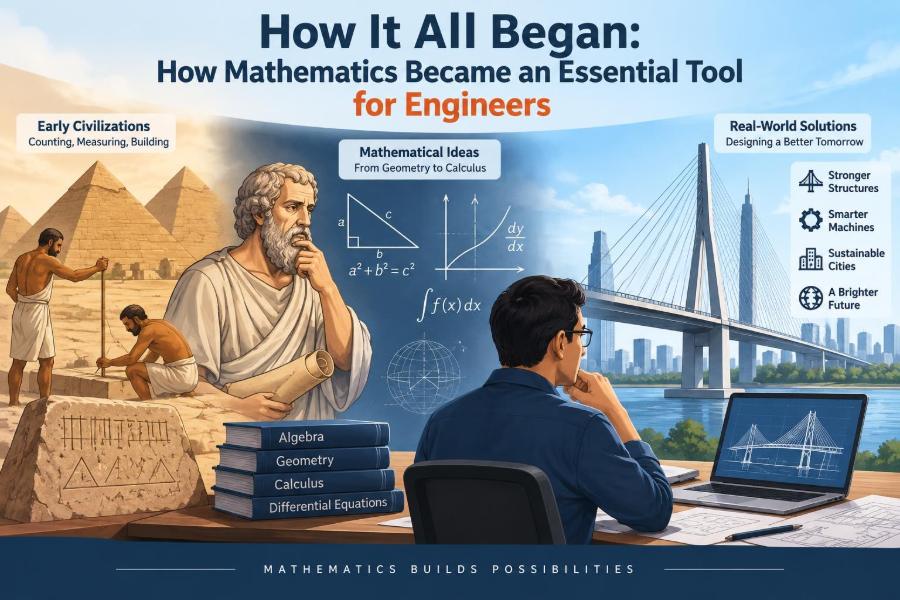

A bridge sways slightly when traffic crosses it. A phone maps a route in seconds. A water-treatment plant keeps flow and pressure within safe limits. None of these systems works by intuition alone.
Engineers must turn real conditions—loads, motion, heat, uncertainty, cost, and material limits—into decisions that can be checked before anything is built. Mathematics is the language that makes that translation possible.
For students, this can make an equation-heavy course feel less abstract. For working professionals, it explains why familiar tools such as spreadsheets, simulation software, and design standards still rest on mathematical ideas developed over many centuries.
The story is not that mathematics appeared first and engineering followed. People built roads, buildings, machines, and ships long before modern equations existed. But as engineering problems became larger, riskier, and less forgiving, mathematics became the tool that allowed experience to become reliable prediction.
🏗️ Engineering Began as Practical Problem-Solving
Early engineering was closely tied to craft knowledge. Builders learned which shapes stood up, which soils settled, and which materials failed by observing previous work.
This knowledge was valuable, but it was often local and difficult to transfer. A method that worked for a short stone span in one location might fail for a longer bridge, a different foundation, or an unfamiliar material.
Mathematics offered a way to describe relationships rather than memorize isolated rules. Instead of saying “make this beam thick,” an engineer could ask how thickness must change when span or load changes.
📏 Measurement Created the First Common Language
Before a structure can be designed, it must be measured. Length, area, volume, angle, mass, and time made it possible to compare a proposed design with the physical world.
Land surveying drove much of this development. When boundaries, irrigation channels, or building layouts had to be set out accurately, geometry became more than a classroom subject: it became a working tool.
Measurement is never perfectly exact. Good engineering therefore considers tolerance, the permitted variation in a dimension or result, rather than pretending every value is absolute.
🔺 Geometry Turned Shapes into Design Decisions
Geometry studies shape, position, distance, and angle. Its early engineering value was immediate: laying out right angles, estimating areas, calculating volumes, and creating repeatable proportions.
A surveyor can use triangles to determine the width of a river without crossing it. A builder can use geometric layout to place columns on a grid. A machinist can use angles and radii to define a component precisely.
Geometry also reveals why shape matters. An arch redirects load mainly into compression, while a flat beam must resist bending. The material may be the same, but the geometry changes the structural behavior.
🌊 Civilizations Used Mathematics Before Modern Engineering Existed
Ancient societies used arithmetic and geometry in construction, agriculture, navigation, and administration. Large projects required records of materials, labor, dimensions, and seasonal conditions.
It is tempting to treat historic structures as proof that formal analysis is unnecessary. They instead show that observation, empirical rules, skilled labor, and practical mathematics can achieve remarkable results.
What later changed was the ability to explain and extend such success. Mathematical models made it easier to adapt a known solution to a new scale or condition rather than relying solely on trial and error.
⚖️ Mechanics Connected Force to Motion
A major step came when mathematics was used to describe motion and forces systematically. Mechanics is the branch of science that studies bodies at rest or in motion under the action of forces.
For a stationary object, equilibrium is the key idea: the forces and turning effects must balance. This lets an engineer determine reactions at supports, forces in truss members, or the load carried by a cable.
For moving systems, forces determine acceleration. That connection is central to vehicles, cranes, robots, machinery, and vibration analysis.
🧱 Static Structures Needed More Than Rules of Thumb
A beam supporting a floor does not merely carry a weight; it bends, shears internally, and transfers force to its supports. These effects vary along the beam’s length.
Statics provides a first model by balancing forces and moments. A moment is the turning effect of a force about a point, like the extra leverage obtained by pushing a door near its handle rather than close to its hinge.
This analysis does not eliminate engineering judgment. Real structures involve connections, imperfect construction, changing loads, and material variation. But it gives a disciplined starting point for identifying where critical forces occur.
🌀 Calculus Made Change Calculable
Geometry is excellent for fixed shapes. Engineering also needs to describe quantities that change continuously: velocity, temperature, pressure, electrical current, and deflection.
Calculus provides two complementary tools. Differentiation describes a rate of change, while integration accumulates many small contributions into a total.
For example, velocity is the rate at which position changes. The area under a load distribution can represent a total force. These ideas made it possible to analyze systems whose behavior changes across space or over time.
🚂 Industrial Machines Raised the Stakes
As engines, factories, railways, and large-scale production developed, engineering decisions affected greater power, speed, and public safety. A design error could no longer be treated as a minor inconvenience.
Machines introduced rotating parts, fatigue from repeated loading, heat transfer, fluid flow, and control of energy. Each problem required quantities to be related, estimated, and checked.
Mathematics did not replace workshop experience. It helped engineers decide which concepts to test, which dimensions mattered most, and whether a proposed design was plausible before costly fabrication.
🔥 Energy Unified Many Engineering Problems
Energy provides a powerful accounting framework. It can be stored, transferred, converted, or dissipated, but a correct model must keep track of where it goes.
In mechanical engineering, energy may move between motion, height, elastic deformation, and heat. In electrical systems, it may be stored in magnetic or electric fields and then delivered to a load.
An energy balance can sometimes solve a problem more simply than listing every individual force. For a falling object, for instance, loss of gravitational potential energy helps predict speed—provided air resistance is either modeled or reasonably neglected.
💧 Fluid Flow Demanded Models of the Invisible
Water in a pipe, air around an aircraft, and oil through a hydraulic system are difficult to inspect at every point. Engineers therefore use pressure, velocity, density, and flow rate as measurable descriptions.
Fluid mechanics combines conservation principles with mathematical equations. The resulting models help size pipes, estimate pump requirements, predict pressure losses, and understand lift and drag.
Fluid behavior can become highly complex, especially when flow is turbulent. In such cases, a simple equation may provide an estimate, while testing or computational simulation is needed for higher confidence.
⚡ Electrical Engineering Made Abstract Quantities Useful
Voltage and current cannot be seen directly, yet they can be measured and modeled. Circuit equations link voltage, current, resistance, capacitance, and inductance into relationships that guide practical design.
Complex numbers later became especially useful for alternating-current analysis. They provide a compact way to represent both magnitude and phase, meaning the timing offset between repeating signals.
The notation may look abstract, but the purpose is practical: predicting how motors, filters, power systems, and communication circuits respond to changing electrical signals.
📊 Algebra Made Relationships Portable
Algebra uses symbols to express general relationships. This is what lets an engineer solve a whole class of problems rather than only one numerical example.
Consider a simple resistance relationship: V = IR. Once the relationship is known, a designer can calculate current from voltage and resistance, or rearrange it to select a resistance for a desired current.
The deeper value is portability. A formula can be checked, reused, incorporated into software, and applied to different dimensions or operating conditions.
🧮 Linear Algebra Scaled Engineering Up
Many engineering systems involve multiple quantities influencing one another at once. Linear algebra organizes these relationships using vectors and matrices.
A structural model may have many connected joints. A circuit may have many unknown currents. A matrix can represent all the equations together, allowing a computer to solve them systematically.
Linear methods are not appropriate for every system. Materials can yield, flows can become turbulent, and controls can saturate. Still, linear approximations are often extremely useful near a chosen operating condition.
📉 Differential Equations Described System Behavior
A differential equation relates a quantity to one or more of its rates of change. It is the mathematical form behind many models of vibration, heat conduction, population-independent chemical reactions, and electrical transients.
Imagine a spring carrying a mass. Its position changes over time, and that motion depends on spring force, inertia, and damping. A differential equation captures that interaction.
The solution is not always a tidy formula. Engineers often solve differential equations numerically, using carefully chosen time or distance increments and checking whether the answer stabilizes as the increments become smaller.
🌡️ Heat Transfer Showed Why Gradients Matter
Heat naturally moves from warmer regions to cooler regions, but the rate depends on material properties, geometry, temperature difference, and the mode of transfer.
A gradient describes how rapidly a quantity changes with position. A steep temperature gradient through a wall generally drives stronger conductive heat flow than a gentle one.
These ideas influence insulation, electronics cooling, engines, refrigeration, and building design. They also show why an average temperature alone may hide a critical local overheating problem.
🧪 Materials Required Statistics, Not Just Nominal Values
Real materials vary. Two samples with the same specification can differ because of composition, manufacturing history, microscopic defects, or environmental exposure.
Statistics helps engineers describe variation and make decisions with incomplete information. Instead of treating one test result as universal, a design process may consider distributions, sample sizes, and conservative characteristic values.
This does not mean every project requires advanced statistical analysis. It means that a reported “strength” or “lifetime” needs context: how was it measured, under what conditions, and how variable is it likely to be?
🎯 Probability Brought Uncertainty into the Model
Some engineering inputs are inherently uncertain. Wind varies, traffic loads fluctuate, component dimensions have tolerances, and measurements include noise.
Probability gives a structured way to represent uncertain events and ranges rather than hiding them inside a single assumed number. It supports risk-based thinking in reliability, quality control, forecasting, and safety assessment.
A probability model is only as useful as its assumptions. Using a sophisticated distribution with poor input data can create false confidence, so engineering judgment remains essential.
🛡️ Safety Factors Acknowledge What Models Miss
No mathematical model captures every detail of a real system. Designers account for this using safety factors, design margins, testing, codes, inspections, and conservative assumptions where appropriate.
A factor of safety is not a substitute for understanding failure. It is a margin between expected demand and available capacity, chosen in relation to uncertainty and the consequences of failure.
Too little margin can be unsafe. Excessive margin can make a product unnecessarily heavy, expensive, or inefficient. Mathematics helps quantify trade-offs, but acceptable risk is also shaped by standards, context, and professional responsibility.
🔬 Experiments Keep Equations Honest
Engineering mathematics is strongest when it is tied to observation. An equation begins with assumptions about the system, and experiments reveal whether those assumptions are adequate.
Wind-tunnel testing, material tests, sensor measurements, prototype trials, and field monitoring all provide evidence for model calibration and validation. Calibration adjusts uncertain parameters; validation checks whether the model predicts behavior it was not fitted to.
A model can match one dataset yet fail elsewhere. Engineers should ask whether test conditions represent the real operating range, including unusual but credible conditions.
💻 Computers Changed the Scale, Not the Principles
Computers can solve thousands or millions of equations quickly, making methods such as finite element analysis, computational fluid dynamics, and optimization widely available.
Finite element analysis divides a complex object into many small pieces and approximates behavior across them. It can reveal stress concentrations or deflection patterns that would be difficult to estimate by hand.
However, software does not know whether the boundary conditions, material properties, contacts, or loads entered by the user are realistic. A colorful contour plot is an output, not automatic evidence of a correct design.
🧩 Models Are Useful Simplifications
A model deliberately leaves out some details to focus on the behavior that matters. A beam model may assume small deflections; a circuit model may ignore parasitic effects; a thermal model may treat a material as uniform.
The right question is not “Is this model perfectly true?” but “Is it accurate enough for this decision?” That depends on the required precision, safety consequences, available data, and cost of further analysis.
Good engineers state assumptions clearly. This makes a calculation reviewable and tells others where the result may stop being reliable.
🧱 Units Prevent Surprisingly Serious Errors
Numbers without units are incomplete in engineering. A value of 20 could mean 20 millimetres, 20 metres, 20 seconds, or 20 megapascals—each leading to very different decisions.
Dimensional analysis checks whether the units in an equation are compatible. If one side represents energy and the other reduces to force, something is wrong even before any numbers are entered.
Unit mistakes can occur when calculations pass between teams, software packages, or measurement systems. Keeping units visible through a calculation is a simple habit with major practical value.
🧠 Estimation Remains a Core Engineering Skill
Modern tools make exact-looking answers easy to produce. Estimation helps determine whether those answers make physical sense.
Before accepting a calculated pump power, an engineer can estimate the likely order of magnitude from flow rate and pressure rise. Before accepting a beam deflection, they can ask whether the result is closer to a hair’s width or a room’s width.
These checks do not replace detailed analysis. They catch misplaced decimal points, inconsistent units, implausible assumptions, and software setup errors early.
🗺️ Optimization Turned “Works” into “Works Well”
Engineering rarely has a single goal. A vehicle part may need to be light, strong, inexpensive, manufacturable, and durable. Improving one objective can worsen another.
Optimization uses mathematics to search for the best design according to stated objectives and constraints. Constraints are non-negotiable limits such as maximum stress, available space, regulations, or a required operating temperature.
The result depends on what has been included. A design optimized only for minimum mass may be difficult to manufacture or repair, so problem formulation matters as much as the algorithm.
🤖 Control Theory Let Engineers Manage Change
Many systems must respond continuously rather than simply operate once. A thermostat regulates temperature, cruise control adjusts vehicle speed, and a robot corrects its position.
Control theory uses feedback: the system measures an output, compares it with a target, and adjusts an input. Mathematical models help predict whether the response will be stable, sluggish, oscillatory, or overly sensitive to noise.
Feedback can improve performance, but poorly tuned feedback can amplify errors. This is why control design considers delays, sensor limitations, actuator limits, and disturbances from the real environment.
🧾 Engineering Standards Convert Knowledge into Practice
Equations alone do not define a responsible design process. Standards and codes translate accumulated knowledge, testing experience, and safety expectations into practical requirements.
They may specify load combinations, material testing methods, documentation, inspection, or acceptable calculation procedures. Engineers must understand which requirements apply to their field and location.
Following a standard is not the same as switching off judgment. Novel designs, unusual environments, and interactions between systems may require analysis beyond a minimum requirement.
🚧 Common Mathematical Mistakes in Engineering Work
Many failures in analysis are not advanced-mathematics failures. They begin with a poorly defined problem, a missing load case, an incorrect sign convention, or a number copied into the wrong cell.
- Using a formula outside its assumptions: for example, applying a small-deflection beam model to a heavily deformed component.
- Confusing accuracy with precision: many decimal places do not make an uncertain input trustworthy.
- Ignoring boundary conditions: supports, constraints, and interfaces often control the result.
- Skipping independent checks: a hand estimate or alternate method can expose a hidden error.
Careful documentation, peer review, and clear diagrams are mathematical safety tools as much as organizational ones.
🎓 Learning Mathematics as an Engineer
The most effective approach is to connect each topic to a physical question. When learning derivatives, ask what is changing and why its rate matters. When learning matrices, ask what set of connected unknowns they organize.
Practice should include both symbolic work and interpretation. Solving an equation is only half the task; the other half is explaining what the result means, what units it has, and whether it is plausible.
A useful study routine is:
- Sketch the system and label knowns, unknowns, directions, and units.
- State assumptions before selecting equations.
- Perform the calculation carefully.
- Check units, limiting cases, and approximate magnitude.
- Write one sentence explaining the engineering implication.
🔗 The Core Principle: Mathematics Makes Engineering Testable
Engineering mathematics became essential because it makes design reasoning visible. It converts observations and requirements into models that can be calculated, challenged, compared, and improved.
Its power does not come from producing impressive formulas. It comes from linking a physical system to a defensible prediction while making assumptions and uncertainty explicit.
From ancient geometry to modern simulation, the pattern remains the same: measure the world, build a suitable model, test it against reality, and revise the design when evidence demands it.
Mathematics is essential to engineering because it turns practical ideas into predictions that can be checked before those ideas become real structures, machines, and systems. That is how engineers move from “this might work” to “here is why it should work, and where its limits are.” 📐⚙️🌍