
A pump curve looks reasonable on screen, but the installed system delivers less flow than expected. A structural spreadsheet returns a neat answer, yet a small unit mismatch has quietly changed the loading by a factor of one thousand. A simulation converges after thousands of iterations, although nobody has checked whether it converged to the right physical solution.
These situations are familiar because engineering calculations are rarely wrong for just one dramatic reason. More often, accuracy is lost through a chain of small decisions: a vague objective, uncertain input data, an inappropriate model, a hidden assumption, or an unchecked result.
Better accuracy is not simply a matter of using more decimal places or buying more computing power. It means building a dependable path from a physical question to a decision, while understanding the uncertainty that remains.
That discipline matters whether the task is a hand calculation, a finite-element model, a process simulation, a spreadsheet estimate, or embedded control software. The following practices make numerical work more trustworthy, more efficient to review, and less likely to mislead.
🎯 Begin with the decision, not the equation
Every calculation should start by stating what decision it will support. Is the aim to size a beam, compare two heat-exchanger concepts, estimate pressure drop, or determine whether a design meets a safety limit?
This question sets the required accuracy. Early concept selection may only need the correct order of magnitude, while a final manufacturing tolerance or protection setting may demand a much tighter result. Seeking high precision before defining the decision wastes effort and can create false confidence.
- Define the output quantity, units, and acceptable uncertainty.
- State the operating conditions and load cases being considered.
- Identify the consequence if the result is wrong.
- Record who will use the result and what action they may take.
🧭 Separate accuracy, precision, and uncertainty
Accuracy describes closeness to the real physical value. Precision describes repeatability or numerical detail. A calculation can produce 12 identical decimal places and still be inaccurate because its material property, boundary condition, or governing assumption is wrong.
Uncertainty is the range of plausible values caused by imperfect knowledge, measurement variation, model simplification, and numerical approximation. Reporting it is not a weakness; it tells others how much reliance the result can support.
For example, reporting a predicted temperature as 72.438°C is rarely meaningful if the convection coefficient is only approximately known. A rounded value with a stated sensitivity is often more useful.
📏 Choose the right level of model fidelity
A model is a purposeful simplification, not a duplicate of reality. The best model contains the physics that materially affect the decision and omits detail that does not.
A one-dimensional conduction model may be appropriate for a long insulated pipe with nearly uniform surroundings. It may be inadequate near a flange, a thermal bridge, or a local heat source, where multidimensional effects control the answer.
Increasing fidelity has costs: more inputs, longer runtimes, harder review, and more opportunities to introduce uncertain parameters. Use a simpler model first when possible, then add complexity only when a sensitivity check shows it matters.
🔍 Write assumptions where reviewers can find them
Hidden assumptions are among the most common sources of misleading results. Put them near the calculation, not only in the analyst’s memory or an informal conversation.
Useful assumptions are specific: “steady state,” “small deflection,” “incompressible flow,” “uniform heat generation,” or “linear elastic material below yield.” Each should be plausible for the actual operating range.
- State assumptions about geometry, symmetry, supports, and contacts.
- State whether properties are constant or temperature-dependent.
- Distinguish measured inputs from estimates and conservative values.
- List excluded effects, such as vibration, radiation, corrosion, or transient loading.
If an assumption is uncertain but influential, it should become a scenario to test rather than a sentence to overlook.
🧱 Build a traceable input-data chain
The output cannot be more reliable than the inputs that dominate it. Create an input register for important variables: value, unit, source, date, range, owner, and any conversion applied.
This is especially valuable when values pass through drawings, supplier sheets, test reports, spreadsheets, and simulation files. Traceability lets a reviewer answer a basic question quickly: where did this number come from?
For geometry, distinguish nominal dimensions from measured as-built dimensions. For material properties, check whether the quoted value applies at the relevant temperature, strain rate, moisture condition, or manufacturing state.
🔢 Control units before they control the result
Unit errors can survive review because the arithmetic may be internally correct. The failure occurs when a value in millimetres is treated as metres, a pressure is confused with a force, or a gauge value is used where an absolute value is needed.
Use one consistent unit system within a calculation where practical. Attach units to named variables, input cells, axes, tables, and final outputs. Dimensional analysis should be part of the working process, not an emergency check at the end.
For a quick example, pressure drop from a friction relation must end in pressure units. If intermediate terms leave dimensions of force or energy per mass, the formula or unit conversion deserves immediate inspection.
🧮 Scale equations to avoid numerical trouble
Computers represent numbers with finite precision. Calculations can become unstable when they combine quantities with vastly different magnitudes, subtract nearly equal large numbers, or raise poorly scaled variables to high powers.
Non-dimensionalization rescales variables using characteristic values, such as a reference length, velocity, temperature difference, or pressure. This often makes coefficients near unity and helps reveal which physical effects dominate.
Even in spreadsheets, sensible scaling helps. Store a small clearance as 0.25 mm rather than 0.00025 m if the surrounding formulae and units are designed consistently, then convert deliberately at interfaces.
🧠 Select numerical methods that fit the problem
Not every equation should be solved with the same method. Root finding, numerical integration, ordinary differential equations, optimization, and large sparse linear systems each have methods with different strengths and failure modes.
A fast method may require a good initial estimate. For instance, Newton-type root finding can converge quickly near a smooth root but may diverge or settle on an unintended root when started poorly. A slower bracketing method can be safer when the function is discontinuous or poorly understood.
Choose methods based on smoothness, stiffness, constraints, expected solution count, and the cost of a wrong answer—not only on speed.
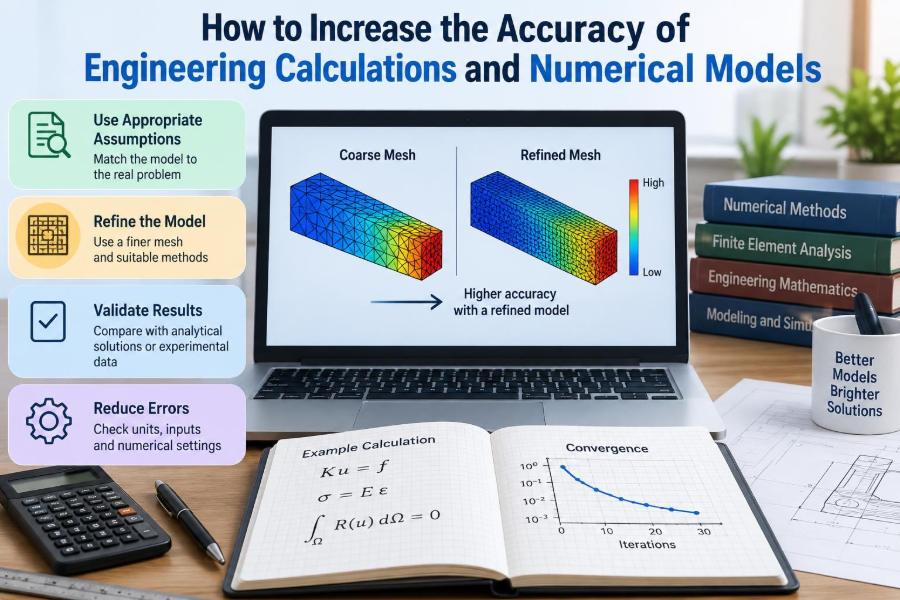
🕸️ Check mesh and time-step independence
In finite-element, finite-volume, and finite-difference models, the mesh or grid replaces a continuous field with discrete points or elements. In transient models, time is also divided into finite steps. Both choices affect the answer.
Run a refinement study: solve with a baseline mesh or time step, refine it systematically, and compare the quantity that matters. A local peak stress, total heat transfer, and pressure drop may converge at very different rates.
Do not assume that a visually fine mesh is adequate. Thin boundary layers, sharp corners, contact regions, shock-like gradients, and moving interfaces often require deliberate local refinement.
⏱️ Distinguish stable results from converged results
A solver may report convergence because its residual has fallen below a threshold. That does not automatically mean the physical output is stable or correct. Residuals measure equation imbalance in a particular numerical formulation; they are not a universal accuracy certificate.
Monitor both solver diagnostics and engineering quantities: force balance, mass balance, energy balance, reaction forces, outlet temperature, maximum displacement, or total flow rate. These outputs should stop changing materially as iterations continue.
For nonlinear problems, inspect iteration histories. Oscillation, abrupt jumps, or sensitivity to tiny changes in relaxation settings can indicate multiple solutions, poor conditioning, or an unsuitable setup.
⚖️ Preserve conservation laws
Many engineering systems are governed by conservation of mass, momentum, energy, charge, or species. These balances offer powerful checks because they are independent of many model details.
For a steady pipe network, total inflow should match total outflow within an appropriate numerical tolerance. For a thermal model, generated heat should be balanced by heat stored or removed through boundaries. A mismatch may point to an incorrect boundary condition, sign convention, or coding error.
Conservation checks are particularly valuable after changing geometry, adding a source term, or coupling two software tools.
🧷 Apply boundary conditions with physical care
Boundary conditions often influence a model more than the governing equation. A beautifully detailed geometry cannot compensate for an unrealistic restraint, inlet profile, contact condition, ambient temperature, or load distribution.
Ask what the real system can actually do. A support labeled “fixed” in software may be free to rotate in reality. A prescribed uniform temperature may represent a complicated convection environment only approximately.
Where the condition is uncertain, test credible alternatives. The spread in results may be more informative than choosing one convenient boundary condition and treating it as fact.
🧩 Model geometry and interfaces deliberately
Geometric simplification can save substantial time, but it can also remove the feature that controls failure or performance. Holes, fillets, gaps, weld transitions, seals, roughness, and contact patches should be judged by their effect, not by their visual complexity.
Interfaces need similar attention. Perfectly bonded contact, frictionless sliding, thermal resistance, leakage, and electrical contact resistance represent very different physical behaviours. Selecting a default contact setting without justification can dominate the answer.
Use symmetry only when the load, geometry, material response, and boundary conditions genuinely preserve that symmetry.
🧪 Use material properties in their valid range
Material data are not universal constants. Elastic modulus, strength, conductivity, viscosity, density, and fatigue behaviour can vary with temperature, frequency, direction, chemical environment, manufacturing route, and ageing.
A linear elastic analysis may be suitable for a small service-load deformation, but not for forming, impact, creep, plastic collapse, or large cyclic strain. Likewise, a constant fluid viscosity may be acceptable over a narrow temperature range but not across a strongly heated process.
When data are sparse, state the limitation and assess how the plausible range affects the outcome. Avoid implying that a database value describes every specimen and condition.
🧫 Verify the implementation before trusting outputs
Verification asks whether the equations and numerical method were implemented correctly. It is different from validation, which asks whether the model represents the real system adequately.
Useful verification tests include cases with known analytical solutions, manufactured solutions designed to exercise code paths, simple limiting cases, and comparison with an independent implementation. A beam model, for example, can be checked first against a textbook cantilever case before it is used on a complex frame.
Automated regression tests are valuable for code and recurring spreadsheets. They detect when a later edit changes a previously correct result.
🏭 Validate against reality when data exist
Validation compares model predictions with relevant measurements or observed system behaviour. The comparison should match the intended use: validating average outlet temperature does not automatically validate local wall temperature or peak stress.
Measurements also have uncertainty, imperfect sensor placement, and operating variation. A disagreement does not always mean the model is wrong, but it should prompt investigation of both the model and the test conditions.
When experimental data are unavailable, use benchmark cases, established correlations within their published applicability, and independent physical reasoning. Be explicit that confidence is lower than for a directly validated model.
🔁 Compare independent routes to the answer
One of the strongest practical checks is an independent estimate. It need not be as detailed as the main model; in fact, a simpler method is often better because it is less likely to repeat the same mistake.
Compare a computational fluid dynamics pressure drop with a hand calculation from a suitable friction-factor relation. Compare a finite-element deflection with beam theory. Compare a process simulation energy duty with an enthalpy balance.
If the answers differ, do not average them. Find the source: differing assumptions, property values, geometry, correlations, or numerical settings often reveal the issue.
📊 Perform sensitivity analysis, not guesswork
Sensitivity analysis changes one input or assumption at a time, or varies several systematically, to see how much the output responds. It identifies the quantities worth measuring more carefully and the assumptions that deserve review.
Suppose a heat-loss estimate depends on insulation thickness, wind speed, surface emissivity, and ambient temperature. If insulation thickness changes the result very little over its tolerance range while wind speed changes it substantially, effort should focus on the external convection condition.
Local sensitivity is useful near a baseline design. For wider ranges or interacting variables, scenario sweeps or structured sampling provide a more complete picture.
🎲 Treat uncertainty as a range of outcomes
When important inputs vary, a single “best estimate” can hide decision-relevant risk. Represent uncertain inputs by credible ranges or distributions when sufficient information exists, then propagate them through the model using scenarios or repeated calculations.
The output may be a range, a set of percentiles, or a conservative envelope rather than one number. The appropriate format depends on the decision and the quality of available input information.
Do not assign elaborate probability distributions merely to make uncertainty look rigorous. If knowledge is limited, transparent bounded scenarios are often more defensible.
🛡️ Use safety factors for their intended role
Safety factors and design margins account for some combination of uncertainty, variability, consequences, and accepted design practice. They are not a substitute for checking the model.
Applying a large factor to an incorrect load path, omitted failure mode, or invalid material model can still produce an unsafe design. Conversely, stacking unrelated conservatisms without understanding them can lead to unnecessary cost or an impractical design.
Keep model uncertainty separate from formal code or organizational design factors where possible. This makes the reasoning auditable and avoids accidentally counting the same uncertainty twice.
🧾 Make spreadsheets auditable
Spreadsheets are powerful because they are accessible, but their flexibility makes silent errors easy to introduce. A copied formula, hidden row, overwritten constant, or circular reference can affect many downstream cells.
Good spreadsheet practice includes named inputs, protected formula cells, visible units, clear separation of inputs and outputs, and a change log for critical models. Avoid embedding unexplained constants inside long formulae.
Use check cells for balances, limiting cases, and expected signs. A result that suddenly changes when a noncritical input is edited should be investigated, not dismissed as “spreadsheet behaviour.”
💻 Make code readable and testable
Calculation code should communicate intent. Use descriptive variable names, small functions, explicit unit handling where feasible, and comments that explain decisions rather than restating syntax.
Version control protects the history of a model and makes it possible to compare changes. Record the software version, key libraries, solver settings, random seed where relevant, and input dataset used for an important result.
Peer review is more effective when another engineer can reproduce the result without guessing which file, parameter set, or hidden preprocessing step was used.
👀 Review the result visually and physically
Plots often expose problems that tables conceal. Examine deformed shapes, contours, flow streamlines, time histories, residual histories, and distributions along meaningful paths.
Look for nonphysical patterns: a temperature jump where no thermal resistance exists, velocity through a wall, stress singularity treated as a material failure, or a pressure rise across a passive restriction. Colour scales can mislead, so inspect actual values and use consistent limits when comparing cases.
A physical walk-through helps too: trace where force enters and leaves a structure, where energy is generated and removed, or where fluid can realistically flow.
🚨 Recognize warning signs early
Certain behaviours should trigger a pause rather than a quick acceptance. They do not prove the result is wrong, but they identify a calculation that needs stronger evidence.
- Outputs change sharply with small mesh, time-step, or solver-setting changes.
- Results violate a conservation balance or a basic limiting case.
- A value has an unexpected sign, unit, trend, or order of magnitude.
- Peak values occur at idealized point loads, sharp corners, or constraints.
- The model matches an expected answer only after unexplained parameter tuning.
Developing this skepticism is a professional advantage. Numerical output is evidence to evaluate, not an authority to obey.
🧷 Avoid false precision in reporting
Round outputs to a level justified by the input quality and purpose. Excess digits imply knowledge that the calculation may not possess.
Report the basis alongside the result: operating case, principal assumptions, model version, applicable range, and significant uncertainties. For a design decision, include the governing load case and acceptance criterion, not only the final number.
A concise statement such as “predicted pressure drop is approximately 18 kPa under the stated nominal flow condition” is clearer than a long decimal without context.
🗂️ Document enough for reproduction
A future reviewer should be able to understand what was done, reproduce the essential result, and identify what changed. Documentation does not need to be a lengthy report for every task, but it should match the consequence and complexity of the decision.
At minimum, retain the problem statement, inputs, assumptions, equations or software setup, verification checks, results, and conclusions. For high-consequence work, include review records, validation evidence, uncertainty treatment, and configuration control.
Good documentation also prevents an old model from being reused outside the conditions for which it was created.
🤝 Use peer review as an engineering tool
An independent reviewer can spot assumptions that seem invisible to the person who built the model. The most productive reviews begin with the physical problem and decision, then move through inputs, setup, checks, and interpretation.
Ask reviewers to challenge the model’s applicability, not merely inspect arithmetic. A short review using a checklist can catch unit errors, missing load cases, inconsistent constraints, and unsupported conclusions before they reach a design release.
For complex work, divide review into stages so that an incorrect model concept is not discovered only after detailed meshing and post-processing.
🔄 Update models as evidence changes
Engineering models should evolve when new measurements, drawings, operating data, or failure observations become available. A model that was reasonable during concept design may become unsuitable once as-built tolerances or real duty cycles are known.
Track what changed and why. If a revised result differs substantially, determine whether the change comes from physics, geometry, inputs, numerical settings, or post-processing. This maintains confidence and helps teams learn from the difference.
Updating does not mean endlessly tuning a model until it agrees with a preferred answer. Changes should have a physical rationale and remain traceable.
🧰 Match the workflow to consequence
Not every calculation needs the same level of formal control. A quick internal estimate can use simple checks and documented assumptions, while a result affecting safety, compliance, major expenditure, or irreversible manufacturing needs stronger verification, review, and records.
| Decision context | Appropriate emphasis |
|---|---|
| Early feasibility estimate | Order of magnitude, transparent assumptions, sensitivity to key inputs |
| Design comparison | Consistent cases, independent checks, uncertainty ranking |
| Detailed design release | Validated inputs, convergence evidence, review, traceable documentation |
| High-consequence assessment | Formal verification, validation evidence, configuration control, independent review |
More rigor should be directed where error has the greatest consequence, rather than applied uniformly to every model.
📐 Build accuracy through a defensible chain
The central lesson is that calculation accuracy is a system property. Reliable answers come from a clear purpose, appropriate physics, trustworthy inputs, sound numerical settings, independent checks, and honest communication of uncertainty.
Start simple enough to understand the dominant behaviour. Check units, balances, limiting cases, and trends. Refine only where the result is sensitive, then validate against reality whenever relevant evidence is available.
A numerical result becomes useful when its assumptions, limits, and checks are as visible as its final value. That is how engineering calculations become not merely more detailed, but more dependable.
Better engineering accuracy comes from disciplined reasoning at every step—not from extra decimal places alone. Treat each model as a testable argument about the physical world, and your conclusions will be clearer, safer, and easier to trust. 📐🔍⚙️