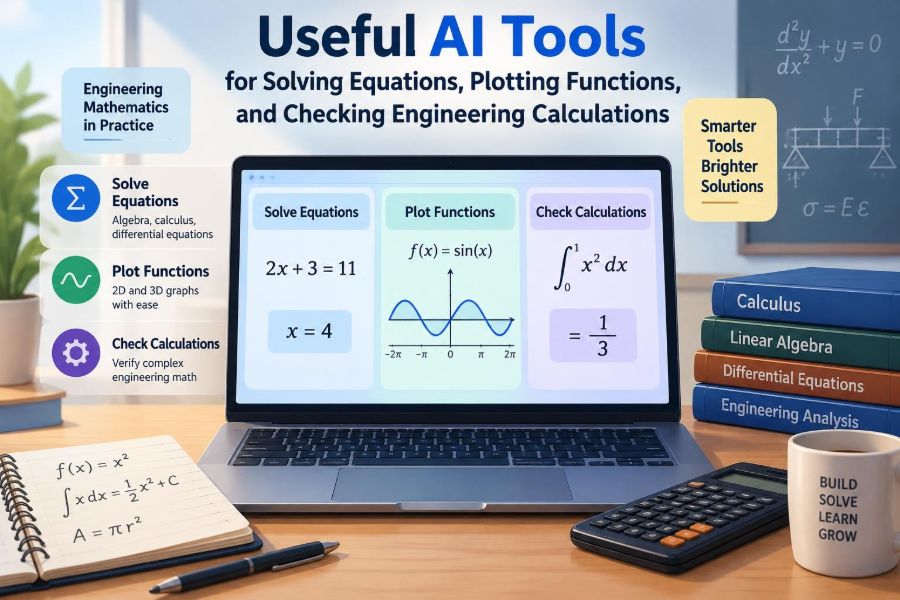

A pump-sizing calculation, a beam-deflection formula, or a control-system model can look perfectly manageable until one sign is reversed, a unit is mixed, or a root is selected without checking what it means physically. The arithmetic may take seconds; finding the mistake can take an afternoon.
AI-assisted mathematics tools can reduce that friction. They can rearrange equations, produce symbolic derivations, draw response curves, generate code, and suggest ways to verify a result. Used well, they turn routine calculation work into a faster feedback loop.
But engineering is not a contest to obtain an answer first. A numerical result has to satisfy units, boundary conditions, material limits, assumptions, and the actual system being designed or operated.
The most useful approach is therefore not to hand a problem to a tool and accept its output. It is to use AI and mathematical software as reasoning assistants and independent checkers, while retaining responsibility for the model and its engineering interpretation.
🧭 Start with the engineering question
Before choosing a tool, state what must be found. “Solve this equation” is often too narrow. You may need a flow rate that meets a pressure requirement, a resonant frequency within an operating range, or a curve showing where a design becomes infeasible.
Write the unknown, known quantities, units, expected range, and acceptance criterion. This short setup prevents a tool from solving a mathematically valid problem that is not the problem you intended.
🤖 What AI math tools actually do
The phrase “AI tool” covers several different capabilities. A conversational model can explain notation, formulate equations, or write analysis code. A computer algebra system can manipulate expressions exactly. Graphing and numerical programs evaluate models and visualize results.
Many platforms combine these capabilities, but they are not interchangeable. A fluent explanation is not evidence that a symbolic transformation or numerical calculation is correct. Treat each output according to the engine and method behind it.
🧰 A practical tool landscape
| Tool category | Best use | Primary caution |
|---|---|---|
| Conversational AI | Explaining methods, translating prose into equations, drafting code | May invent steps or misread ambiguous notation |
| Symbolic algebra systems | Exact solving, differentiation, integration, simplification | Conditions and domains may be omitted from a compact answer |
| Graphing tools | Function shape, roots, intersections, parameter effects | A graph window can hide features or create visual illusions |
| Numerical computing tools | Large systems, simulation, optimization, repeated calculations | Results depend on algorithms, tolerances, and implementation |
| Spreadsheets | Transparent tabulation, quick scenarios, design checks | Cell references and hidden unit inconsistencies are easy to miss |
The strongest workflow often uses more than one category. A symbolic result can be evaluated numerically, while a graph supplies a visual check on both.
📝 Give the tool a complete mathematical prompt
Ambiguity is a frequent source of wrong answers. Use parentheses generously, specify angle units, state whether variables are real or complex, and distinguish a decimal point from a thousands separator according to the software convention.
A useful prompt includes the equation, variable, domain, parameter values, units where relevant, and desired form of the answer. For example: Solve 0.5x^2 - 3x + 4 = 0 for real x, then evaluate the residual of each root.
🔣 Use symbolic solvers for structure, not just answers
Symbolic tools are especially useful when a parameter should remain visible. Solving a heat-transfer expression for area, for example, shows directly how area varies with heat duty, overall coefficient, and temperature difference.
This form helps engineers inspect sensitivity and dimensional consistency. A decimal answer may be enough for one case, but an algebraic form often reveals the design relationship behind many cases.
🧩 Ask for assumptions and solution conditions
An equation can have different answers depending on its domain. The expression sqrt(x^2) is |x| for real x, not automatically x. Dividing by an expression can discard the case where that expression is zero.
Ask the tool to list restrictions introduced by denominators, logarithms, square roots, and substitutions. In engineering, also ask which mathematical roots are physically admissible.
🪜 Inspect the derivation one step at a time
When a result matters, request a derivation with named steps rather than only a final expression. This is useful for checking sign conventions in mechanics, exponent handling in empirical correlations, and rearrangements in circuit equations.
Do not assume a long derivation is reliable because it looks detailed. Check the transitions where errors commonly enter: expansion of brackets, division, substitution, and conversion between forms.
🔁 Substitute answers back into the original equation
The simplest equation check is substitution. Put each proposed solution into the original equation, not merely a rearranged version, and calculate the residual: the left side minus the right side.
For an exact symbolic result, the residual should simplify to zero under the stated assumptions. For a numerical solution, it should be small relative to the scale and tolerance of the problem. A residual of 0.001 is excellent in one model and unacceptable in another.
📏 Make dimensional analysis a non-negotiable check
AI can manipulate symbols without knowing whether they represent metres, seconds, kilograms, or degrees Celsius. You must enforce dimensions. Every additive term in an equation must have the same dimensions, and the dimensions on both sides must match.
If a computed pipe velocity is expressed in square metres or a calculated stress has units of newtons, stop before interpreting the number. Unit errors often expose an incorrect formula, conversion, or input definition.
🌡️ Keep unit conversions outside the black box when possible
Convert quantities to a coherent unit system before solving, then label the answer clearly. Mixing millimetres with metres or kilopascals with pascals within a single prompt makes mistakes harder to trace.
Temperature deserves particular care. Temperature differences can be expressed in Celsius or kelvin with the same numerical increment, but absolute-temperature equations, such as gas-law calculations, require an absolute scale.
📉 Plot before you trust a root
A plot is one of the quickest sanity checks for a nonlinear equation. If you solve f(x)=0, graphing f(x) over the meaningful range lets you see crossings, tangencies, discontinuities, and regions where the model is invalid.
A solver may return several roots, including values outside a feasible operating range. A graph adds context that a list of numbers cannot provide.
🔍 Choose a graph window deliberately
Default graph bounds are not engineering evidence. A narrow range may miss a second intersection; an extremely wide range can flatten meaningful behavior into what appears to be a straight line.
Choose horizontal limits from physical constraints and vertical limits from expected magnitudes. Then zoom into roots, maxima, asymptotes, and threshold crossings. Record the range used when the plot supports a design decision.
📊 Use parameter sliders to explore sensitivity
Graphing tools with sliders are valuable for asking “what changes the result most?” In a simple mass-spring model, adjusting mass or stiffness immediately shows how the natural frequency shifts.
This is exploratory analysis, not a substitute for formal uncertainty work. Still, it can identify parameters worth measuring more accurately and reveal whether a design is close to a limit.
🧮 Distinguish symbolic, numerical, and approximate answers
A symbolic answer preserves exact relationships. A numerical method provides a decimal approximation, often because no simple closed-form solution exists. An approximate model may intentionally simplify the underlying physics.
These categories answer different questions. Do not report a decimal with many digits simply because the software displayed them; precision in the output cannot exceed the reliability of inputs and assumptions.
🎯 Understand tolerances and convergence
Iterative numerical methods repeatedly improve an estimate. They stop when a criterion is met, such as a small residual or a small change between successive values. This is called convergence.
Convergence does not automatically mean correctness. A method can converge to an unintended root, a local minimum, or a result distorted by poor scaling. Ask for the stopping criterion, iteration history when practical, and residual at the final answer.
⚖️ Scale variables before solving difficult systems
Engineering equations may mix values near one million with values near one millionth. Such scale differences can make numerical algorithms less stable and make tolerances difficult to interpret.
Where appropriate, nondimensionalize variables or rescale them near order one. For example, solve for pressure in megapascals rather than pascals if the rest of the model is expressed on that scale. Document the conversion so the final result remains unambiguous.
🧱 Solve systems of equations with physical constraints
Real engineering models often have several unknowns: node voltages, reaction forces, component flows, or state variables. Define each equation and constraint explicitly, including conservation laws and boundary conditions.
After solving, check every equation rather than only the headline result. A negative mass flow, a support reaction inconsistent with the free-body diagram, or a concentration above a physical bound can indicate a sign error or an unsuitable model.
📐 Use matrices for repeatable linear calculations
Linear systems are naturally expressed as Ax=b. Numerical software is useful here because it can handle many equations, but entering the matrix correctly remains your responsibility.
A good independent check is to calculate Ax from the returned vector x and compare it with b. Also inspect whether the system is singular or poorly conditioned, meaning that small input changes can cause large changes in the solution.
🧠 Let conversational AI explain methods, not certify results
Conversational AI is helpful for translating a word problem into variables, explaining why a boundary condition is needed, or outlining an algorithm. It can also draft spreadsheet formulas or scripts that you can inspect and test.
Its limitation is that plausible language can conceal an incorrect equation or invented software behavior. For consequential work, verify its mathematics in a calculator, symbolic system, graphing tool, or reviewed code.
💻 Generate code, then test it like engineering code
AI can accelerate small Python, MATLAB, or similar scripts for root-finding, curve fitting, matrix operations, and plotting. The speed advantage is real when you understand enough to review variable names, units, formulas, and library calls.
Test code with a case whose answer is already known. Then test limiting cases: zero input, a symmetry case, and a value near a boundary. A script that works for one example has not necessarily been validated.
📋 Build transparent spreadsheet checks
Spreadsheets remain powerful engineering tools because assumptions, inputs, intermediate quantities, and outputs can be seen together. AI can help formulate a calculation, but the sheet should still make the logic auditable.
Separate input cells from calculated cells, display units beside quantities, and avoid burying constants inside long formulas. Add simple flags for conditions such as an exceeded allowable stress or a negative discriminant.
🧪 Compare an independent method
The best checks are independent: they fail differently. If you derive a root symbolically, compare it with a numerical root finder. If you use a spreadsheet calculation, compare a selected case with a hand calculation or a separate script.
Merely entering the same formula into two tools is useful for catching transcription errors, but it may reproduce the same modeling error. Independence comes from changing the method, formulation, or source of the equation.
🧷 Check limiting and special cases
Limiting cases test whether a model behaves sensibly at extremes. If a load tends to zero, predicted elastic deflection should tend to zero. If resistance increases without bound in an ideal circuit branch, current through that branch should tend toward zero.
Special cases are equally useful. Set a parameter equal to a value that makes the result obvious, such as equal temperatures, identical resistors, or zero damping. These checks are fast and often reveal structural errors.
🛑 Recognize physically impossible answers
Mathematics can return roots that physics rejects. A quadratic may produce a negative time, a negative absolute temperature, or a geometrical dimension outside the space available. Complex roots may signal that a requested real operating condition does not exist.
Do not delete an inconvenient answer without explanation. State why it is excluded: it violates a domain restriction, a conservation requirement, a material limit, or the intended operating interval.
⚠️ Watch for false confidence from polished output
Clear formatting, a detailed table, or a smooth plot can make a result feel more trustworthy than it is. Tools often present output with more decimal places and confidence than the underlying inputs justify.
Keep a distinction between calculation correctness and model validity. A perfectly solved equation is still unsuitable if friction losses, heat leakage, nonlinear material behavior, or another relevant effect was omitted.
🔒 Protect sensitive engineering information
Do not paste confidential drawings, proprietary dimensions, customer data, security-sensitive facility information, or controlled technical material into a public AI service unless your organization has explicitly approved that use.
Use anonymized examples where possible, and follow workplace rules for approved software, data retention, and review. Convenience should not override confidentiality or contractual obligations.
👥 Keep human review for consequential decisions
Calculations connected to public safety, regulated work, production release, structural adequacy, clinical equipment, or high-cost operation require appropriate professional review. AI output does not replace design authority, peer checking, testing, or required sign-off.
The reviewer needs more than the final number: they need assumptions, source equations, inputs, units, solver settings, and evidence of verification. A reproducible calculation is easier to audit and improve.
📚 Create a reusable calculation record
For repeated work, keep a compact record containing the problem statement, model diagram or description, equations, assumptions, units, software version where relevant, input source, outputs, and checks performed.
This habit helps you revisit a calculation months later, hand it to a colleague, or identify why two scenarios differ. It also prevents an AI-generated explanation from becoming the only record of how a result was obtained.
🧭 A reliable everyday workflow
- Define the engineering question, knowns, unknowns, units, and acceptable range.
- Derive or confirm the governing equation from a trusted source or first principles.
- Use AI or software to rearrange, solve, plot, or automate the calculation.
- Check dimensions, signs, domains, and physically meaningful constraints.
- Substitute solutions back, inspect residuals, and plot the relevant range.
- Compare with a hand estimate, limiting case, or independent method.
- Document assumptions and obtain review appropriate to the consequence of the decision.
This sequence is quick enough for many routine tasks and scalable enough for more formal analysis.
🚀 Choose the simplest tool that preserves clarity
A sophisticated system is not always the best choice. A hand estimate and a spreadsheet may be clearer than a generated script for a single transparent calculation. Conversely, repetitive parameter studies may justify code and automated plots.
Select tools based on the complexity, required traceability, risk of error, and need for reuse. The goal is not maximum automation; it is a result that is correct enough, explainable enough, and robust enough for its purpose.
✅ The core principle: verify the model, not only the number
AI tools are most valuable when they shorten routine algebra and make alternative checks easy. They can help you see a function, test a scenario, or expose an error before it reaches a drawing, report, or control setting.
They cannot decide whether your assumptions represent the physical system. That judgement comes from engineering knowledge, careful definitions, dimensional reasoning, and proportionate verification.
Use AI to accelerate calculation, but use engineering judgement to establish whether the calculation deserves to be trusted. With a clear model and independent checks, these tools become practical partners rather than opaque answer machines. 📐🧠✅