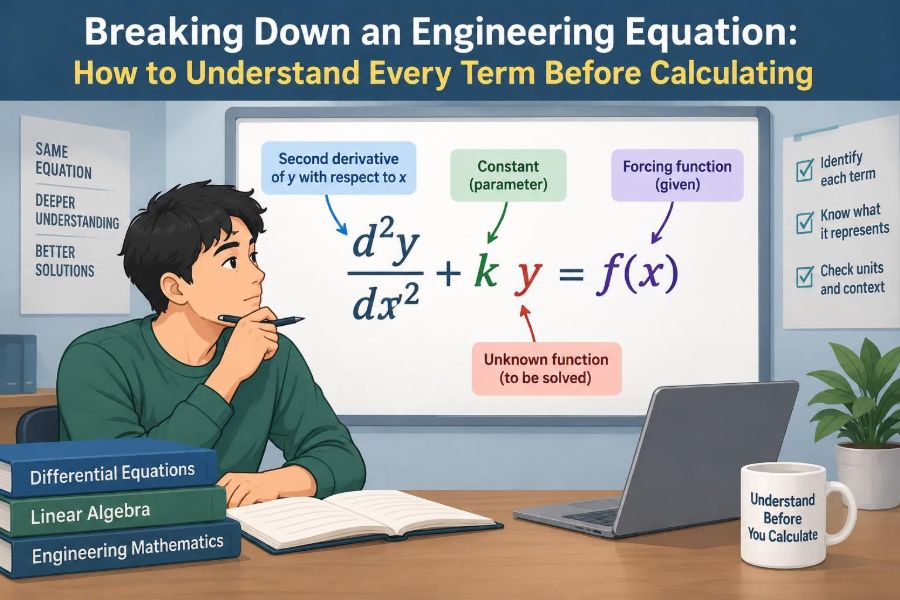

A pump specification gives a pressure-rise equation. A beam design sheet gives a deflection formula. A heat-transfer problem appears to offer everything needed: a diagram, several values, and one intimidating line of symbols.
The tempting move is to find the unknown, substitute numbers, and reach for a calculator. That can produce an answer quickly—but not necessarily an answer that describes the physical system.
Engineering equations are compressed models. Each symbol represents a measurable property, a condition, an assumption, or a relationship between causes and effects. Reading the equation well is often the real engineering work.
Before calculating, slow down long enough to ask what every term means, where it comes from, what units it carries, and whether it belongs in the situation at hand. That habit turns formula use into engineering judgment.
🧭 Start by Identifying the Physical Question
An equation is never just a string of mathematical operations. It answers a particular question: How much force is required? How fast will a tank drain? What voltage appears across a component? How far will a beam bend?
Write the question in ordinary language before interpreting symbols. For example, “Find the steady-state temperature at the inner wall of a pipe” is much more informative than “solve for T.” It tells you that temperature is the output and that steady-state behavior is assumed.
This first step also exposes mismatches. A formula for transient heating cannot directly answer a steady operating-temperature question, and a static beam equation cannot describe vibration without further modeling.
🔎 Read the Equation Before Reading the Numbers
Consider the familiar relationship V = IR. It is short, but it contains a complete statement: voltage difference across an ideal resistive element equals current through it multiplied by resistance.
Before using values, read it aloud in words. Doing so forces you to notice its direction and scope. It does not say that every electrical device has constant resistance, nor that any measured voltage and current pair will obey the relation under every operating condition.
A useful rule is: translate symbols into a sentence before translating values into numbers. The sentence is your first check that the formula represents the system you are analyzing.
🏷️ Name Every Symbol Explicitly
Symbols are efficient, but they are not universal. A lowercase v may mean velocity, specific volume, voltage, or Poisson’s ratio in different contexts. An uppercase P might be power, pressure, a load, or a probability.
Create a symbol list beside the equation. Include the definition, likely unit, and whether it is known, unknown, or calculated from another quantity. This takes little time and prevents one of the most common calculation errors: using the right number for the wrong meaning.
| Symbol | Possible meaning | Helpful check |
|---|---|---|
F |
Force | Usually measured in newtons or pounds-force |
p |
Pressure | Force per area, such as pascals |
Q |
Heat transfer rate or volumetric flow rate | Check the surrounding subject and units |
E |
Young’s modulus or energy | Context determines whether its unit is Pa or J |
Never assume that a symbol means what it meant in the previous chapter. Let the equation, diagram, and stated definitions decide.
🧩 Separate Variables, Constants, and Parameters
A variable changes during the problem or across the system. Time t, position x, velocity v, and temperature T are common examples.
A constant is treated as fixed within the model, such as gravitational acceleration in a local mechanics calculation. A parameter characterizes a particular system: pipe diameter, spring stiffness, material modulus, or motor resistance.
The distinction matters because a quantity may be constant in one model and variable in another. Density is often treated as constant in a low-speed liquid-flow calculation, but it can vary substantially in compressible gas flow.
📏 Give Every Term Its Units
Units are not administrative labels attached after the mathematics. They are part of the meaning of a physical quantity. A value of 20 is incomplete until you know whether it means 20 millimeters, 20 meters, 20 degrees Celsius, or 20 kilopascals.
For each term, assign units before inserting numbers. In the equation F = ma, mass has units of kilograms and acceleration has units of meters per second squared. Their product has units of kilogram-meters per second squared: a newton.
If you cannot state a term’s units, you probably do not yet know what the term represents.
⚖️ Use Dimensional Analysis as an Early Alarm
Dimensional analysis checks whether both sides of an equation have compatible physical dimensions. You cannot add a force to an energy, just as you cannot add 3 meters to 5 seconds.
Suppose a proposed pressure relation contains ρgh, where ρ is density, g is gravitational acceleration, and h is height. Multiplying the dimensions gives pressure, so the form is plausible. This does not prove the model is correct, but an incompatible result proves something is wrong.
Use dimensional analysis at three points:
- when selecting an equation,
- after rearranging it, and
- when checking the final result.
It catches missing exponents, inverted fractions, unit-conversion mistakes, and symbols copied incorrectly.
🧱 Find the Structure of the Equation
Most engineering equations have recognizable building blocks: a driving effect, a resisting effect, a storage term, a geometry term, or a correction factor. Finding those blocks makes a dense equation easier to understand.
Take the one-dimensional conduction relation Q = kA(Thot - Tcold)/L, often written with a sign convention for heat-flow direction. Temperature difference drives heat flow. Thermal conductivity k and area A make transfer easier. Length L resists it.
Once that structure is clear, you can predict behavior before calculating: a thicker wall reduces heat transfer, while a larger area increases it.
➡️ Identify What Causes What
Equations frequently express a cause-and-effect relationship, but the algebra alone may hide it. A pressure difference causes fluid to move; a voltage difference drives current; a temperature difference drives heat transfer; a net force changes motion.
This does not mean every relationship is simple or one-way. In real systems, flow can alter pressure losses, temperature can change material properties, and deformation can change the applied load path.
Still, asking “what is the driver?” helps interpret signs and trends. It also prevents treating every input as equally influential when the physics says otherwise.
🧮 Notice Addition, Multiplication, and Division
Mathematical operations tell a physical story. Terms added together often represent contributions to a total. For example, a total thermal resistance may be the sum of separate layer resistances when heat flows through them in series.
Multiplication often combines effects. In F = pA, pressure acts over area to create force. Division often signals spreading, resistance, or normalization: stress is force divided by area, and average speed is distance divided by time.
Do not treat brackets as decoration. In y = a(b + c), a multiplies both contributions. Missing those brackets can change the physical interpretation as well as the number.
🔢 Read Powers, Roots, and Inverses Carefully
Exponents indicate non-linear behavior. Kinetic energy depends on velocity squared, so doubling speed increases kinetic energy by a factor of four. A pipe-flow relation may involve diameter raised to a high power, making geometry errors especially consequential.
Roots reverse that sensitivity. If a quantity depends on the square root of another, a fourfold input change produces only a twofold output change. Inverse relations work differently again: doubling a denominator halves the result when all else is fixed.
Before calculating, state the expected direction and rough sensitivity. That prediction gives you a benchmark against which to judge the calculator output.
➕ Treat Signs as Physical Information
A negative sign is rarely a nuisance to discard. It can represent direction, loss, opposition, compression rather than tension, cooling rather than heating, or a coordinate convention.
Fourier’s law is commonly written q = -k dT/dx. The minus sign says heat flows toward lower temperature, opposite to the direction in which temperature increases. Removing it may leave a numerical magnitude but loses directional meaning.
Choose a positive direction or reference state early. Then retain signs consistently. If the final answer is negative, ask what that result says physically before deciding whether a magnitude alone is needed.
🗺️ Connect the Equation to a Diagram
A diagram gives symbols a location and direction. Sketch the beam, circuit, tank, pipe, or control volume, even if the problem already includes a figure. Mark forces, temperatures, flow directions, dimensions, and coordinate axes.
For a beam, the same load can create very different bending behavior depending on support locations. For a fluid system, elevation changes and pipe sections determine where pressure terms belong. The equation cannot rescue a model that describes the wrong geometry.
A quick sketch also exposes whether a quantity is local, such as stress at a point, or global, such as total load on a structure.
🎯 Define the System Boundary
Many equations apply to a chosen system boundary: the imagined line separating what you analyze from its surroundings. In a control-volume analysis of a turbine, mass and energy may cross the boundary. In a closed piston-cylinder model, mass stays inside while energy can cross as heat or work.
Boundary choice determines which terms belong in a balance equation. A force exerted by the surroundings is external to one system but internal to a larger system that includes both objects.
Draw the boundary and label what crosses it. This simple action makes conservation equations far less mysterious.
⚙️ Ask Which Conservation Principle Is Operating
A large share of engineering equations comes from conservation of mass, momentum, energy, charge, or angular momentum. Recognizing the underlying principle tells you what kinds of terms to expect.
A general balance often follows this pattern:
accumulation = input - output + generation - consumption
For mass in an ordinary flow system, generation and consumption are usually absent. For chemical species, reactions can generate or consume a species. For energy, work and heat transfers may appear alongside mass-flow energy.
When an equation seems hard to memorize, trace it back to its conservation statement. The terms then become necessary parts of a balance rather than arbitrary symbols.
⏱️ Check Whether Time Matters
Some equations describe a snapshot; others describe change. A derivative such as dT/dt or dv/dt tells you that the quantity changes with time. A derivative with respect to position, such as dP/dx, tells you how it changes across space.
The phrase steady state usually means relevant properties at a fixed location do not change with time. It does not mean nothing moves: water can flow steadily through a pipe while pressure and velocity remain constant in time at each location.
Do not set a time-derivative term to zero merely because a problem gives one instant of data. It must state, or the situation must justify, a steady or equilibrium condition.
🌡️ Separate Properties from Process Quantities
A property describes the state of a system, such as pressure, temperature, density, volume, or internal energy. Its value belongs to the system at a particular state.
Heat and work are different. They describe energy crossing a boundary during a process, not energy stored inside an object as a property. This distinction is central in thermodynamics and helps prevent phrases such as “the tank contains heat.”
Similar distinctions appear elsewhere: electric charge is a stored quantity, while current is charge flow rate. Knowing whether a term is a state, a rate, or a transfer clarifies both units and applicable equations.
🧪 Inspect the Assumptions Behind the Formula
Every engineering equation omits some effects. The omitted effects are its assumptions, and they define where the formula can be trusted.
A simple beam-deflection equation may assume small deflections, linear-elastic material behavior, a uniform cross-section, and ideal supports. Ohm’s law in its basic form assumes an element whose resistance is appropriately represented under the relevant conditions. A fluid relation may assume incompressible flow or negligible friction.
List the assumptions in plain language. Then ask whether the physical situation violates any of them enough to matter.
🚧 Distinguish an Ideal Model from a Real System
Ideal models are not failures; they are deliberate simplifications. A frictionless pulley, perfectly insulated wall, rigid tank, or ideal voltage source lets you isolate one mechanism and calculate efficiently.
Real equipment introduces friction, heat loss, manufacturing variation, aging, measurement noise, and interactions that may not fit the first model. Engineers often begin with an ideal estimate, then add correction factors, empirical data, safety margins, or more detailed simulation as the decision requires.
The question is not “Is this model perfectly real?” It is “Is this model accurate enough for this purpose?”
🧷 Recognize Coefficients and Correction Factors
Terms such as friction factor, drag coefficient, efficiency, discharge coefficient, or safety factor often package complicated behavior into a usable number. They are not universal constants in the same sense as mathematical constants.
A drag coefficient depends on object shape and flow conditions. Efficiency depends on operating point and loss mechanisms. A friction factor may depend on flow regime and surface roughness.
Whenever a coefficient appears, ask where its value comes from: a material data sheet, a chart, a test, a correlation, or a stated assumption. Using a coefficient outside its intended conditions can make a neat calculation misleading.
📊 Know Whether an Equation Is Theoretical or Empirical
A theoretical equation is derived from physical laws and stated assumptions. An empirical equation is fitted to observations or experimental data. Many practical engineering correlations combine both approaches.
Neither category is automatically superior. A well-tested empirical correlation can be highly useful within its calibrated range, while a theoretical model may be less useful if its assumptions are poorly matched to reality.
Empirical formulas require special caution about range. Check the fluid, material, geometry, operating regime, and unit convention used when the correlation was developed.
🔄 Rearrange Algebra Without Changing Meaning
Rearranging an equation is routine, but it is a high-risk moment for lost squares, signs, and parentheses. Move whole terms, not isolated symbols, and write each algebraic step when the expression is complex.
For example, from Q = kAΔT/L, solving for thickness gives L = kAΔT/Q. The result should make physical sense: a larger required heat-transfer rate implies a smaller thickness when the other quantities remain fixed.
After rearranging, perform a unit check. This is especially valuable when solving for a quantity that was originally in a denominator or exponent.
🔁 Convert Units Before Substitution
Use one consistent unit system throughout a calculation. Mixing millimeters with meters, kilopascals with pascals, or hours with seconds can create errors by factors of a thousand or more.
Convert values before substituting them into the equation, and write conversion factors so units visibly cancel. For instance, convert a 25 mm diameter to 0.025 m before using a relation expressed in SI units.
Temperature needs extra care. Temperature differences in degrees Celsius and kelvins have equal numerical increments, but absolute-temperature formulas require kelvins. A simple conversion habit prevents serious errors in gas-law and radiation calculations.
🧾 Substitute Values in a Transparent Order
Keep the symbolic equation visible until the relationship is understood and units are compatible. Then substitute values with parentheses and units attached where practical.
F = pA = (200,000 Pa)(0.010 m²) = 2,000 N
This layout makes the origin of each value easy to inspect. It also reduces calculator-entry errors and creates a calculation trail someone else can review.
Avoid entering a crowded expression from memory. Break it into intermediate quantities when they correspond to meaningful physical parts of the model.
🔍 Estimate the Answer Before Trusting the Calculator
A rough estimate is one of the best quality checks available. Round inputs to convenient values, track the order of magnitude, and predict whether the answer should be small, moderate, or large.
If a pressure of roughly 200 kPa acts over an area near one-hundredth of a square meter, the force should be in the thousands of newtons, not 2 newtons or 2 million newtons. You do not need an exact mental answer to spot an implausible result.
Estimation also encourages physical intuition. Over time, familiar scales for stress, power, temperature differences, and flow rates become easier to recognize.
🧠 Use Limiting Cases to Test Behavior
A limiting case asks what the equation predicts when an input becomes very small, very large, or takes a special value. It is a powerful way to test whether you understand the relationship.
In Q = kAΔT/L, heat transfer should go to zero when the temperature difference goes to zero. It should increase as wall thickness approaches a smaller value, assuming the model remains applicable.
If your interpretation predicts the opposite, revisit the algebra or physical meaning. Limiting cases do not replace validation, but they reveal many conceptual mistakes before detailed work begins.
📈 Identify Sensitive Inputs
Not every input deserves equal attention. If a variable appears squared, cubed, or in a denominator, small uncertainty in that variable may strongly affect the result. Geometry measurements can be particularly influential in flow and structural relations.
For a practical sensitivity check, vary one uncertain input slightly while holding others fixed. Observe whether the output barely changes or shifts substantially. This helps prioritize better measurement, tighter tolerance, or conservative design choices.
Sensitivity is also why carrying many decimal places can be misleading when an input measurement is only approximate.
🎯 Match Precision to the Data
A calculator may display ten digits, but the physical data may not justify them. If a length was measured as 1.2 m, reporting a final result as 1.237846 m implies knowledge that was never available.
Keep extra digits during intermediate calculations to avoid accumulated rounding, then round the final answer sensibly. The appropriate precision depends on measurement quality, design needs, and the consequences of error.
State units with the final result and, where useful, state whether it is an estimate, a nominal value, or a value based on idealized assumptions.
⚠️ Watch for Common Interpretation Mistakes
Many wrong answers begin before any arithmetic. The recurring mistakes are usually readable once you know where to look:
- using a symbol definition from another topic or textbook section;
- confusing a rate with a total quantity;
- mixing gauge pressure and absolute pressure;
- discarding a negative sign without interpreting direction;
- using diameter where an equation requires radius;
- assuming steady state, linearity, or negligible losses without justification;
- copying a correlation while omitting its unit convention or range.
These are not merely “careless errors.” They are modeling errors, and they can survive flawless arithmetic.
🗣️ Explain the Result in Engineering Language
A final number should answer the original physical question. Instead of writing only 2,000, write: “The pressure produces an outward force of approximately 2.0 kN on the specified area, assuming uniform pressure distribution.”
This sentence communicates magnitude, units, direction or interpretation, and a key assumption. It gives the number a usable engineering meaning.
If the result affects a design choice, add a brief implication: whether the value is a load a component must resist, a heat loss to be managed, or a flow rate a pump must supply.
🛠️ Use Tools to Verify, Not Replace Understanding
Spreadsheets, symbolic solvers, simulation packages, and code are valuable for repetitive calculations and complex systems. They can also conceal an incorrect formula, a misplaced parenthesis, or an unreasonable input with impressive speed.
Build a manual understanding first: define terms, inspect units, estimate scale, and test a simple case. Then use tools to evaluate scenarios, perform sensitivity studies, or automate reliable workflows.
A good practice is to test a digital model with a case whose answer you can calculate or estimate independently. If the model fails that test, more elaborate output will not make it trustworthy.
✅ Follow a Repeatable Pre-Calculation Routine
A short routine makes equation reading faster with practice and more reliable under deadline pressure:
- State the physical question and desired output.
- Sketch the system, boundary, directions, and known conditions.
- Define every symbol and assign units.
- Identify the governing principle and equation scope.
- List assumptions and check whether they are reasonable.
- Convert to consistent units and rearrange symbolically.
- Predict trend and approximate magnitude.
- Calculate, check dimensions, and interpret the result.
You will not need the same level of detail for every routine exercise. But the habit of asking these questions remains useful from introductory homework to professional design review.
🧠 The Core Principle: Understand First, Calculate Second
An engineering equation is a compact model of a physical situation. Its symbols carry definitions, units, directions, assumptions, and limits. Calculation comes after those meanings are clear.
When you identify the system, translate the equation, check dimensions, inspect assumptions, and estimate behavior, you make it much harder for an incorrect result to pass unnoticed. You also become able to adapt formulas rather than merely recall them.
The deepest advantage is judgment. Two people can use the same calculator, but the person who understands every term can recognize when the calculation does not represent reality.
Before trusting any numerical answer, make sure you can explain what every term means, why it is present, and what physical condition allows the equation to apply. That is the difference between completing a calculation and doing engineering. 📐🔧