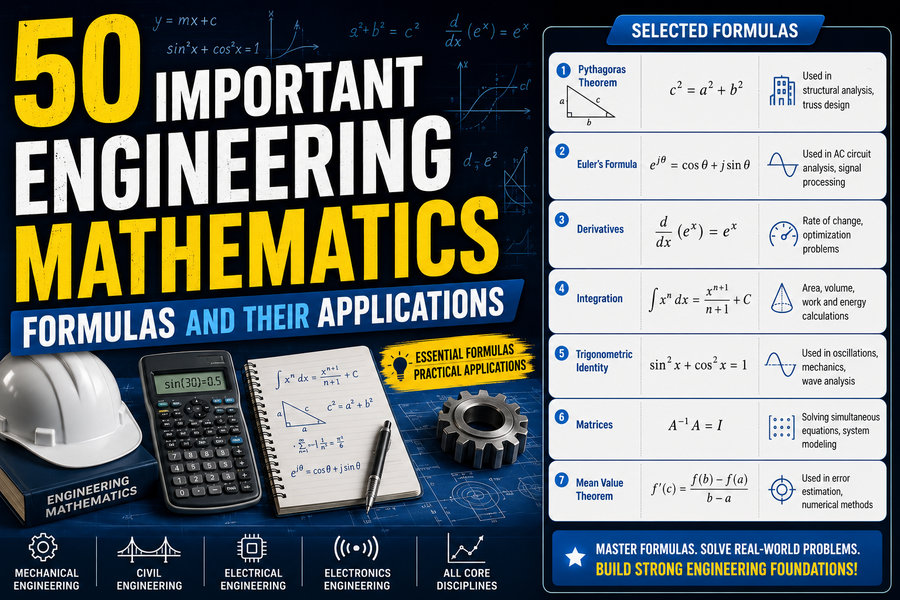

50 Important Engineering Mathematics Formulas and Their Applications 📐⚙️📊
Engineering mathematics provides the mathematical foundation for nearly every branch of engineering. Civil engineers use equations to calculate structural loads and fluid flow, electrical engineers analyze signals and circuits, mechanical engineers model motion and heat transfer, and computer engineers use matrices, probability, and numerical methods to solve complex computational problems. 🏗️⚡💻
While engineering mathematics contains thousands of equations, a relatively small group of formulas appears repeatedly across many technical subjects. Understanding these formulas—and more importantly, knowing where to apply them—can make engineering problem-solving much easier.
Below are 50 important engineering mathematics formulas, together with their meanings and common engineering applications.
🔢 1. Quadratic Formula
Used to solve equations of the form:
🛠️ Applications
Used in projectile motion, circuit equations, optimization problems, structural calculations, and many engineering models involving second-degree equations.
📐 2. Pythagorean Theorem
For a right triangle, (c) is the hypotenuse.
🛠️ Applications
Used in surveying, construction, vector resolution, mechanical design, coordinate geometry, and calculating distances.
📏 3. Distance Between Two Points
🛠️ Applications
Useful in CAD, robotics, surveying, structural layouts, computer graphics, and navigation.
🎯 4. Midpoint Formula
🛠️ Applications
Used in geometry, structural layouts, machine design, coordinate modeling, and computer-aided engineering.
📈 5. Slope of a Straight Line
🛠️ Applications
Used for road gradients, linear calibration curves, engineering graphs, structural slopes, and rate-of-change calculations.
🔺 6. Sine Rule
🛠️ Applications
Important in surveying, force triangles, navigation, structural geometry, and resolving non-right triangles.
🔺 7. Cosine Rule
🛠️ Applications
Used to determine distances, forces, link lengths, and unknown angles in engineering geometry.
🔄 8. Degrees-to-Radians Conversion
🛠️ Applications
Essential because calculus, rotational mechanics, vibration equations, and electrical phase calculations normally use radians.
📊 9. Arithmetic Progression
where:
- (a) = first term
- (d) = common difference
🛠️ Applications
Useful for regularly increasing loads, dimensions, production quantities, and sequence modeling.
📊 10. Sum of an Arithmetic Progression
🛠️ Applications
Used for cumulative loads, material quantities, staged production, and engineering cost calculations.
📈 11. Geometric Progression
🛠️ Applications
Appears in compound growth, signal attenuation, repeated scaling, population models, and engineering economics.
💰 12. Compound Interest Formula
🛠️ Applications
Used in engineering economics, project financing, investment analysis, and equipment-replacement decisions.
∑ 13. Binomial Theorem
🛠️ Applications
Used in approximation methods, probability, signal analysis, numerical computation, and algebraic expansion.
🧮 14. Permutation Formula
🛠️ Applications
Used when arrangement order matters, such as scheduling, communication channels, system configurations, and coding problems.
🎲 15. Combination Formula
🛠️ Applications
Used in reliability engineering, probability, quality control, and selecting component combinations.
📉 16. Basic Derivative
🛠️ Applications
Used to determine velocity, acceleration, gradients, optimization points, stress variation, and changing electrical signals.
🔗 17. Product Rule
🛠️ Applications
Used when differentiating products of engineering quantities such as variable force and displacement functions.
➗ 18. Quotient Rule
🛠️ Applications
Useful when engineering functions involve ratios of variable quantities.
🔗 19. Chain Rule
🛠️ Applications
Used extensively in thermodynamics, fluid mechanics, control engineering, optimization, and nonlinear modeling.
📈 20. Second Derivative
🛠️ Applications
Represents acceleration when position is differentiated twice with respect to time. It also appears in beam bending, vibration, heat transfer, and stability analysis.
🏆 21. Condition for Maximum or Minimum
A stationary point occurs where the first derivative is zero.
🛠️ Applications
Used to minimize material usage, maximize efficiency, optimize dimensions, and determine maximum stress or power.
∫ 22. Basic Integration Formula
for (n\neq -1).
🛠️ Applications
Used to calculate areas, volumes, accumulated energy, displacement, charge, mass, and fluid quantities.
📐 23. Definite Integral
🛠️ Applications
Calculates total quantities accumulated between two limits, such as work, volume, charge, distance, and energy.
🔄 24. Integration by Parts
🛠️ Applications
Used for integrating products of functions in signal processing, dynamics, electromagnetic theory, and probability.
🔗 25. Fundamental Theorem of Calculus
where:
🛠️ Applications
Connects differentiation and integration and is fundamental to nearly every engineering analysis involving continuous systems.
📊 26. Taylor Series
🛠️ Applications
Used for numerical approximations, nonlinear systems, control theory, computer simulations, and engineering modeling.
🔍 27. Maclaurin Series
🛠️ Applications
Useful for approximating exponential, sine, cosine, and other functions near zero.
📐 28. Partial Derivative
🛠️ Applications
Used when a quantity depends on several variables, such as pressure (P(x,y,z)), temperature (T(x,y,z)), or fluid velocity.
🌡️ 29. Gradient
🛠️ Applications
The gradient indicates the direction of maximum change and is used in heat transfer, fluid mechanics, electromagnetics, and optimization.
🌊 30. Divergence
🛠️ Applications
Used to describe sources and sinks in fluid flow, electromagnetic fields, heat transfer, and conservation equations.
🌀 31. Curl
In determinant form:
🛠️ Applications
Measures rotational behavior of vector fields and is especially important in fluid mechanics and electromagnetism.
➡️ 32. Dot Product
🛠️ Applications
Used to calculate work:
and to determine angles between vectors.
✖️ 33. Cross Product
🛠️ Applications
Used to calculate torque, moments, magnetic forces, angular momentum, and areas.
📏 34. Magnitude of a Vector
🛠️ Applications
Used to determine resultant force, velocity, acceleration, electric field strength, and displacement.
🧭 35. Unit Vector
🛠️ Applications
Used to represent direction independently of magnitude in mechanics, robotics, navigation, and electromagnetic analysis.
🔢 36. Matrix Determinant for a 2×2 Matrix
For:
🛠️ Applications
Used in solving simultaneous equations, structural analysis, transformations, control systems, and circuit-network calculations.
🔄 37. Inverse of a 2×2 Matrix
provided:
🛠️ Applications
Used to solve systems of linear equations, control-system models, electrical networks, and structural calculations.
🧠 38. Eigenvalue Equation
🛠️ Applications
Extremely important in vibration analysis, structural dynamics, stability studies, control engineering, quantum mechanics, and data science.
🎵 39. Simple Harmonic Motion
or:
🛠️ Applications
Models mechanical vibration, alternating signals, spring systems, pendulum approximations, and rotating machinery.
🔄 40. Angular Frequency
🛠️ Applications
Used in vibration analysis, AC circuits, communications, signal processing, and control systems.
📉 41. First-Order Differential Equation
🛠️ Applications
Models cooling, electrical RC circuits, fluid systems, chemical concentration, population change, and many dynamic processes.
🔧 42. Second-Order Linear Differential Equation
🛠️ Applications
Appears in mechanical vibrations, RLC circuits, structural deflection, control systems, and dynamic response analysis.
⚡ 43. Exponential Growth or Decay
🛠️ Applications
Used in radioactive decay, capacitor charging models, thermal processes, chemical reactions, and population models.
🔁 44. Laplace Transform
🛠️ Applications
One of the most important tools in control systems, electrical circuits, signal processing, differential equations, and dynamic-system analysis.
🎶 45. Fourier Series
🛠️ Applications
Used to break complex periodic signals into sinusoidal components.
It is fundamental in:
🎧 Audio engineering
📡 Communications
⚡ Electrical engineering
🌡️ Heat-transfer analysis
🔊 Vibration analysis
📡 46. Fourier Transform
🛠️ Applications
Converts signals from the time domain to the frequency domain and is widely used in telecommunications, radar, image processing, acoustics, and electronics.
🎲 47. Mean or Arithmetic Average
🛠️ Applications
Used in quality control, experimental measurements, manufacturing statistics, engineering data analysis, and calibration.
📊 48. Variance
For a population:
🛠️ Applications
Measures how widely engineering measurements vary around the mean.
It is important in reliability, manufacturing tolerances, experimental analysis, and quality assurance.
📉 49. Standard Deviation
🛠️ Applications
Used to quantify measurement variation, manufacturing consistency, uncertainty, reliability, and process quality.
A smaller standard deviation generally indicates more consistent results.
🎯 50. Newton-Raphson Method
🛠️ Applications
Used to numerically solve nonlinear equations when an exact algebraic solution is difficult or impossible.
Engineering applications include:
⚡ Power-flow analysis
🌊 Fluid calculations
🏗️ Structural analysis
🔥 Thermodynamics
⚙️ Mechanical design
📚 Engineering Fields That Use These Formulas
These 50 formulas appear across a wide range of disciplines.
🏗️ Civil Engineering
Civil engineers use calculus, matrices, vectors, differential equations, probability, and numerical methods for structural analysis, geotechnical calculations, hydraulics, surveying, and transportation engineering.
⚙️ Mechanical Engineering
Mechanical engineers frequently use vectors, calculus, differential equations, Fourier analysis, and matrix methods for thermodynamics, fluid mechanics, vibrations, machine design, and heat transfer.
⚡ Electrical Engineering
Electrical engineers rely heavily on complex mathematical tools such as differential equations, Laplace transforms, Fourier transforms, matrices, probability, and trigonometric functions.
These methods are essential for circuits, communication systems, power engineering, signal processing, and control theory.
💻 Computer Engineering
Computer and electronics engineers use matrices, probability, numerical methods, vectors, transforms, and optimization in machine learning, computer graphics, signal processing, embedded systems, and digital communications.
🧪 Chemical Engineering
Chemical engineers use differential equations, integration, statistics, numerical methods, and partial derivatives to analyze reaction kinetics, process control, fluid transport, mass transfer, and thermodynamics.
🧠 Why Engineers Need More Than Memorization
Memorizing formulas is useful, but engineering mathematics is not simply about remembering equations.
The more important skill is understanding:
What does the formula represent?
When can it be used?
What assumptions does it make?
What units should the quantities have?
For example, knowing the quadratic formula is valuable, but an engineer must first recognize that the problem can be represented by a quadratic equation.
Similarly, knowing the Fourier transform is useful only when the engineer understands why frequency-domain analysis can reveal information hidden in a complicated time signal.
Engineering mathematics is therefore a language for translating physical problems into solvable mathematical models. 📐⚙️
📌 Five Formula Groups Worth Mastering First
If you are beginning engineering mathematics, the formulas can be divided into five essential groups:
1. Algebra and trigonometry — useful for basic engineering calculations and geometry.
2. Calculus — essential for rates of change, optimization, areas, energy, and continuous systems.
3. Vectors and matrices — necessary for forces, 3D systems, structural models, robotics, and control.
4. Differential equations and transforms — fundamental for dynamic systems, vibrations, circuits, heat transfer, and signals.
5. Probability and numerical methods — critical for real-world data, uncertainty, reliability, and equations that computers must solve approximately.
Mastering these groups creates a strong mathematical foundation for advanced engineering subjects. 🎓📊
🏁 Final Thoughts
Engineering mathematics provides the tools engineers use to transform real-world problems into mathematical equations and practical solutions.
Some formulas, such as the Pythagorean theorem, are simple enough to learn in school. Others, including Laplace transforms, Fourier transforms, eigenvalue equations, gradients, and differential equations, support sophisticated technologies such as aircraft control systems, power grids, telecommunications networks, bridges, robots, and spacecraft. 🚀⚡🏗️
The 50 formulas above are therefore more than examination equations. They form part of the mathematical toolkit behind modern engineering.
An engineer does not necessarily memorize every complicated formula permanently. In professional work, reference books and software are always available. What matters most is understanding the mathematical concept well enough to recognize which formula or method is appropriate, what assumptions it contains, and whether the resulting answer makes physical sense.
That combination of mathematics and engineering judgment is what turns equations into practical technology. 📐🧠