
A pump specification says it must deliver 0.025 cubic metres per second. A spreadsheet returns 25. The arithmetic looks neat, the chart looks convincing, and the project moves forward—until someone asks whether that number is in cubic metres per second, litres per second, or something else entirely.
Most engineering mistakes do not begin with advanced mathematics. They begin with a missed decimal point, a rounded value used too early, an angle entered in the wrong mode, or a unit conversion performed silently in someone’s head.
These errors can affect cost estimates, material quantities, safety margins, test results, and design decisions. Even when the final result is not dangerous, a calculation that cannot be checked wastes time and weakens confidence.
Accuracy is not simply a matter of using more decimal places. It comes from understanding where uncertainty enters, keeping units visible, and choosing a calculation method that does not magnify small mistakes.
🎯 Accuracy Starts With a Clear Question
Before selecting a formula, define exactly what the calculation must produce. “Find the load” is incomplete: do you need the maximum service load, a factored design load, a reaction at one support, or a load per unit area?
A clear statement includes the quantity, conditions, and required unit. For example: determine the pressure drop across a 20 m pipe at the stated flow rate, in kilopascals. This prevents a correct formula from answering the wrong question.
🔍 Accuracy, Precision, and Error Are Different
Accuracy describes closeness to the true or accepted value. Precision describes how closely repeated measurements agree with one another. A digital instrument can report many digits precisely while still being inaccurate because it has a calibration bias.
Error is the difference between an estimate or measured value and the reference value. In real work, the true value is often unknown, so engineers manage error through calibration, tolerances, repeated measurements, validation, and conservative assumptions.
📏 Keep Units Attached to Every Quantity
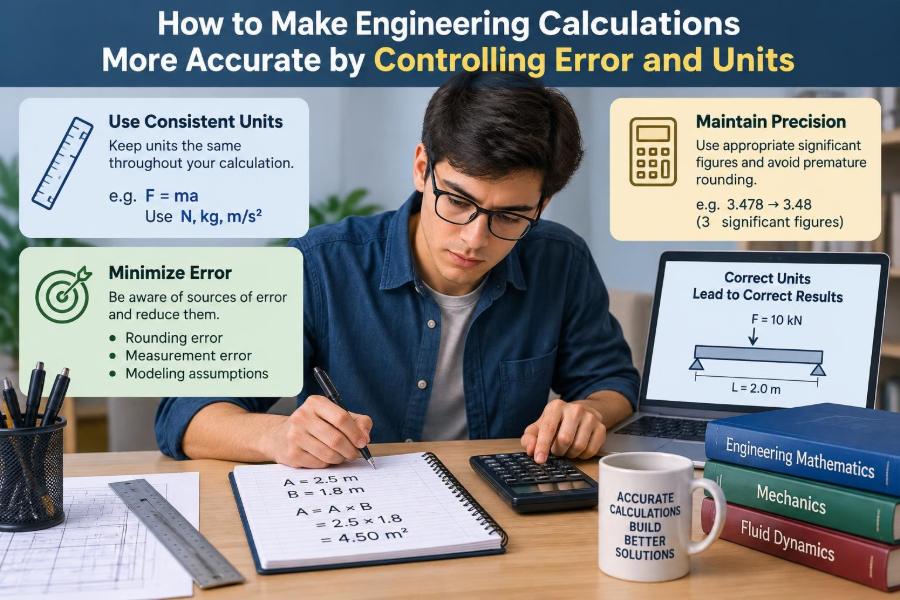
A number without a unit is usually unfinished engineering information. Write 12 kN, not merely 12; write 0.40 m, not merely 0.40. Unit labels reveal whether an expression makes physical sense before it reaches a calculator.
For example, force divided by area should reduce to pressure units: N/m², or Pa. If a proposed pressure calculation ends in N·m, the formula, conversion, or input arrangement needs inspection.
🔄 Convert Units Before Combining Values
Convert values into one consistent system before addition, subtraction, or substitution into a formula. Adding 300 mm to 1.2 m without conversion invites a tenfold or thousandfold mistake.
Multiplication and division can be handled through unit algebra, but mixed inputs still require care. A velocity of 72 km/h may be appropriate for a road report, but it should become 20 m/s before use in an equation written in SI base units.
🧮 Use Dimensional Analysis as a Built-In Check
Dimensional analysis checks the physical dimensions of an equation: mass, length, time, temperature, electric current, and related quantities. It cannot prove that a model is correct, but it can expose many incorrect expressions.
Suppose kinetic energy is calculated with ½mv². The units are kg·(m/s)² = kg·m²/s², which is a joule. If speed were accidentally used as metres per minute while other values used seconds, the numerical answer would be wrong even though the symbolic formula was right.
⚖️ Distinguish Mass, Force, and Weight
Mass is measured in kilograms. Force is measured in newtons. Weight is the gravitational force acting on a mass, often approximated near Earth’s surface by W = mg.
Confusing kilograms with newtons is especially risky in structural, lifting, and mechanical calculations. A 500 kg component has a mass of 500 kg; its weight is approximately 4.9 kN under standard gravitational conditions. State which quantity is intended.
🌡️ Treat Temperature Scales With Special Care
Temperature differences and absolute temperatures behave differently. A change of 1 °C equals a change of 1 K, so either scale may be used for many thermal expansion calculations involving a temperature difference.
But equations involving absolute temperature, such as ideal-gas relationships, require kelvin. Converting 20 °C directly into an absolute-temperature formula as 20 K would produce a physically meaningless result. Use T(K) = T(°C) + 273.15.
📐 Set the Calculator’s Angle Mode Deliberately
Trigonometric functions depend on whether an angle is expressed in degrees or radians. A calculator in radian mode will interpret sin(30) as sine of 30 radians, not sine of 30 degrees.
Check the mode at the start of geometry, surveying, statics, vibration, and signal calculations. In many engineering equations, angular frequency is in radians per second, while drawings commonly show angles in degrees. Convert intentionally rather than assuming the notation resolves the issue.
🔢 Carry Guard Digits Through Intermediate Steps
Rounding each line of a calculation can accumulate error, particularly when later operations multiply, divide, or subtract close values. Keep several extra digits during intermediate work, then round the final reported answer to a sensible precision.
For instance, if a calculation gives 3.1415926, retain that value in the worksheet or software rather than immediately writing 3.14. The final answer might appropriately be 3.14 mm, but the internal calculation may need more detail.
✂️ Understand Significant Figures
Significant figures communicate the resolution justified by data. If a length is measured as 2.4 m, reporting a derived result as 2.438761 m suggests knowledge that the measurement does not support.
For multiplication and division, the result is commonly limited by the input with the fewest significant figures. For addition and subtraction, decimal-place resolution matters more. These rules are useful guides, not substitutes for engineering judgment about instrument resolution and uncertainty.
📉 Avoid Catastrophic Cancellation
Catastrophic cancellation occurs when subtracting two nearly equal numbers. Their leading digits cancel, leaving a result dominated by small uncertainties or rounding errors.
Consider calculating √(x² + 1) − x for a very large value of x. Direct subtraction can lose useful digits. An algebraically equivalent form, 1 / (√(x² + 1) + x), is often numerically more stable because it avoids subtracting nearly identical quantities.
📊 Separate Measurement Error From Model Error
A result can be limited by poor measurements or by an imperfect model. Measurement error may come from sensor calibration, reading resolution, alignment, or environmental conditions. Model error occurs when an equation simplifies a real system too aggressively.
A pipe-flow formula might use idealised assumptions about fluid properties or surface roughness. More precise measurement of diameter will not fix a result if the flow regime or model applicability has been misunderstood.
🎲 Recognize Random and Systematic Error
Random error varies unpredictably from one observation to another. Repeating measurements and using an average can reduce its influence when the measurements are independent and conditions are comparable.
Systematic error shifts results consistently in one direction, such as a scale that reads high because it was not zeroed. Repeating the same biased measurement does not remove the bias; calibration, comparison with a known reference, or a corrected method is required.
🧰 Match Instrument Resolution to the Task
Do not use a measuring tool whose smallest readable increment is too coarse for the design decision. A tape measure may be adequate for preliminary layout but not for checking a close mechanical fit.
At the same time, an extremely fine instrument does not automatically create a more reliable result. The setup, operator technique, surface condition, and calibration must support the desired tolerance. Choose the measurement system as a whole, not only the device.
📥 Record Raw Data Before Processing It
Keep original readings, units, instrument identifiers where relevant, dates, conditions, and any observed anomalies. Raw data makes it possible to trace a surprising result back to its source instead of rebuilding an experiment from memory.
Separate measured values from calculated values in a table or workbook. If a formula later changes, raw readings remain intact and the derived results can be updated transparently.
🧾 Make Assumptions Visible
Every engineering calculation has boundaries. Common assumptions include steady flow, uniform material properties, negligible air resistance, rigid supports, or a constant temperature.
Write assumptions beside the calculation, especially when they simplify a real system. This allows reviewers to judge whether they are acceptable and helps future users understand why the result may differ from field behaviour.
🧱 Use Consistent Reference Conditions
Many quantities depend on a reference condition: gauge versus absolute pressure, elevation datum, ambient temperature, electrical reference potential, or coordinate origin. Mixing references can create an answer that looks plausible but has no clear meaning.
For example, gauge pressure is measured relative to local atmospheric pressure, while absolute pressure is measured relative to vacuum. Gas-law calculations generally require absolute pressure. Labeling the reference is as important as labeling the unit.
🧠 Estimate the Order of Magnitude First
An order-of-magnitude estimate is a rough scale check made before or after detailed calculation. It does not replace the full solution, but it quickly identifies answers that are wildly too large or too small.
If a household water tank holds a few cubic metres, a computed volume of 4,000 m³ deserves immediate investigation. A mental estimate based on approximate length, width, and height could have caught a centimetre-to-metre conversion error.
🔁 Check Results Using a Second Path
Where consequences justify it, verify important calculations independently. The second path might use a rearranged equation, a hand estimate, a graph, a simulation, or a separate spreadsheet created without copying the first formula.
Re-entering the same values into the same formula is useful for detecting typing errors, but it is not a truly independent check. Independence matters because shared assumptions can reproduce the same mistake.
📈 Test Whether the Result Changes in the Right Direction
Ask how the answer should respond when an input changes. If pipe diameter decreases while flow rate stays fixed, fluid velocity should rise. If the result moves in the opposite direction, inspect the formula and units.
This is a simple form of sensitivity thinking. It connects mathematics to physical intuition and often catches inverted ratios, misplaced exponents, and negative signs before they enter a report.
🌐 Use Software Without Surrendering Judgment
Spreadsheets, symbolic tools, and numerical software can reduce repetitive work, but they can also hide errors behind polished formatting. A cell may contain an incorrect reference, a copied formula may shift unexpectedly, or a unit conversion may be absent altogether.
Build transparent calculations: name inputs, show units in adjacent cells, protect key formulas when appropriate, and test known cases. For code, include input validation and simple test cases with expected outputs.
🧮 Design Spreadsheets for Auditability
A reliable engineering spreadsheet allows another person to follow the calculation from inputs to conclusion. Place assumptions and constants in a clearly identified area, avoid unexplained hard-coded numbers, and distinguish inputs from outputs visually.
- Use one unit system within each calculation block.
- Write conversion factors explicitly rather than hiding them in formulas.
- Include a basic reasonableness check for key results.
- Record the source or basis of material properties and design inputs where required by your work process.
Auditability protects both the author and the reviewer. It also makes later revision much faster.
🗂️ Control Versions of Drawings and Inputs
Correct mathematics applied to outdated dimensions is still incorrect engineering. A calculation should identify the drawing revision, specification version, load case, or data set on which it is based.
When input data changes, assess which downstream calculations are affected. This is especially important in collaborative projects, where a small geometry revision may alter quantities, stresses, clearances, and procurement information.
🛡️ Apply Tolerances and Safety Factors Correctly
Tolerance describes an acceptable range of variation in a manufactured or measured quantity. A safety factor, where used in a design method, provides margin between anticipated demand and allowable capacity. They address different issues and should not be treated as interchangeable.
Neither concept excuses unreliable arithmetic. A safety margin may not cover a unit mistake, an omitted load case, or use of the wrong material property. Follow the governing project requirements and applicable design method rather than selecting margins casually.
📦 Track Uncertainty Through a Calculation
Outputs inherit uncertainty from their inputs. If an area is calculated from measured length and width, uncertainty in both dimensions influences the reported area. A highly detailed final number may therefore be unjustified.
For a simple conservative check, vary key inputs within plausible bounds and observe how the result changes. More formal uncertainty propagation may be appropriate in testing, metrology, or high-consequence analysis, but the central habit is the same: know which inputs drive confidence in the output.
🚧 Treat Boundary Cases as Warning Signs
Many formulas work only within a stated range. A beam equation may assume small deflection, a material relationship may apply only within a temperature interval, and a correlation may be fitted to a particular flow regime.
When your inputs sit near or beyond a boundary, do not quietly extrapolate. Identify the limitation, seek a suitable model, or state the uncertainty explicitly. A precise number outside a model’s valid range is not a dependable answer.
🧑🤝🧑 Build Review Into the Workflow
Peer review is not merely a final approval step. A colleague can question an assumption, spot an inconsistent unit, or notice that the answer conflicts with expected physical behaviour.
For routine work, a brief self-review checklist may be enough. For complex, safety-related, or costly decisions, the review should be proportionate to consequence and performed by someone with appropriate competence and access to the relevant design information.
✅ Use a Practical Calculation Checklist
A repeatable checklist reduces reliance on memory. It is most effective when used before submission, fabrication, testing, or design release—not only after a problem appears.
- Define the required output and operating condition.
- List inputs, sources, assumptions, and reference conditions.
- Convert to a consistent unit system.
- Check dimensions and calculator settings.
- Keep guard digits and round only at reporting.
- Estimate the expected scale and direction of the result.
- Verify critical work by an independent route.
- Document units, revisions, limits, and final conclusions.
🏁 The Core Principle: Make Errors Easy to See
Reliable engineering calculations are not those with the longest strings of decimals. They are calculations in which units remain visible, assumptions can be challenged, input data can be traced, and results can be checked against physical reality.
Controlling error is a disciplined process: measure carefully, select an appropriate model, preserve numerical stability, communicate uncertainty honestly, and review the work at a level suited to its consequences. Each step makes hidden mistakes easier to detect while they are still inexpensive to correct.
The most accurate engineering calculation is one that is physically sensible, unit-consistent, transparent about its limits, and straightforward for another person to verify. That standard turns mathematics from a sequence of button presses into dependable engineering judgment. 📐🔍✅