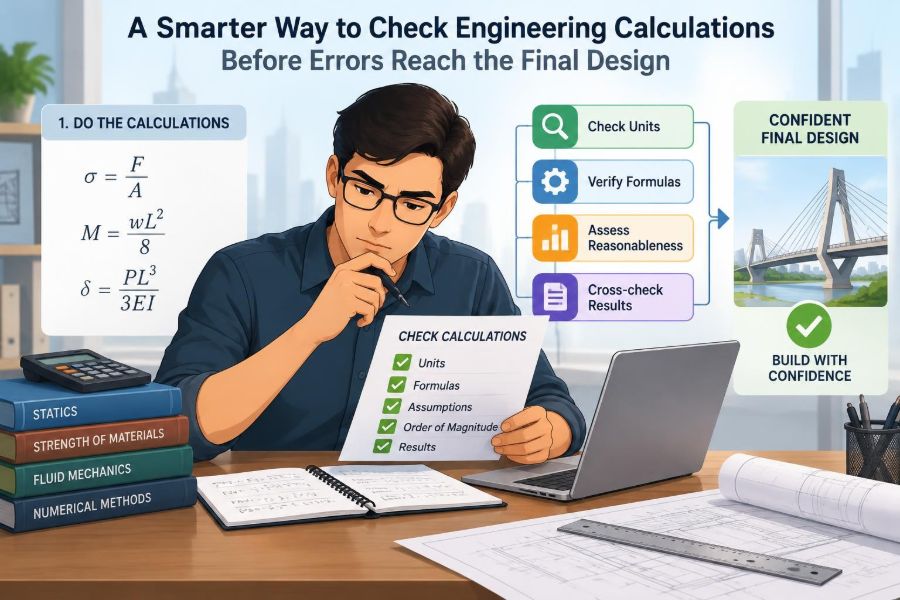

A calculation can look perfectly respectable on a screen: formulas are filled in, a spreadsheet has no visible errors, and the final answer carries several decimal places. Then someone asks a simple question: “Does this result make physical sense?”
That question often exposes what the arithmetic did not. A beam reaction may be larger than the applied load. A pipe pressure loss may have the wrong units. A motor may appear to deliver more power than it receives. These are not always difficult-mathematics problems; they are frequently checking problems.
Engineering calculations turn assumptions, measurements, models, and requirements into design decisions. If an error survives that chain, it can influence dimensions, material selection, cost, safety margins, and construction instructions.
The practical goal is not to inspect every line forever. It is to build a checking process that catches the errors most likely to matter, early enough that correcting them is cheap and straightforward.
🧭 Checking Is a Design Activity, Not Final Admin
Calculation checking is sometimes treated as a final signature step after “real engineering” is complete. In reality, it is part of design thinking. A check asks whether the model represents the system, whether inputs are credible, and whether the output supports the decision being made.
A correct solution to the wrong model is still a poor design basis. For that reason, good checking begins while the calculation is being built, not only when the document is ready to issue.
🎯 Start With the Decision the Calculation Supports
Before reviewing equations, identify the design decision. Is the calculation sizing a member, selecting a pump, verifying a clearance, estimating a heat load, or demonstrating compliance with a stated criterion?
This prevents a common failure: producing an accurate number that does not answer the actual question. Write a one-sentence purpose statement, such as: Verify that the proposed support member remains within the specified deflection limit under the defined service loading.
🗺️ Make the Physical System Visible First
A reviewer should be able to understand the system before reading the mathematics. Use a sketch, free-body diagram, process diagram, circuit diagram, or annotated geometry drawing as appropriate.
The drawing should show boundaries, coordinate directions, connections, known dimensions, loads, flow directions, and supports. A simple diagram often reveals omitted forces, impossible restraints, or a length taken from the wrong part of an assembly.
🧱 Separate Facts, Assumptions, and Choices
Not every input has the same status. Measured dimensions, client requirements, material data, estimated operating conditions, and conservative simplifications should not be mixed into one unexplained list.
| Input type | Example | What to check |
|---|---|---|
| Known fact | Drawing dimension | Revision, location, and transcription |
| Requirement | Allowable deflection | Applicable project basis or specification |
| Assumption | Uniform load distribution | Reasonableness and conservatism |
| Design choice | Selected pipe diameter | Whether it is an input or an output |
This distinction makes review more honest. A calculation can be internally correct while still relying on an assumption that needs agreement from another discipline or the project team.
📏 Use Dimensional Analysis as a First-Line Filter
Dimensional analysis checks whether the units on both sides of an equation agree. It is one of the fastest ways to catch a missing length, an accidental square, or an incompatible conversion.
For example, stress must reduce to force divided by area. If a proposed stress expression ends in force divided by length, something is missing. Units do not prove a formula is physically correct, but inconsistent units prove that it is not.
🔄 Convert Units Once, and Show the Conversion
Mixed-unit work is a routine source of silent errors. Converting millimetres to metres in one line, then using a property expressed in millimetre-based units later, can introduce factors of one thousand or one million.
Choose a coherent unit system at the start. Record conversions explicitly near the inputs, rather than hiding them inside formulas. Avoid repeatedly converting the same value in different spreadsheet cells.
⚖️ Check Conservation Laws Before Fine Detail
Many engineering systems are governed by balances: force and moment equilibrium, conservation of mass, conservation of energy, conservation of charge, or continuity of flow. These provide powerful independent checks.
For a static structure, total reactions should balance total applied load, and moments should balance about a chosen point. For a steady flow system, unexplained mass should not appear or disappear. If a balance fails, detailed refinements rarely fix the underlying issue.
🔢 Estimate the Order of Magnitude
An order-of-magnitude estimate deliberately uses rounded values to predict the scale of an answer. It is not a substitute for the final calculation; it is a test of whether the final result belongs in the right neighbourhood.
Suppose a small steel member carries a load of a few kilonewtons over a short span. A predicted deflection of several metres should immediately trigger review. Likewise, a result of a few micrometres might be plausible only if the member is unusually stiff or the load is very small.
📈 Test Limiting Cases
Ask what should happen when an input approaches a meaningful extreme. If load approaches zero, deflection and stress should generally approach zero. If conductor resistance increases while current remains fixed, resistive power loss should increase.
Limiting cases expose formulas that have been rearranged incorrectly or applied outside their intended conditions. They are especially useful when a complicated equation is difficult to inspect term by term.
↔️ Check Direction, Sign, and Coordinate Conventions
Sign errors can produce answers with plausible magnitudes but opposite physical meaning. This is common with bending moments, shear forces, heat flow, voltage polarity, pressure differences, and acceleration components.
State the convention near the diagram: for example, upward force positive, clockwise moment positive, or heat flow positive into the control volume. Then apply it consistently. Do not change convention halfway through because a negative answer feels inconvenient.
🧮 Keep the Equation Trail Auditable
A reviewer should not have to reverse-engineer a dense spreadsheet cell to discover what was calculated. Show the governing equation, define symbols, substitute values, and present the result with units.
For more complex models, an equation trail may be a calculation note, a script with comments, or linked spreadsheet tabs. The essential quality is traceability: each important output can be traced back to identifiable inputs and assumptions.
🧠 Use Independent Methods, Not Repeated Methods
Re-entering the same formula into a second spreadsheet may catch a typing mistake, but it can reproduce the same conceptual mistake. Strong verification uses a method with different failure modes.
- Compare a hand estimate with a finite-element result.
- Check a pipe-network output against a simplified pressure-loss estimate.
- Compare a numerical integration with a known closed-form case.
- Use a supplier curve or physical test data where applicable.
Agreement is more meaningful when the methods are genuinely independent.
🧪 Verify the Model’s Range of Validity
Every formula carries assumptions, whether stated or not. Beam equations may assume small deflections and particular support conditions. Empirical correlations may apply only to certain flow regimes, geometries, or materials.
Checking therefore includes asking: does the system fall within the model’s range? A precise answer from an invalid model is not reliable merely because the calculation software completed without warnings.
🏗️ Review Boundary Conditions With Extra Care
Boundary conditions define how a system interacts with its surroundings: fixed or pinned supports, prescribed temperatures, inlet conditions, electrical grounding, restraints, and contacts. They often control the result as strongly as material properties do.
In structural analysis, treating a connection as fixed when it behaves closer to pinned can greatly change moments and deflections. In heat transfer, assuming a surface remains at a fixed temperature may overstate or understate actual heat flow.
🧩 Break Complex Calculations Into Checkable Blocks
Large calculations become easier to review when divided into logical stages: inputs, loads, governing effects, capacity or response, and acceptance check. Each stage should have a visible output that can be sanity-checked before proceeding.
This also helps isolate defects. If the final result is wrong, you can determine whether the issue entered through loading, geometry, a material parameter, or the response equation instead of searching an entire workbook at once.
📊 Design Spreadsheets to Expose Errors
A spreadsheet is a useful engineering tool, but it is not a checking method by itself. Its layout can either reveal mistakes or conceal them.
- Use distinct formatting for user inputs, formulas, and locked reference values.
- Put units beside every input and meaningful output.
- Avoid hard-coded constants inside long formulas.
- Use named, readable cells cautiously and consistently.
- Add visible warning checks for invalid ranges or failed criteria.
Clear layout reduces the chance that a reviewer changes the wrong cell or misses an overridden formula.
💻 Treat Software Results as Evidence, Not Authority
Analysis software can solve models that would be impractical by hand. It can also generate convincing graphics from incorrect geometry, restraints, mesh settings, load cases, or material definitions.
Before trusting a result, verify the model inputs, inspect deformed shapes and reactions, and compare key outputs with a simple estimate. A colourful contour plot is useful only after the underlying model has earned trust.
🕸️ Check Meshes, Time Steps, and Numerical Sensitivity
Numerical models approximate a physical system using finite elements, finite volumes, time increments, or other discretisations. Results can change when that approximation is refined.
Where consequences justify it, vary the mesh density, time step, or solver settings and observe whether the design-relevant result stabilises. This is not a demand for endlessly finer models; it is a way to identify whether the answer is controlled by physics or by numerical setup.
🔗 Trace Inputs Back to Their Source
An input value should have a source: a current drawing, a project design basis, a verified measurement, a material certificate, a manufacturer’s data sheet, or a clearly labelled engineering assumption.
Copying values between old projects is risky because context changes. A load, ambient condition, or material grade that was appropriate for one site or revision may be unsuitable for the next.
🧾 Control Revisions and Calculation Status
Many real errors arise after the mathematics was originally correct. A geometry revision, changed equipment mass, or updated operating condition can invalidate an earlier calculation without making it look outdated.
Include document revision, source revisions, date, author, checker, and status. When design inputs change, identify affected calculations rather than assuming a revised drawing has no analytical consequences.
👥 Use Peer Review for Different Kinds of Defects
Peer review is most valuable when the checker has enough independence to question the approach. The reviewer does not need to repeat every derivation; they should understand the purpose, inspect critical assumptions, and challenge surprising results.
A useful review conversation includes questions such as: What result would have surprised you? Which assumption has the greatest influence? What could make this calculation unconservative? These questions examine engineering judgement, not just arithmetic.
🔍 Match Review Depth to Risk
Not all calculations deserve identical effort. A quick estimate for an early layout decision can receive a lighter review than a calculation that governs a safety-critical component, expensive procurement, or irreversible construction work.
Risk-based checking considers consequence, uncertainty, novelty, complexity, and opportunity for later correction. Higher-risk work usually merits clearer documentation, an independent check, and more formal approval.
🚩 Know the Warning Signs That Demand a Pause
Some features should stop a calculation from moving forward until they are explained. They do not automatically prove an error, but they are signals to investigate.
- Results that conflict with a basic physical expectation.
- Very high sensitivity to a small input change.
- Unexpected negative values or abrupt jumps.
- Outputs far outside comparable designs without a clear reason.
- Capacity utilisation just below a limit with uncertain inputs.
- Manual adjustments made solely to obtain a desired answer.
The right response is not to force the result into a familiar range. It is to locate the cause and document the explanation.
🧷 Avoid False Precision
Reporting 12.4837 mm suggests a level of certainty that may not exist if loading, geometry, or material behaviour is estimated. Carry sufficient precision during calculation, then report a sensible number of significant figures for the decision.
False precision distracts from real uncertainty. A design margin based on approximate inputs should be described accordingly, especially when the result sits close to an acceptance threshold.
🌡️ Explore Sensitivity and Uncertainty
Sensitivity analysis asks how much an output changes when an input changes. It identifies the variables that deserve the best data, closest tolerance control, or additional conservatism.
For example, if heat loss changes little across a plausible insulation-thickness range but changes substantially with wind speed, effort should focus on the environmental assumption. This is more useful than treating every input as equally uncertain.
🛡️ Understand What Safety Factors Do—and Do Not Do
Safety factors and partial factors provide margin against recognised uncertainties, but they do not repair a wrong load path, a missing load case, an invalid model, or a transcription error. Margin is not permission to skip checking.
Use the factors required by the applicable design basis, and understand what they cover. If a major uncertainty lies outside the assumed conditions, it may require a different model, test, review, or design change rather than a casually increased factor.
🧰 Build Reusable Checklists Without Turning Off Thought
Checklists are valuable for recurring work because they reduce omission errors. A pump calculation checklist might include fluid properties, operating point, suction conditions, pipe losses, curve interpretation, and motor selection.
But checklists cannot replace judgement. Add an open question such as What is unique about this case? It prompts the engineer to notice conditions that the standard list does not anticipate.
📝 Record the Checks You Actually Performed
A calculation note should state more than the final answer. Briefly record key checks: equilibrium satisfied, units verified, hand estimate compared, model limitations considered, or peer review completed.
This creates an audit trail and helps future engineers understand the confidence behind the result. It also prevents a vague statement such as “checked” from hiding what was, or was not, reviewed.
🔁 Learn From Near Misses and Corrections
When an error is found, the productive question is not only who made it. Ask how the process allowed it to pass. Was an assumption unclear? Was a template misleading? Did a review focus on formatting instead of physics?
Update the calculation template, checklist, training example, or review gate where appropriate. A correction becomes valuable organisational knowledge when it reduces the chance of the same mechanism recurring.
⏱️ A Practical Checking Sequence
A compact sequence works across many disciplines. It should be adapted to project requirements and the consequence of failure, but it gives everyday calculation work a dependable rhythm.
- Define the decision, acceptance criterion, and system boundary.
- Draw the physical system and state assumptions.
- Validate inputs, units, and source revisions.
- Perform the calculation in traceable blocks.
- Check units, balances, signs, scale, and limiting cases.
- Compare with an independent estimate or method.
- Review sensitivity, validity range, and residual uncertainty.
- Document results, checks, and required actions.
✅ The Core Principle: Make Errors Struggle to Hide
The strongest calculation process does not rely on a single brilliant reviewer catching everything. It uses multiple, complementary barriers: clear physical models, explicit assumptions, unit checks, independent estimates, sensible software verification, proportionate peer review, and disciplined revision control.
Each barrier catches different defects. A unit check may detect a conversion mistake; equilibrium may reveal a missing load; sensitivity analysis may show that an apparently minor assumption controls the design; independent review may challenge the whole framing of the problem.
The aim is practical confidence, not impossible certainty. Engineering decisions are often made with incomplete information, but uncertainty should be visible, understood, and managed rather than hidden behind a polished calculation sheet.
Smart calculation checking means repeatedly connecting the mathematics back to the physical system, the design decision, and the evidence supporting every key input. That habit protects both the design and the people who must rely on it. 📐🔍🛠️