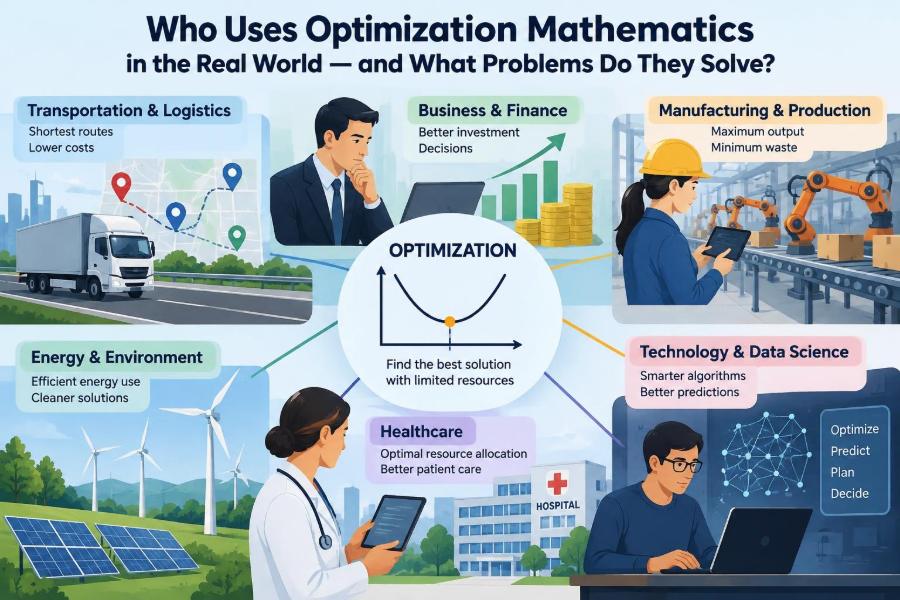

A delivery van has limited space, several urgent stops, traffic to avoid, and a driver who must finish before a shift ends. A hospital has a fixed number of beds, staff with different skills, and patients arriving unpredictably. A factory must decide what to make next week while materials, machine time, and customer orders all compete.
None of these decisions is solved well by simply choosing the first reasonable option. Each involves trade-offs: lower cost versus faster service, high output versus reliable quality, or a full schedule versus enough flexibility for surprises.
This is where optimization mathematics appears. Often working quietly inside software, spreadsheets, and planning systems, it helps people choose a best feasible decision from many possible alternatives.
Optimization is not a magic button that removes judgment. It is a disciplined way to state goals, respect real limits, compare choices, and understand what must be sacrificed when every desirable outcome cannot happen at once.
🧭 What optimization mathematics actually does
Optimization is the mathematics of choosing values for decision variables to maximize or minimize an objective while satisfying constraints. A decision variable might be the number of vehicles assigned to a route, units produced, workers scheduled, or megawatts generated.
The objective is the quantity to improve: cost, travel time, waste, emissions, risk, profit, or a carefully weighted combination. Constraints are non-negotiable rules such as capacity, budgets, safety limits, delivery windows, and conservation of material.
A useful mental model is planning a suitcase. You want to pack valuable items, but weight and space are limited. Optimization formalizes that familiar process when there are thousands or millions of choices rather than a few shirts and shoes.
🎯 Why “best” always needs a definition
There is no universally best plan without a stated measure of success. A retailer may seek minimum transport cost; its customers may care more about short delivery times. An emergency service may prioritize response time even when that leaves some vehicle capacity unused.
Good optimization begins by asking: what outcome are we optimizing, for whom, and over what time period? An unclear objective produces a mathematically tidy answer to the wrong operational question.
Organizations often use several objectives. They may minimize cost subject to a service target, or find a set of plans that show the trade-off between cost and carbon emissions. This makes disagreement visible instead of hiding it inside an unexplained formula.
🧱 Constraints turn wishes into workable plans
Constraints distinguish a desirable idea from a plan that can actually be implemented. A production schedule cannot use more machine hours than are available. A school timetable cannot place one teacher in two rooms at the same time.
Some constraints are physical, such as tank volume or road capacity. Others reflect policy, contracts, regulations, skills, fairness, or customer promises. A model that omits a crucial constraint may return an attractive but unusable recommendation.
Modelers also distinguish hard constraints, which cannot be violated, from soft constraints, which can be violated at a stated penalty. Allowing a small penalty for a late delivery may be preferable to declaring the whole planning problem impossible.
📊 The basic building blocks of a model
Most practical optimization models contain the same ingredients, although the surrounding industry language changes. Seeing them clearly helps a team challenge assumptions before trusting a solver.
- Decision variables: choices under the planner’s control.
- Objective function: the score to minimize or maximize.
- Constraints: limits and required relationships.
- Data: costs, demand estimates, travel times, capacities, and other inputs.
- Parameters: fixed assumptions used by the model.
For example, a bakery may decide daily quantities of each product. Demand forecasts, oven time, flour availability, shelf life, and ingredient costs shape the feasible choices.
🏭 Manufacturers plan what to make and when
Manufacturing optimization supports production planning, batch sizing, machine assignment, and sequencing. The question is rarely just “Which product is most profitable?” A factory must also account for setup time, maintenance, material availability, due dates, and inventory limits.
A paint line, for instance, may reduce cleaning time by producing light colors before dark colors. Yet it cannot simply group every light-color order if some dark-color orders have earlier delivery commitments. The optimized schedule balances those competing effects.
These models are particularly useful when small choices accumulate. One unnecessary changeover may be manageable; dozens across a week can reduce output and make delivery promises harder to meet.
📦 Logistics teams choose routes, loads, and networks
Routing is one of the most recognizable applications of optimization. Dispatchers decide which vehicles serve which customers, in what order, with what loads, and sometimes from which depot.
The classic vehicle-routing problem grows rapidly as more stops, vehicle types, time windows, and driver rules are included. Real systems may also include road restrictions, refrigeration needs, charging requirements, and uncertainty in travel times.
An optimized route does not necessarily look intuitively shortest on a map. It may avoid a late arrival, respect a vehicle weight limit, combine nearby stops efficiently, or reserve capacity for a priority collection later in the day.
🛒 Retailers balance availability against waste
Retail optimization connects forecasting with replenishment. Stores want popular products available when customers want them, without filling shelves and warehouses with stock that becomes obsolete, damaged, or perishable.
For fresh food, ordering too little causes lost sales; ordering too much can create waste. The appropriate decision depends on forecast uncertainty, shelf life, delivery frequency, storage space, and the cost of disappointing customers.
Assortment decisions add another layer. A retailer may have room for only a limited number of product variants. Optimization can identify a mix that meets demand patterns while using constrained shelf space sensibly.
🏥 Hospitals allocate scarce capacity carefully
Hospitals use optimization for staff rostering, operating-room schedules, bed management, appointment planning, and supply distribution. These are sensitive applications because efficiency must never displace clinical judgment or patient safety.
Consider operating rooms: procedures have uncertain durations, surgeons and specialist teams have availability constraints, and emergency cases can arrive without warning. Leaving no buffer may maximize scheduled minutes on paper but cause severe disruption when reality differs.
Good healthcare models therefore include service priorities, safety policies, staffing qualifications, and resilience. Their role is often to support planners with better options, not to make autonomous clinical decisions.
🚑 Emergency services position resources before calls arrive
Ambulance, fire, and rescue services face a location problem: where should resources wait so that likely incidents can be reached quickly? Historical patterns can help estimate demand, but calls are inherently uncertain.
Coverage models may seek to place stations or standby vehicles so that as many people as possible are within a target response area. More detailed models account for a vehicle already being busy when the next call arrives.
The ethical dimension is central. A model that only minimizes average response time can hide poor service for smaller or remote communities. Equity-oriented measures and minimum coverage requirements can change the recommended deployment.
✈️ Airlines coordinate an interdependent system
Airline planning includes fleet assignment, crew scheduling, gate allocation, maintenance routing, and passenger rebooking. These decisions are linked: an aircraft delayed on one flight may affect crew legality, gate availability, and later connections.
Optimization helps create schedules that use expensive aircraft and crews effectively while observing safety, maintenance, labor, and airport constraints. When disruption occurs, rapid re-optimization can compare recovery options.
A plan with the fewest canceled flights is not automatically best if it produces extreme delays for many passengers or puts crews out of legal duty limits. The objective must reflect the operational priorities of the moment.
⚡ Power systems match supply and demand
Electricity must be balanced continuously: generation and demand must remain aligned within the operating requirements of the grid. Power-system optimization determines which generators to run, how much each should produce, and how power should move through the network.
Generators differ in fuel cost, ramping speed, minimum output, emissions, and start-up time. Transmission lines have limits, while weather-dependent renewable generation adds uncertainty.
Grid operators use specialized models and engineering safeguards because a least-cost dispatch that ignores network physics or reserve requirements would not be safe. Optimization works inside a broader reliability framework.
🔋 Energy storage needs a time-aware decision
A battery has value because it can shift energy through time. Charging now means less capacity available for a possible later opportunity, while discharging now may protect the grid or avoid buying expensive power.
Storage optimization considers state of charge, charging losses, power limits, degradation, forecasts, and contractual obligations. These models can also schedule industrial loads, such as cooling or pumping, around energy availability.
Forecasts matter greatly. A plan based on expected wind or prices may need updating as conditions change. Rolling optimization repeatedly solves the near-term problem using the newest available information.
🚦 Cities improve traffic signals and public transport
Urban planners and transport agencies optimize traffic-signal timing, bus schedules, train timetables, vehicle circulation, and maintenance windows. The objective may be lower passenger delay, improved reliability, reduced congestion, or better connections.
Optimizing a single intersection can accidentally move a queue downstream. Network models try to account for these interactions, although real travel behavior and incidents make perfect prediction impossible.
Public transport introduces fairness questions too. A timetable that improves the average journey may worsen access for people who rely on infrequent routes. Planning criteria should therefore include more than a citywide average.
🏗️ Construction managers sequence work and equipment
Construction projects require tasks to happen in a feasible order. Concrete cannot be poured before formwork is ready, and crews cannot safely work in the same restricted area at the same time.
Scheduling models represent dependencies, labor availability, equipment, materials, weather-sensitive tasks, and contractual milestones. They can reveal which activities lie on the critical path: a sequence whose delay delays the entire project.
The result is not a promise that nothing will change. It is a structured baseline for deciding where delays matter most and where resources can be reassigned without harming completion.
💧 Water utilities manage flows, pressure, and treatment
Water systems use pumps, reservoirs, pipes, and treatment facilities with physical and operational limits. Optimization can schedule pumping to maintain service and storage while managing energy use and equipment wear.
Because electricity costs and demand can vary through the day, pumping at one time rather than another may change operating cost. However, minimum pressure, water-quality requirements, and emergency reserves remain essential constraints.
Leakage, uncertain consumption, and aging infrastructure limit model accuracy. Engineers use optimization alongside hydraulic models, field measurements, and operator experience rather than treating it as a replacement for them.
🌾 Farmers optimize under biological uncertainty
Agricultural decisions include crop allocation, irrigation scheduling, fertilizer application, harvest planning, and machinery routes. Land quality, weather, water availability, market conditions, and crop rotations all influence the feasible choices.
An irrigation model may prioritize fields when water is limited, but it needs agronomic knowledge to avoid treating crops as interchangeable units. Soil conditions and crop growth stages can make the same amount of water have very different value.
Optimization can clarify trade-offs between yield, water use, labor, and environmental impacts. It cannot remove uncertainty from weather or guarantee a harvest outcome.
💰 Finance uses optimization to manage trade-offs, not predict certainty
In finance, portfolio optimization allocates investments according to objectives such as expected return, risk exposure, liquidity, and diversification. Other applications include cash management, transaction scheduling, and risk-limiting decisions.
Financial models depend strongly on assumptions about future returns, correlations, and trading costs. These quantities can change sharply, so an optimized portfolio is not a prediction or a guarantee of performance.
Robust limits, scenario testing, and human oversight are especially important. A model that appears sophisticated can still create concentrated risk if its inputs or assumptions are poorly chosen.
📡 Telecommunications allocate limited network resources
Telecommunications providers decide how to allocate radio spectrum, route data, place infrastructure, and manage network capacity. Users expect fast, reliable service, but bandwidth and equipment are finite.
Network optimization may steer traffic away from congested links, assign frequencies to reduce interference, or plan expansion where demand is expected to grow. The system often needs answers quickly, sometimes in near real time.
The challenge is that local improvements can create wider effects. Routing more users through one link may relieve another but introduce delay elsewhere, so models must reflect the network as a connected whole.
🧪 Scientists design experiments efficiently
Optimization is not only used to run operations; it also helps decide what information to collect. In experimental design, researchers choose settings, samples, or measurements that are expected to provide useful evidence within limited time and budget.
Engineers may optimize the shape of a component, control settings in a test rig, or combinations of materials to investigate. The aim is often to learn efficiently, not merely to maximize an immediate output.
Experimental optimization requires care around measurement error and model validity. A result may be optimal for the tested conditions but not automatically for a wider population or operating range.
🧑💼 Workforce scheduling must respect people
Call centers, warehouses, hotels, transit operators, and service organizations schedule people to cover variable demand. The model must match skills and staffing needs while honoring availability, rest periods, contracts, and preferences.
A schedule that covers every busy hour but repeatedly assigns undesirable shifts to the same workers may be technically feasible and operationally damaging. Fairness can be modeled through limits on consecutive nights, balanced workloads, or preference penalties.
Transparency matters. Staff should understand the rules affecting schedules and have a way to correct inaccurate availability or exceptional circumstances. Optimization should support humane management, not obscure it.
♻️ Waste and circular-economy systems choose better flows
Waste-management optimization determines collection routes, transfer-station use, recycling allocations, and treatment or disposal choices. The goal may combine cost, emissions, capacity, and recovery of useful materials.
In a circular-economy setting, firms can also optimize reuse, repair, remanufacturing, and reverse logistics. A returned product may have several possible pathways, each with different processing needs and value.
Environmental objectives require careful boundaries. Reducing transport distance may lower vehicle emissions but could conflict with a recovery option that saves more material overall. The model should make such assumptions explicit.
🧩 Linear programming is often the starting point
Linear programming is used when the objective and constraints can be expressed as linear relationships. “Linear” means that changing a variable has a proportional, additive effect within the model; there are no products of decision variables or curved relationships.
A simple product-mix problem fits this form: choose quantities of products to maximize contribution while staying within labor and material limits. Linear programs can be solved very effectively, even at large scale.
The method is powerful, but its simplicity is an assumption. Quantity discounts, nonlinear energy losses, queues, and threshold effects may require a different representation.
🔢 Integer decisions capture yes-or-no choices
Many choices cannot be fractional. A company cannot open 0.4 of a warehouse, assign half a bus to a route, or send 2.7 technicians. Integer and mixed-integer optimization handle whole-number and binary decisions.
Binary variables are commonly written as 0 or 1: open or do not open, select or do not select. They allow models to represent logical rules, such as “if this facility opens, at least one supervisor must be assigned.”
These models can be computationally demanding because combinations multiply quickly. In practice, a very good feasible plan delivered on time can be more valuable than an unproven perfect plan that arrives too late.
🌊 Nonlinear and dynamic models handle richer behavior
Some systems have relationships that are not linear: chemical reactions, fluid flow, aerodynamic forces, battery behavior, and certain pricing or demand responses. Nonlinear optimization addresses these curved or interacting effects.
Dynamic optimization adds time and state. The decision now changes what is possible later, as with reservoir levels, inventory, battery charge, or disease-control resources.
Greater realism can bring greater difficulty. A more complex model may be harder to solve, explain, validate, and maintain. The right model is usually the simplest one that captures decisions that materially affect the outcome.
🔍 Data quality can matter more than solver sophistication
An optimizer uses the data and assumptions it receives. Incorrect product dimensions, stale travel times, missing maintenance limits, or biased demand forecasts can push even an excellent algorithm toward poor recommendations.
Data preparation includes checking units, definitions, duplicates, missing values, and whether a number describes a typical condition or a worst case. It also requires conversations with the people who generate and use the data.
A practical test is to ask whether the recommended plan makes operational sense. A surprising result may reveal an insight, but it may also expose a data error or an omitted constraint.
🧪 Validation means testing the model against reality
Validation asks whether the model is adequate for its intended decision. Teams may compare outputs with historical operations, inspect extreme cases, review plans with domain experts, and test whether constraints are truly respected.
Scenario analysis is essential when demand, travel time, prices, or availability are uncertain. Instead of asking only for one best plan, ask what happens if demand is higher, a machine fails, or a key route is unavailable.
A model should also be monitored after deployment. When operations change, yesterday’s assumptions may no longer describe today’s system.
🛡️ Robustness beats fragile perfection
A plan can be optimal for a single forecast and still fail under small disruptions. Robust optimization and related approaches seek plans that remain acceptable across a range of plausible conditions.
For example, a delivery schedule may leave spare vehicle capacity, or a production plan may retain material buffers. Such choices can cost more in the nominal case but reduce costly failures when demand or supply changes.
The right amount of protection depends on consequences. A low-stakes promotional shipment can tolerate more risk than a hospital supply plan or a power-system reserve decision.
⚖️ Fairness, safety, and ethics belong in the formulation
Optimization does what it is asked to do, not what its users vaguely intend. If the sole objective is cost reduction, the resulting plan may place burdens on workers, neighborhoods, or customers with less power to object.
Ethical design can include explicit safeguards: maximum workload differences, minimum service levels, protected safety margins, explainable decision rules, and review of who benefits and who bears risk.
Not every value can be reduced cleanly to one number. In high-impact settings, optimization should inform accountable human decisions, with clear escalation when a recommendation conflicts with safety, rights, or professional judgment.
🧠 Common mistakes when applying optimization
Several errors recur across industries. They are usually modeling and implementation problems, not failures of mathematics itself.
- Optimizing a convenient metric rather than the real goal.
- Leaving out practical rules known by experienced operators.
- Treating uncertain forecasts as exact facts.
- Using a solution without explaining it to the people who must carry it out.
- Measuring success only at launch instead of tracking real outcomes.
A model earns trust when users can see why it recommends a plan, identify its assumptions, and raise legitimate exceptions.
🧰 A practical workflow for solving real problems
Successful projects generally start small enough to learn quickly. First define the decision, decision-maker, objective, constraints, time horizon, and consequences of a bad recommendation.
- Map the current process with domain experts.
- Collect and clean the data needed for the first model.
- Build a transparent baseline model.
- Validate it with historical cases and operational review.
- Test scenarios, then pilot the decision process.
- Monitor outcomes and revise assumptions over time.
This workflow prevents a common trap: building an impressive model before confirming that it solves a decision anyone can act on.
🎓 Skills that make optimization useful at work
Mathematics matters, including algebra, calculus, probability, linear algebra, and discrete reasoning. But real-world optimization also needs programming, data handling, visualization, and the ability to translate a messy process into a clear model.
Equally valuable are communication skills. A planner, manager, nurse, dispatcher, or operator may know a constraint that never appears in a database. Listening well often improves a model more than adding a sophisticated algorithm.
Students can begin with small spreadsheet models, then progress to optimization software and code. The enduring skill is not memorizing one solver; it is learning to frame decisions precisely.
🌍 The central lesson: optimize decisions, not just numbers
Optimization mathematics is used wherever scarce resources must be allocated among competing needs: time, money, energy, space, materials, equipment, and human attention. Its reach extends from a local workshop schedule to regional transport and energy systems.
Its value comes from making trade-offs explicit. Rather than relying only on intuition, organizations can compare feasible choices, test assumptions, and explain why one plan was selected over another.
But the model is always a representation, not the entire world. The strongest applications combine sound mathematics with reliable data, domain expertise, uncertainty testing, ethical safeguards, and feedback from the people affected.
Optimization is most valuable when it helps people make clearer, fairer, and more resilient decisions under real constraints—not when it merely produces the lowest number on a dashboard. 📐🔧🌍