
A pump specification says it can deliver a certain flow rate. A pipe calculation predicts the pressure loss. A spreadsheet combines the two and produces a neat answer with several decimal places. But if one quantity was entered in litres per minute and another in cubic metres per second, the result may be neat, plausible, and completely wrong.
This kind of mistake is easy to make because equations often look like patterns of numbers. Engineering equations are not number recipes, though. Every symbol carries a physical meaning, and its dimension is part of that meaning.
Dimensional consistency is the discipline of making sure that an equation describes quantities of the same physical kind on both sides. It is one of the fastest ways to find a flawed model, a missing conversion, or a misused formula before that error reaches a drawing, prototype, plant, or safety calculation.
The rule is simple. Its consequences reach from first-year mechanics to simulation software, control systems, and professional design reviews.
🧭 What dimensional consistency means
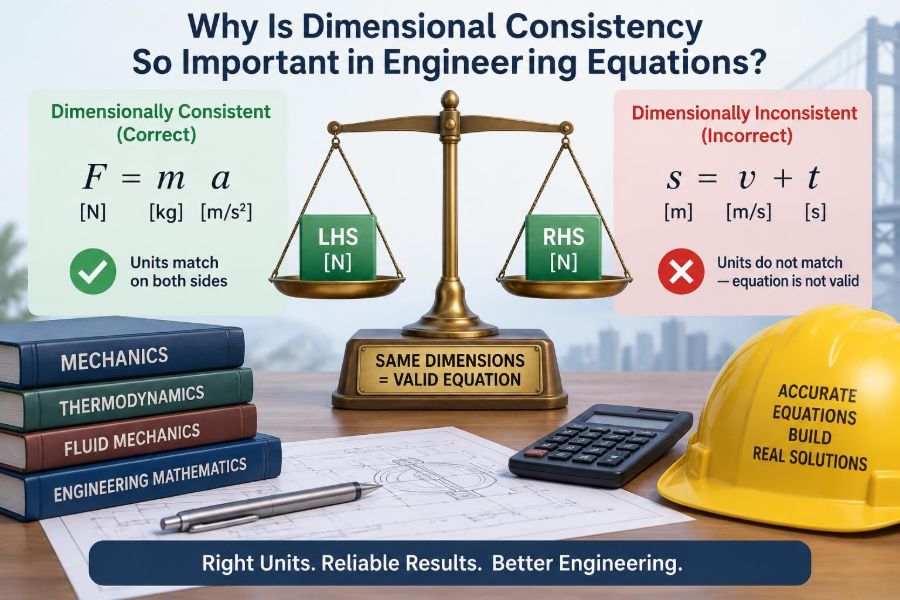
An equation is dimensionally consistent when every term that is added, subtracted, or compared has the same dimensions, and when the dimensions on the left-hand side match those on the right-hand side.
For example, displacement in constant-acceleration motion can be written as s = ut + ½at². The displacement s has dimensions of length, written [L]. Initial velocity times time gives [LT⁻¹][T] = [L], and acceleration times time squared gives [LT⁻²][T²] = [L]. Every term is a length.
That check says nothing yet about whether the equation suits a particular physical situation. It does say the equation passes a basic structural test.
🏷️ Dimensions are not the same as units
A dimension describes the physical nature of a quantity. A unit is the agreed scale used to measure it. Length has dimension [L]; metre, millimetre, foot, and inch are units of length.
Force has dimensions [MLT⁻²]. A newton is one unit of force, while a pound-force is another. Switching units changes the numerical value, but it does not change the dimension.
This distinction matters because an equation can use metres or feet and still be dimensionally sound. It becomes numerically wrong when values from different unit systems are combined without their conversion factors.
🧱 The base dimensions engineers use
Most engineering dimensional analysis begins with a small set of base dimensions. Mechanical problems frequently need mass [M], length [L], and time [T]. Thermodynamics and electromagnetics require additional dimensions.
| Quantity | Common dimension symbol | Example SI unit |
|---|---|---|
| Mass | [M] |
kilogram, kg |
| Length | [L] |
metre, m |
| Time | [T] |
second, s |
| Temperature | [Θ] |
kelvin, K |
| Electric current | [I] |
ampere, A |
| Amount of substance | [N] |
mole, mol |
Derived quantities are combinations of these. Velocity is [LT⁻¹], pressure is [ML⁻¹T⁻²], and energy is [ML²T⁻²].
➕ Addition is where the rule becomes strict
You may multiply or divide quantities with different dimensions. Area is length times length, and density is mass divided by volume. Addition and subtraction are different: they require like dimensions.
Writing 3 m + 4 s is not merely inconvenient; it has no physical interpretation. Similarly, an expression such as pressure + velocity is invalid unless the velocity has first been converted into a quantity with pressure dimensions through a meaningful relation.
A useful mental test is to read each term aloud. If they cannot all be described in the same kind of quantity, the sum needs scrutiny.
⚖️ Both sides of an equation must balance dimensionally
Newton’s second law provides a familiar example: F = ma. Mass is [M] and acceleration is [LT⁻²], so the right side is [MLT⁻²], exactly the dimension of force.
Suppose someone writes F = mv. The right side has dimensions [MLT⁻¹], which is momentum, not force. A dimensional check immediately reveals that a time-related factor is missing or that the intended physical quantity has been named incorrectly.
This is why checking dimensions should happen before trusting a calculator result.
🔍 Dimensional analysis is a fast error filter
Dimensional analysis means replacing variables with their dimensions and simplifying the result. It is usually faster than re-deriving an equation, especially when reviewing a long calculation or a colleague’s spreadsheet.
For instance, kinetic energy is expected to have dimensions [ML²T⁻²]. In E = ½mv², the factor ½ has no dimension, and [M]([LT⁻¹])² gives the expected result.
It cannot prove that the coefficient is correct, but it can catch an impossible form such as E = ½mv.
🚫 Passing the check does not prove an equation is correct
This limitation is essential. The expressions F = ma and F = 7ma are both dimensionally consistent. So are many incorrect combinations of variables that happen to carry matching dimensions.
Dimensional consistency is therefore a necessary condition, not a sufficient condition for a valid engineering model. The equation must still follow the appropriate physics, assumptions, boundary conditions, and empirical evidence.
Think of it as checking that a key fits a lock’s outline. It does not guarantee the key will turn, but a key with the wrong outline certainly will not.
🧮 Dimensionless constants can hide in plain sight
Pure numbers such as 2, π, ½, and a geometric ratio have no dimensions. They can multiply a physical quantity without changing its dimensions.
Many coefficients in engineering formulas are dimensionless because they arise from geometry, idealized theory, or fitted relationships expressed in carefully chosen variables. Other coefficients are not dimensionless and must carry units to make the equation balance.
Never assume that every symbol called a “coefficient” is unitless. A spring constant in F = kx, for example, has units of force per length.
📏 A simple beam-deflection check
For a simple loading case, a beam deflection may have the form δ = CL³/(EI), where C is a dimensionless factor, L is length, E is Young’s modulus, and I is second moment of area.
The dimensions are [L³] / ([ML⁻¹T⁻²][L⁴]) after including load dimensions in the appropriate numerator. The result reduces to length, as deflection should.
This check is valuable because powers of length are easy to mistype. Replacing L³ with L² may produce a numerical answer, but the dimensions expose the error immediately.
🌊 Fluid mechanics uses dimensions to organize complexity
Fluid flow involves velocity, viscosity, density, pressure, gravity, surface tension, and geometry. Dimensional consistency ensures the terms in a governing equation can be compared meaningfully.
In the Navier–Stokes equations, pressure-gradient, viscous, inertial, and body-force terms are arranged so that each represents force per unit volume. That common dimension allows their relative importance to be assessed rather than merely listed.
When flow conditions change, engineers often rely on dimensionless groups to express those relative effects more clearly.
🌀 Dimensionless numbers make different systems comparable
A dimensionless number is formed by combining dimensional variables so that all dimensions cancel. The Reynolds number, commonly written Re = ρVL/μ, compares inertial and viscous effects in a flow.
Because it has no units, Reynolds number can help compare flows in pipes, around models, and across different scales when the relevant similarity requirements are met. It does not make every pair of flows equivalent; geometry, roughness, compressibility, and other effects may still matter.
Other familiar examples include the Mach number, Froude number, and Nusselt number. Their usefulness begins with dimensional structure.
🧪 Buckingham Pi theorem provides a systematic route
The Buckingham Pi theorem formalizes the search for dimensionless groups. If a physical problem involves a chosen number of dimensional variables built from a chosen number of independent base dimensions, the variables can be reorganized into a smaller set of independent dimensionless groups.
In practice, the method helps engineers plan experiments and reduce the number of variables that need to be explored. Rather than testing every possible speed, size, density, and viscosity independently, a test program may focus on the governing combinations.
Choosing variables requires engineering judgment. Omitting a relevant physical effect can produce elegant dimensionless groups that still describe the wrong problem.
🧊 Scale models depend on dimensional similarity
Wind-tunnel models, ship-tank models, and laboratory flow rigs are useful only when the important force ratios are represented appropriately. Geometric similarity alone is rarely enough.
A scaled aircraft model, for example, cannot simply be tested at an arbitrary speed and assumed to predict full-scale behavior. Matching a suitable Reynolds number or Mach number may be important, and sometimes both cannot be matched perfectly in the available facility.
That limitation does not make model testing useless. It means results must be interpreted through the relevant similarity criteria and practical compromises.
🌡️ Temperature needs special care
Temperature differences can be handled in kelvins or degrees Celsius because a change of one kelvin equals a change of one degree Celsius. Absolute temperatures cannot be shifted casually.
For example, an ideal-gas relation uses absolute temperature. Substituting a Celsius reading directly where kelvins are required changes the physical meaning of the calculation.
Expressions involving ratios, logarithms, powers, or exponential functions are especially sensitive. The input must have the form required by the model, often an absolute temperature or a dimensionless temperature ratio.
🔌 Electrical equations have dimensions too
Electrical engineering uses volts, amperes, ohms, farads, henries, and watts, but the same discipline applies. Ohm’s law, V = IR, is dimensionally consistent because resistance has units of volts per ampere.
In a capacitor relation, Q = CV, capacitance must have units of charge per volt. In an inductor relation involving voltage and rate of change of current, the time dimension is indispensable.
Dimensional checks are particularly helpful when moving between mechanical and electrical analogies, where similar mathematical forms can mask different physical meanings.
💻 Software will calculate nonsense faithfully
Most programming languages and spreadsheet tools treat ordinary numeric variables as dimensionless values. If a line of code adds a pressure measured in pascals to one accidentally entered in kilopascals, the software may not object.
Unit-aware libraries, typed quantity classes, and model-based tools can reduce this risk by storing both a value and its unit. They are safeguards, not replacements for understanding: a wrongly labelled input can still pass through a unit-aware workflow.
For critical calculations, make units visible at interfaces: input forms, data files, function names, plots, and report tables.
📊 Spreadsheets create a particular unit risk
A spreadsheet makes it easy to copy formulas down hundreds of rows, which makes a hidden unit error easy to repeat hundreds of times. Column headings alone are not always enough if intermediate cells lack clear labels.
Good practice includes keeping a dedicated units row or field, converting inputs near the point of entry, and separating raw data from normalized calculation data. Named ranges such as pipe_diameter_m communicate more than generic names such as D.
Also inspect orders of magnitude. A dimensional check catches structural errors; a rough engineering estimate catches many conversion errors.
🔄 Unit conversion is algebra, not decoration
Correct conversion multiplies a quantity by a factor equal to one. For example, to convert kilometres per hour to metres per second, use conversion factors arranged so unwanted units cancel.
72 km/h × (1000 m / 1 km) × (1 h / 3600 s) = 20 m/sThe numbers change, but the physical speed does not. Writing units through each conversion step prevents a reversed factor from quietly multiplying a result by a large amount.
📐 Degrees and radians can cause subtle mistakes
Angles are often treated as dimensionless because a radian is a ratio of arc length to radius. Yet radians carry contextual meaning, and that context matters in formulas and software.
Trigonometric functions used in calculus, vibration analysis, and numerical software generally expect angles in radians. A value entered in degrees may yield an output that is mathematically valid for the software but physically unintended.
Be especially careful with angular velocity. It is often written in rad/s, while rotational speed may be supplied in revolutions per minute. The conversion must be explicit.
🧷 Logarithms and exponentials require dimensionless inputs
The expression exp(x) and the logarithm ln(x) require a dimensionless argument. Writing exp(-t) is incomplete if t is time in seconds; a physically meaningful decay law is typically exp(-t/τ), where τ is a time constant.
Similarly, a logarithm of pressure should normally be written as a ratio such as ln(p/p₀), with a reference pressure p₀. The ratio is dimensionless.
This requirement is easy to overlook because notation is often shortened once the reference quantity is understood.
🧠 Nondimensionalization improves numerical models
Nondimensionalization rescales variables using characteristic values, such as a reference length, velocity, temperature, or time. The transformed variables are often near unity rather than spread across many orders of magnitude.
That can improve numerical conditioning and make governing parameter ratios visible. For a heat-transfer model, nondimensional time and position can reveal whether diffusion, convection, or boundary effects dominate the behavior.
It also makes results easier to reuse. A nondimensional solution can often represent a family of physically different systems, provided the relevant dimensionless parameters match.
🛠️ Material properties must match the equation’s unit system
Material data arrives in many forms: elastic modulus, thermal conductivity, density, yield strength, viscosity, and thermal expansion coefficient. Each has dimensions that must align with the rest of the calculation.
For example, elastic modulus might be reported in gigapascals while geometry is entered in millimetres and force in newtons. This can be handled consistently, but only if the selected unit system is carried through every term.
Do not convert values from a handbook by memory alone. Record the supplied unit, the target unit, and whether the property definition itself has a specific reference condition.
🧰 Derived units can conceal the underlying structure
Named SI units make equations readable, but expanding them is often illuminating. A watt is a joule per second, so it has dimensions [ML²T⁻³]. A pascal is a newton per square metre, or [ML⁻¹T⁻²].
When a heat-transfer, vibration, or fluid equation seems confusing, reducing named units to base dimensions can reveal whether its terms truly match. This is also useful when combining datasheets that use different derived units.
You do not need to expand every unit in routine work. Use the technique when an equation, coefficient, or conversion feels uncertain.
⚠️ Common failure: confusing mass with weight
Mass is measured in kilograms and has dimension [M]. Weight is a force, approximately W = mg, with dimensions [MLT⁻²]. They are related but not interchangeable.
The confusion is common in informal language and can lead to errors in force balances, structural loads, and dynamics. A component described as “weighing 10 kg” needs interpretation before entering a calculation: is 10 kg intended as mass, or is a force value required?
State the quantity explicitly. If force is needed, use mass and the appropriate gravitational acceleration or use a specified force value.
🧯 Common failure: mixing gauge and absolute pressure
Gauge pressure is referenced to local atmospheric pressure; absolute pressure is referenced to a vacuum. Both may be expressed in pascals, so dimensional consistency alone cannot distinguish them.
This is a useful reminder of the method’s boundary: quantities can share dimensions and units while having different reference states. Gas-law calculations generally require absolute pressure, while many piping and equipment readings are reported as gauge pressure.
Label pressure values as gauge or absolute in calculations and drawings whenever the distinction affects the model.
🧾 Common failure: trusting a familiar formula outside its assumptions
A dimensionally correct equation can still be applied in the wrong regime. A low-speed incompressible-flow relation may not suit a highly compressible flow. A small-deflection beam equation may not describe a member undergoing large geometric change.
Dimensional consistency checks form, not applicability. Before using a formula, ask what it assumes about material behavior, geometry, loading, time scale, temperature range, and boundary conditions.
This two-part habit is powerful: first verify dimensions, then verify the model.
✅ A practical dimensional-check workflow
Use a short, repeatable process whenever you derive, code, or review an equation:
- Write the intended output quantity and its expected dimensions.
- Assign dimensions or units to every input and coefficient.
- Check each additive term separately.
- Reduce both sides to base dimensions where uncertainty remains.
- Convert all numerical inputs into one declared unit system.
- Estimate whether the final magnitude is physically reasonable.
- Confirm the equation’s assumptions and reference states.
The final two steps matter because dimensional correctness alone cannot detect every mistake.
👥 Communication makes consistency easier to maintain
Unit problems often occur at handoffs: between design and manufacturing, test and analysis, supplier data and internal models, or one software package and another. Clear notation is a technical control, not cosmetic formatting.
Use units in table headings, define symbols near equations, state the chosen unit system, and avoid unexplained abbreviations. In code and reports, include enough context that another engineer can reconstruct what a value means.
A calculation that cannot be audited is harder to trust, even when its final number appears reasonable.
🎓 Building the habit as a student or professional
At first, writing dimensions beside every variable can feel slow. With practice, it becomes a quick pattern-recognition skill: energy, pressure, torque, flow rate, frequency, and stiffness each begin to carry a recognizable dimensional signature.
Students can strengthen the habit by checking every derived formula before inserting numbers. Working professionals can build it into templates, peer reviews, calculation notes, and automated tests.
The goal is not ritual. It is to make physically impossible statements difficult to overlook.
🧩 The core principle to carry forward
Dimensional consistency connects mathematics to physical meaning. It ensures that an equation does not merely manipulate symbols but relates quantities that can sensibly be compared, combined, and measured.
It catches missing factors, exposes invalid additions, guides unit conversion, supports scale-model reasoning, and clarifies the structure of complex governing equations. At the same time, it must sit alongside sound assumptions, correct data, and engineering judgment.
The most reliable engineering calculations are dimensionally consistent, unit-controlled, and physically appropriate to the problem being solved.
Before accepting the next result from a calculator, spreadsheet, or simulation, ask one quiet question: do the dimensions make sense? That small check is one of engineering’s most practical forms of quality control. 📐🔧