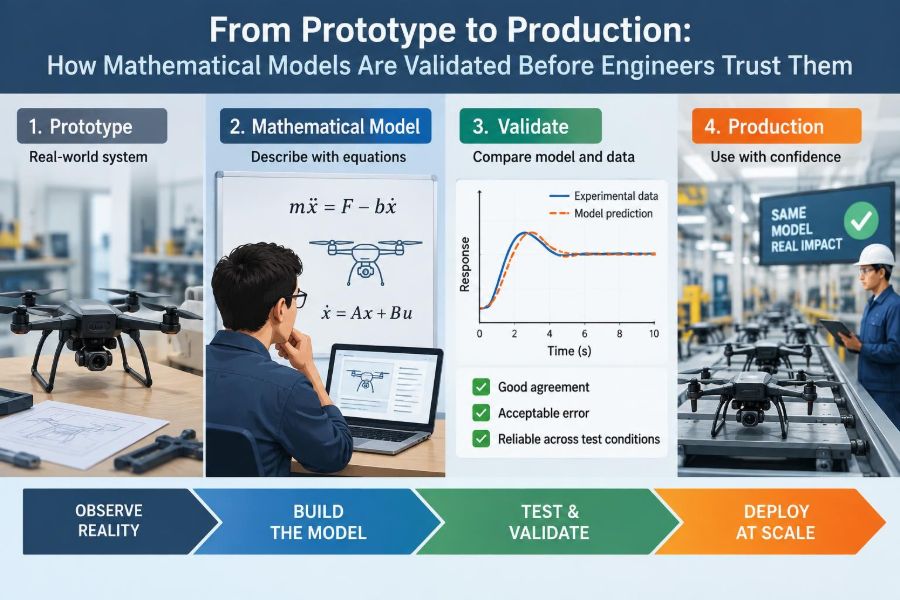

A prototype behaves beautifully in a workshop. Then the weather changes, a supplier substitutes a material, or thousands of users arrive at once. The same design can reveal weaknesses that were invisible on the bench.
That gap is why engineers use mathematical models carefully. A model can predict a bridge vibration, a battery’s temperature, a factory queue, or the pressure inside a pipe—but a prediction is not yet evidence.
Before a model influences a production decision, engineers must ask what it represents, where its data came from, and how badly it can be wrong. Validation is the disciplined process that turns equations from plausible ideas into tools with known limits.
The goal is not to prove that a model is perfect. It is to establish whether it is reliable enough for a particular decision, under stated conditions.
🧭 A model is a purposeful simplification
A mathematical model translates part of a real system into variables, equations, rules, and assumptions. It leaves details out on purpose. A heat-transfer model may represent temperature, conductivity, and airflow while ignoring tiny surface scratches.
That simplification is useful only when omitted effects do not materially change the decision. The “best” model is therefore not always the most detailed one; it is the one that answers the engineering question with adequate accuracy, cost, and speed.
🎯 Trust depends on the intended use
A model suitable for early concept selection may be unsuitable for setting a safety limit. Predicting whether a pump is broadly undersized requires less certainty than predicting its vibration near a damaging resonance.
Engineers define an intended use: the output needed, operating range, acceptable error, and consequence of a bad decision. Validation has no meaning without this context.
🧱 Begin with the physics and the boundary
Every model needs a system boundary: what is inside the calculation and what is treated as an external input. For a building energy model, the boundary might include walls and HVAC equipment while using outdoor temperature and occupancy as inputs.
Clear boundaries prevent a common confusion: blaming an equation for uncertainty that actually comes from an unknown input. They also reveal whether important interactions have been excluded.
🔍 State assumptions where people can inspect them
Assumptions are not embarrassing shortcuts; they are conditions under which a model can be used. A beam model might assume small deflections, uniform material properties, and a rigid support.
They should be written in plain language alongside the equations. If a real component bends enough to change its own load path, a small-deflection calculation may no longer represent the physics.
🧮 Verify the mathematics before testing reality
Verification asks whether the model was built and solved correctly. Validation asks whether the correctly solved model represents reality well enough. The distinction matters because matching a faulty test with a coding error is still not validation.
Verification checks algebra, units, numerical implementation, and whether the solver behaves as intended. It is largely a question about the model and software; validation is a question about the physical system.
📏 Check dimensions and units first
Unit mistakes can produce answers that look numerically reasonable while being physically impossible. Each term added in an equation must have compatible dimensions: a force cannot be added to an energy, and a temperature difference cannot automatically be used as an absolute temperature.
Dimensional checks also expose missing factors. If a predicted pressure loss has units of velocity, the formulation is incomplete or incorrectly implemented.
🧪 Use cases with known answers
Simple benchmark problems are powerful verification tools. A finite-element model of a basic bar in tension can be compared with a hand calculation; a fluid solver can be tested against a flow with a known analytical solution.
These tests do not prove performance for a complex product. They do show whether the computational machinery reproduces behavior it should be able to handle.
🕸️ Test numerical convergence
Many engineering models replace a continuous system with discrete pieces: mesh elements, time steps, grid cells, or iterations. Results can shift simply because the discretization is too coarse.
Engineers refine the mesh or reduce the time step and observe whether the output stabilizes. A result that changes substantially under reasonable refinement is not ready to support a precise claim.
📥 Gather data that represent the real question
Validation data should cover the conditions where the model will be used. Testing a battery model only at room temperature says little about a product expected to operate in winter or inside a hot enclosure.
Data must also be traceable: instrument type, calibration status, test configuration, sampling method, and processing choices affect what a measurement means.
🧰 Measure the inputs as carefully as outputs
Predictions depend on inputs such as loads, material properties, boundary temperatures, geometry, and control settings. If these are poorly known, comparing output alone can create false confidence.
For example, a thermal simulation may disagree with a test because the assumed airflow was wrong, not because the heat-transfer equations were inadequate. Input uncertainty belongs in the validation record.
⚖️ Compare like with like
A useful comparison aligns the model’s output definition with the measured quantity. A simulated point temperature should not be casually compared with a sensor reading that averages temperature over a volume and responds slowly.
Time alignment, coordinate systems, filtering, and operating state all matter. Engineers often build a “comparison plan” before looking at results so choices are not adjusted after an inconvenient mismatch appears.
📊 Look beyond a single good match
One matching data point can occur by chance or through compensating errors. A model should be challenged across multiple loads, configurations, times, and environmental conditions relevant to its use.
Residuals—the differences between prediction and observation—are informative. Their pattern can reveal a missing mechanism: an error that grows with speed, for instance, may point toward an unmodeled aerodynamic effect.
🧷 Calibration is not validation
Calibration adjusts uncertain parameters so a model agrees with selected data. It can be legitimate when parameters represent real but unknown properties, such as a heat-transfer coefficient.
Validation should then use separate data, preferably from different tests or conditions. Testing on the same data used to tune the model mainly demonstrates that the tuning process worked.
🧩 Avoid fitting noise
Adding parameters can lower the error on calibration data while making predictions worse elsewhere. This is overfitting: the model learns accidental measurement variation rather than stable physical behavior.
A model with fewer parameters may be more useful when it is easier to interpret, less sensitive to noise, and performs consistently on independent cases.
🌡️ Validate across the operating envelope
An operating envelope is the set of conditions the product is expected to encounter: temperatures, loads, speeds, voltages, materials, and user behaviors. Validation should sample the envelope, including meaningful edges.
Extrapolation beyond tested conditions is inherently riskier. A model may be accepted within a stated range while requiring additional evidence before use outside it.
🎲 Quantify uncertainty instead of hiding it
No measurement is exact, and no model includes every effect. Uncertainty can arise from sensor error, variability in manufacturing, imperfect inputs, simplifications, and numerical approximation.
Rather than reporting only one predicted value, engineers may report a range, confidence bounds, or a distribution. The method chosen should fit the decision and the evidence available.
📈 Sensitivity shows what deserves attention
Sensitivity analysis changes one input or parameter within a plausible range and tracks the effect on an output. If a small change in friction causes a large change in stopping distance, friction deserves better measurement and tighter control.
Conversely, inputs with little influence may not justify expensive data collection. Sensitivity turns uncertainty management into a practical prioritization exercise.
🛡️ Connect error to engineering risk
An average error metric alone does not determine acceptability. Underpredicting temperature by a small amount near a material limit can be more serious than a larger error in a noncritical efficiency estimate.
Acceptance criteria should reflect consequences: safety margins, product performance, regulatory requirements where applicable, cost of failure, and available safeguards. A model is judged for the decision it supports, not by an abstract score.
🏭 Include manufacturing variation
Production parts are not identical prototypes. Thickness, stiffness, surface finish, assembly preload, and electronic component values can vary within tolerances.
Robust models represent this variation where it matters. A design that works only for nominal dimensions may fail to deliver consistent production performance, even if the prototype comparison was excellent.
🔄 Use experiments to improve the model
Validation is iterative. A mismatch prompts investigation: was the test repeatable, was an input mischaracterized, was an assumption violated, or is a physical mechanism missing?
The response should be evidence-driven rather than cosmetic parameter adjustment. Each revision needs renewed verification and comparison so the team understands what improved and what uncertainty remains.
🧠 Combine physics models and data models carefully
Physics-based models encode conservation laws and known mechanisms. Data-driven models learn patterns from examples. Hybrid approaches can be effective—for example, using a physical thermal model with data-based correction of a difficult boundary condition.
But data-driven components require representative data and monitoring for changed conditions. A model trained on one machine, material batch, or operating regime may not transfer safely to another.
🗂️ Keep a validation trail
Trust must survive staff changes, design reviews, and audits. Documentation should identify the model version, governing assumptions, code or solver settings, input sources, test setup, comparison results, limitations, and approval basis.
- What decision may this model support?
- Which conditions were tested, and which were not?
- What error or uncertainty remains?
- When must the model be revalidated?
This record makes model use reviewable rather than dependent on memory.
👥 Separate development from independent review
Model developers know the details, but that familiarity can make assumptions harder to notice. Independent reviewers can challenge boundary conditions, data selection, implementation choices, and whether the evidence actually supports the claimed use.
Review is not a search for blame. It is a structured way to reduce confirmation bias before a design decision becomes expensive to reverse.
🚨 Watch for warning signs
Several patterns should slow a team down:
- Agreement is shown only for hand-picked cases.
- Parameters are repeatedly changed without physical justification.
- Results are quoted with more precision than inputs support.
- Test conditions differ materially from modeled conditions.
- A model is used outside its stated range without new evidence.
None of these automatically invalidates a model, but each requires explanation and corrective work.
🚗 A simple vehicle-braking example
Consider a hypothetical model estimating braking distance. It may combine vehicle mass, speed, tire-road friction, brake force, slope, and response delays. Verification checks that the equations, units, and software produce sensible results in simple cases.
Validation compares predictions with controlled braking tests across relevant speeds, loads, tire conditions, and surfaces. If the model was tuned using dry-road tests, wet-road tests should not be presented as independent validation.
Sensitivity may show that surface friction dominates uncertainty. The production decision might then use conservative friction assumptions, improve sensing, or limit the model’s approved operating conditions.
⏳ Revalidate when the system changes
A validated model is not permanently validated. New materials, revised geometry, different suppliers, updated control software, or a changed use case can break the connection between model and product.
Change control should identify which assumptions and parameters are affected. Sometimes a focused comparison is enough; substantial changes may require a new validation campaign.
🧭 Know when a model is good enough
Engineering rarely waits for perfect information. The practical question is whether remaining uncertainty is understood, bounded, and acceptable for the intended decision.
A transparent model with known limitations is usually safer than a sophisticated-looking model whose assumptions, data, and failure modes are unclear.
✅ The core principle: evidence earns trust
Reliable modeling follows a chain: define the decision, formulate assumptions, verify the mathematics and implementation, obtain representative data, compare independently, quantify uncertainty, and document limits.
That chain does not eliminate judgment. It makes judgment visible and testable. Production engineering becomes more defensible when a model’s confidence is earned through evidence rather than granted because its graphs look convincing.
Engineers trust mathematical models not because they are elegant, but because their assumptions, calculations, and predictions have been challenged against the reality they are meant to guide. 📐🧪🏭