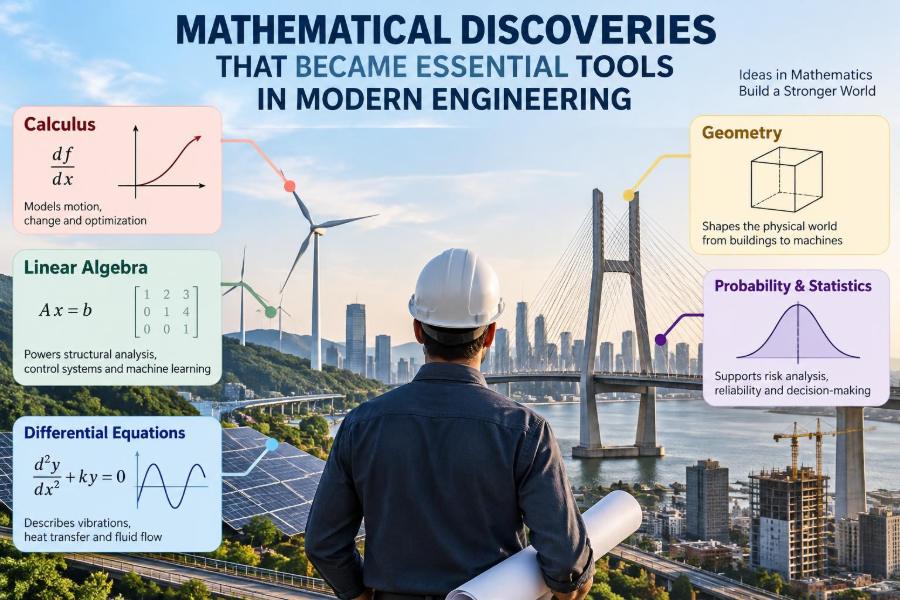

A navigation app quietly estimates your location while a bridge monitoring system filters vibration data, a smartphone compresses an image, and a power grid balances supply with demand. These systems look unrelated, but they rely on mathematical ideas that were often developed long before their practical use was obvious.
For engineering students, mathematics can sometimes feel like a sequence of disconnected courses: calculus, matrices, differential equations, probability, numerical methods. In practice, these subjects form a working toolkit for describing change, managing uncertainty, making predictions, and designing systems that must perform reliably.
The story is not that mathematics magically solves engineering problems. Models make assumptions, measurements contain errors, and real materials behave imperfectly. But mathematical discoveries give engineers a disciplined way to turn a physical question into quantities that can be calculated, simulated, tested, and improved.
Understanding where these tools came from and what they actually do makes the formulas easier to remember—and much easier to use well.
🧭 Mathematics as an Engineering Language
Engineering begins with a physical objective: carry a load, regulate a temperature, send a signal, reduce fuel use, or prevent a failure. Mathematics supplies a compact language for stating relationships between the relevant quantities.
A useful model does not reproduce every detail of reality. It retains the effects that matter for a decision. A beam model may represent geometry, material stiffness, and loading while initially ignoring tiny surface imperfections. The right level of detail depends on the risk, the available data, and the question being asked.
📏 Geometry Turned Space into Design Data
Geometry is among the oldest mathematical discoveries, yet it remains central to modern design. It describes shape, distance, angles, area, volume, curvature, and spatial relationships.
Computer-aided design systems use geometric representations to define parts precisely. Civil engineers use coordinate geometry to lay out roads and tunnels; mechanical engineers use it to check clearances and fit; robotic systems use it to reason about position and orientation.
The key insight is simple: a shape becomes engineerable when it can be measured, parameterized, and transformed without losing its intended meaning.
📐 Trigonometry Made Angles Practical
Trigonometry relates angles to lengths through sine, cosine, and tangent. It became essential wherever forces, rotations, waves, surveying, or periodic motion appear.
Consider a cable supporting a suspended load. The tension is not purely vertical or horizontal. Trigonometric components let an engineer resolve that single force into directions that match the support geometry.
In electrical engineering, sinusoidal functions also describe alternating-current signals. The same mathematics that helps survey a hillside helps analyze voltage that rises and falls repeatedly over time.
🧮 Algebra Made Unknowns Manageable
Algebra introduced a powerful habit: represent an unknown quantity with a symbol and manipulate relationships logically. That may sound elementary, but most engineering design decisions still begin with an equation containing quantities that must be found.
For example, a simple energy balance can relate heater power, heat loss, and target temperature. Rearranging the equation reveals what power is required under the stated assumptions.
Algebra also encourages dimensional checking. If an equation intended to calculate force produces units of energy, the model or calculation deserves another look.
🧱 Calculus Captured Continuous Change
Calculus gave engineers a way to reason about quantities that change continuously. A derivative describes a local rate of change; an integral accumulates many small contributions into a total.
Velocity is the rate of change of position. Acceleration is the rate of change of velocity. The total mass of a non-uniform component can be found by integrating density over its volume.
Calculus matters because engineering systems rarely remain perfectly static. Loads vary, fluids move, temperatures diffuse, and signals evolve. It provides the language for these changes rather than treating them as disconnected snapshots.
🚗 Derivatives Reveal Sensitivity and Motion
A derivative does more than calculate speed. It indicates sensitivity: how much an output changes when an input changes slightly.
In vehicle dynamics, derivatives connect position, velocity, acceleration, and jerk—the rate at which acceleration changes. Large jerk can make a ride feel abrupt even when acceleration remains within acceptable limits.
In design optimization, sensitivity shows which dimensions strongly influence stress, cost, or performance. This helps engineers focus tolerances and testing effort where they have the greatest practical effect.
🫗 Integrals Turn Local Effects into Totals
An integral adds small pieces across distance, area, volume, or time. Pressure on a dam wall varies with depth, so the total force is not found by multiplying one pressure value by the entire area unless an appropriate average has been established.
Similarly, electrical energy is accumulated power over time. A sensor log may record instantaneous values, while an integral converts those values into a total quantity relevant to battery use or energy billing.
Integration is especially useful when the local condition is known but the overall result is needed for design.
🔄 Differential Equations Described System Behaviour
A differential equation relates a quantity to one or more of its rates of change. It is the natural mathematical form for systems with motion, storage, transport, or feedback.
A mass attached to a spring, for example, has inertia, restoring force, and often damping. Its displacement depends not only on the present force but also on its current position and velocity. A differential equation captures those linked effects.
Heat flow, fluid motion, population balances in chemical processes, and electrical circuits all use related ideas. The equations differ, but the structure—state changing in response to governing laws—is shared.
🌡️ Heat Equations Explained Diffusion
Heat naturally flows from warmer regions to cooler ones. The heat equation describes how temperature changes in space and time when conduction is the dominant mechanism.
This became a practical tool for designing heat sinks, estimating temperature gradients in machine parts, and planning thermal processing. In electronics, local heat generation can shorten component life if it is not carried away effectively.
Real thermal problems may also involve radiation, convection, changing material properties, and contact resistance. The equation is valuable not because it removes those complexities, but because it provides a framework for adding the ones that matter.
🌊 Fluid Equations Put Flow Under Analysis
Fluid mechanics uses conservation of mass, momentum, and energy to describe liquids and gases. These principles lead to equations that support the design of pipelines, pumps, aircraft, ventilation systems, and water networks.
Some flow is smooth and predictable; some is turbulent, with fluctuating eddies across many scales. Turbulence is difficult to resolve fully in practical industrial simulations, so engineers often use approximations and validate them against experiments.
This is an important lesson: a mathematically sophisticated model can still be wrong if its boundary conditions, material inputs, or turbulence assumptions do not match the physical system.
⚡ Complex Numbers Simplified Alternating Signals
Complex numbers combine a real part and an imaginary part. Although they once seemed abstract, they became remarkably useful for representing oscillations and rotations.
In alternating-current circuit analysis, voltage and current may be out of step in time because capacitors and inductors store energy differently. Phasors, represented with complex numbers, turn certain time-dependent relationships into more manageable algebraic ones.
The imaginary unit is not a claim that the circuit is unreal. It is a compact bookkeeping device that preserves both magnitude and phase.
〰️ Fourier Analysis Found the Ingredients of Signals
Fourier analysis expresses a signal as a combination of sinusoidal components at different frequencies. A musical note, motor vibration, or radio transmission may look complicated in time, yet reveal a clearer pattern when viewed by frequency.
Engineers use this perspective to identify unwanted vibration frequencies, design filters, inspect rotating machinery, and allocate communication bandwidth. A prominent frequency peak can point to a repeating physical process, though it is not automatically a diagnosis.
Frequency-domain analysis is powerful because some problems are easier to understand by asking which rhythms are present rather than examining every moment separately.
📡 Sampling Connected Continuous Reality to Digital Systems
Sensors often measure continuous physical quantities, but digital controllers and computers process sequences of numbers. Sampling creates those sequences by measuring at discrete times.
If the sampling rate is too low, fast changes can masquerade as slower ones. This effect, called aliasing, can mislead an instrument or control system. Anti-aliasing filters and suitable sample rates are therefore design choices, not afterthoughts.
Digital audio, medical instrumentation, industrial automation, and communications all depend on matching sampling strategy to the frequencies that the system must preserve.
🧩 Linear Algebra Organised Many Interacting Variables
Linear algebra studies vectors, matrices, and transformations. It becomes indispensable when an engineering problem contains many quantities that influence one another.
A matrix can represent a set of simultaneous equations, a geometric rotation, a network of connected nodes, or measurements from many sensors. Instead of handling each relationship separately, engineers can operate on the whole system in a structured way.
This is one reason matrix methods appear across disciplines: structural analysis, robotics, machine learning, image processing, circuit simulation, and control engineering.
🏗️ Matrices Made Structural Analysis Scalable
A small truss can be analyzed by writing force balances at each joint. For a large structure, the same principle becomes too cumbersome to manage manually. Matrix methods organize the relationship between nodal loads, displacements, and stiffness.
In simplified form, a structural model often takes the shape of a stiffness equation: applied forces equal a stiffness matrix multiplied by displacement values. Solving it estimates how the structure deforms under the modeled loads.
Accuracy still depends on modeling choices: support conditions, connection behavior, material assumptions, load combinations, and whether the structure remains in the assumed range of behavior.
🕸️ Eigenvalues Identified Natural Modes
Eigenvalues and eigenvectors reveal special directions or patterns that a transformation preserves in form. In vibration problems, they help identify a structure’s natural frequencies and corresponding mode shapes.
A mode shape is a characteristic pattern of motion: one part of a structure may move strongly while another remains close to still. If a repeated external force is near a natural frequency, vibration can become much larger than expected.
Engineers use modal analysis to guide design changes, such as adjusting stiffness, mass distribution, damping, or operating speed. It supports judgment; it does not replace checking real excitation sources and constraints.
🎲 Probability Brought Uncertainty into the Model
Measurements vary, material properties scatter, loads fluctuate, and future operating conditions are not fully known. Probability provides tools for describing this uncertainty rather than hiding it behind a single convenient number.
A probability distribution represents the range and relative likelihood of possible values under a stated model. It can help an engineer assess variation in manufacturing dimensions, estimate sensor noise, or evaluate demand patterns.
Probability does not predict exactly what will happen to one individual component. It supports decisions about expected behaviour, variation, and acceptable risk across uncertain conditions.
📊 Statistics Separated Signal from Measurement Noise
Statistics turns collections of observations into evidence that can be interpreted carefully. It helps distinguish a genuine process shift from normal random variation.
In manufacturing, repeated measurements of a diameter may reveal that a machine is drifting toward a tolerance limit. In field testing, statistical methods can help quantify uncertainty around an estimated parameter.
A common mistake is treating a statistical result as a physical explanation. A pattern in data may identify where to investigate, but engineering knowledge is still needed to explain the mechanism behind it.
🎛️ Control Theory Made Feedback Reliable
Feedback control compares a measured output with a desired target, then adjusts an input to reduce the difference. A thermostat is a familiar example: it observes temperature and changes heating behaviour in response.
Modern control theory extends this idea to aircraft attitude, motor speed, chemical plants, robotic arms, and process equipment. It considers stability, response speed, disturbances, sensor noise, and actuator limits.
A controller that reacts too aggressively can cause oscillation. One that reacts too slowly may fail to reject disturbances. Good control design balances competing demands rather than maximizing one metric blindly.
🧠 State-Space Models Unified Dynamic Systems
State-space modelling represents a system through a set of internal variables, called states, that contain enough information to predict future behaviour when inputs are known. Position and velocity are typical states for a moving object.
This approach handles multiple inputs and outputs naturally, which is useful for complex systems such as drones, vehicles, and industrial processes. Matrices describe how states evolve and how sensors observe them.
Not every internal state can be measured directly. Engineers may estimate unmeasured states from available sensor data, but the estimate depends on model quality and measurement reliability.
🔍 Optimization Turned “Best” into a Defensible Choice
Optimization seeks the best available design according to an objective, such as minimum mass, minimum energy use, maximum efficiency, or lowest cost, while respecting constraints.
A bridge component cannot simply be made thinner to save material; it must satisfy strength, stiffness, fatigue, fabrication, and safety requirements. Optimization formalizes this trade-off instead of relying only on trial and error.
The word “best” must always be qualified. The lowest-cost option may not minimize maintenance, emissions, or operational risk. A good optimization problem makes its priorities and constraints explicit.
🗺️ Numerical Methods Made Unsimplified Problems Solvable
Many useful engineering equations cannot be solved exactly in a closed mathematical form. Numerical methods approximate solutions with controlled computational procedures.
Root-finding algorithms locate an operating point, numerical integration estimates accumulated effects, and iterative solvers handle large systems of equations. The result is an approximation, not a license to ignore error.
Practical checks include refining the computational settings, comparing with a simpler known case, examining conservation laws, and asking whether the answer changes materially when the discretization is improved.
🔺 Finite Element Analysis Divided Complexity into Pieces
Finite element analysis, or FEA, breaks a complex object into many smaller elements connected at nodes. Within each element, the field of interest—such as displacement or temperature—is approximated with relatively simple functions.
Assembling the elements produces a system that can estimate stress, deformation, heat flow, and other quantities across a complicated geometry. It is widely used because real components rarely have ideal textbook shapes.
Mesh density matters. A mesh that is too coarse may miss sharp gradients; one that is unnecessarily fine can consume time without improving the decision. The useful question is whether the result has converged sufficiently for its intended purpose.
🧪 Simulation Needs Verification and Validation
Verification asks whether the equations were solved correctly by the code and setup. Validation asks whether the chosen model represents the real system adequately for the intended use.
These are different questions. A simulation can be numerically correct but based on an unrealistic material law. Conversely, a physically reasonable model can produce poor results if units, boundary conditions, or solver settings are wrong.
Comparing a model with known solutions, laboratory tests, field data, and independent calculations builds confidence. Agreement should be interpreted within measurement uncertainty and the limits of the test conditions.
🛡️ Reliability Mathematics Supports Safer Decisions
Reliability engineering uses probability, statistics, physics, and systems thinking to consider how components and systems may fail over time. It is especially relevant where failure consequences are high or maintenance access is difficult.
Redundancy can improve resilience, but it also adds components, interfaces, and possible failure modes. A backup system is useful only if it remains independent enough and is tested or maintained appropriately.
Mathematical risk analysis helps compare scenarios, yet it cannot decide every ethical or operational question. Engineers must also consider consequences, regulations, inspection practices, and conservative design where uncertainty remains significant.
🔐 Number Theory Secured Digital Engineering
Number theory studies properties of integers. For centuries it was viewed largely as pure mathematics, but it became foundational to modern cryptography.
Digital signatures, secure communications, and identity checks rely on mathematical problems designed to be easy to compute in one direction and difficult to reverse without authorized information. The implementation also matters: weak key management, flawed software, or insecure hardware can undermine sound mathematics.
This is a striking reminder that abstract discoveries can become infrastructure once technology creates the right application.
🤖 Discrete Mathematics Built Networks and Algorithms
Not every engineering problem is continuous. Discrete mathematics deals with countable objects, logical statements, graphs, combinations, and algorithms.
A graph represents objects as nodes and connections as edges. It can model transport routes, electrical networks, software dependencies, or communication links. Algorithms can then search for paths, allocate resources, or detect connectivity problems.
As engineered systems become more networked, discrete reasoning becomes as important as traditional continuous modelling.
⚖️ Choosing the Right Mathematical Tool
The most advanced method is not always the best method. A hand calculation may expose the governing physics faster than a detailed simulation, while a detailed model may be necessary when geometry, interactions, or safety consequences demand it.
| Engineering question | Useful mathematical starting point | What to check |
|---|---|---|
| How does a quantity change over time? | Calculus or differential equations | Initial conditions and physical assumptions |
| How do many variables interact? | Linear algebra and matrices | Units, conditioning, and data quality |
| How uncertain is the result? | Probability and statistics | Distribution assumptions and sample limits |
| What design meets competing constraints? | Optimization | Objective definition and omitted constraints |
| What happens in a complex shape? | Numerical simulation or FEA | Mesh, boundary conditions, verification, validation |
Starting with the physical question prevents “tool-first” analysis, where software is selected before the problem has been defined.
⚠️ Common Mistakes When Applying Engineering Mathematics
Errors often arise not from difficult arithmetic but from a mismatch between the model and reality. Several habits reduce that risk:
- Define what each variable means and record its units.
- State assumptions before calculating, especially about loads, geometry, and operating conditions.
- Use limiting cases: does the result behave sensibly when an input becomes very small or very large?
- Check orders of magnitude before trusting many decimal places.
- Separate model uncertainty from numerical precision.
- Compare results with measurements or independent methods when the decision warrants it.
A result with six decimal places may still be uncertain in its first significant digit if the underlying inputs are poorly known.
📚 Learning the Ideas Behind the Formulas
Students often gain more from mathematics when they move repeatedly between four views: physical system, diagram, equation, and computed result. Each view can reveal a mistake the others hide.
For working professionals, revisiting fundamentals is valuable when adopting unfamiliar analysis tools. Ask what is conserved, what changes, what is measured, what is assumed, and what output will influence a real decision.
Small practice problems are useful, but so are model critiques. Taking an existing spreadsheet or simulation and identifying its assumptions is close to the work engineers do every day.
🌟 The Enduring Principle: Abstract Ideas Become Practical Through Models
Geometry, calculus, complex numbers, matrices, probability, and numerical methods were not created as one unified engineering package. Their value emerged as engineers connected abstract structures to physical laws, measured data, and design constraints.
The central skill is therefore not memorizing every formula. It is recognizing the type of problem, choosing a model with appropriate assumptions, calculating carefully, and judging whether the answer makes physical sense.
Mathematics becomes an engineering tool when it remains connected to evidence, uncertainty, and purpose. That connection is what turns symbols on a page into safer structures, cleaner energy systems, reliable devices, and better technical decisions.
The lasting power of engineering mathematics lies in its ability to make complex reality clear enough to question, test, and improve. 📐⚙️🔎