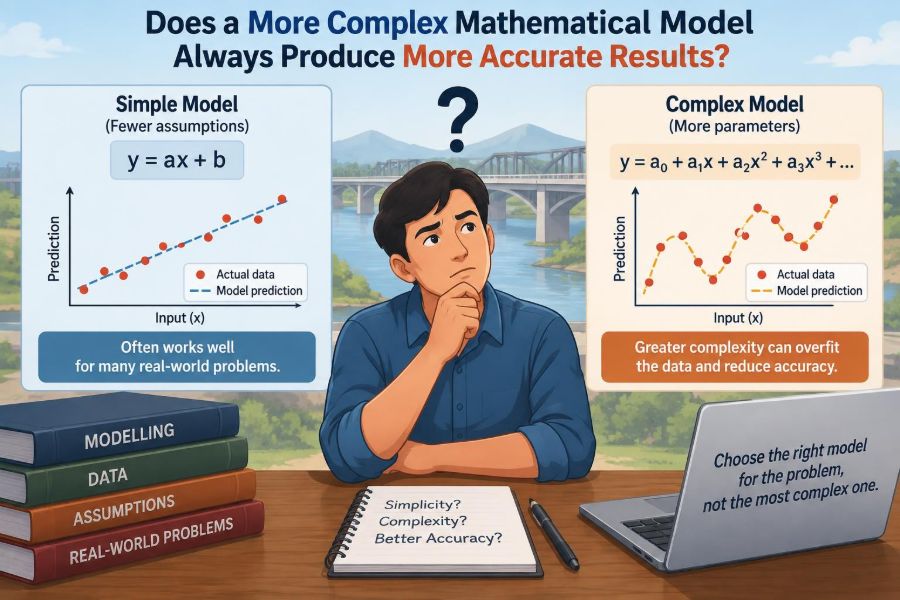

A logistics team needs to predict tomorrow’s delivery delays. One analyst proposes a compact model based on distance, traffic category, and weather. Another builds a far larger system with dozens of inputs, nonlinear equations, and machine-learning components.
The second model looks more sophisticated. It takes longer to run, produces more detailed charts, and can fit historical data extremely closely. But when a road closes unexpectedly or a holiday changes traffic patterns, the simpler model may be the one that gives the more useful forecast.
This situation appears across engineering: estimating structural loads, controlling a motor, forecasting energy demand, modelling fluid flow, or detecting faults in industrial equipment. More detail can help—but it can also amplify noise, conceal bad assumptions, and make a model harder to trust.
The practical question is not whether complexity is good or bad. It is whether a model is complex enough to represent the decision-relevant behaviour, but simple enough to validate, understand, and use reliably.
🧭 What a Mathematical Model Actually Is
A mathematical model is a deliberately simplified representation of a real system. It translates relationships between quantities into equations, rules, algorithms, or statistical patterns.
For example, a basic heat-loss model for a room might relate heat transfer to wall area, insulation, and temperature difference. It does not represent every microscopic interaction of air molecules. It captures the effects that matter for the intended calculation.
Every model leaves something out. That is not a flaw by itself; it is the reason models can be solved, interpreted, and applied.
🎯 Accuracy Depends on the Question
“Accurate” has no useful meaning until the task is defined. A model suitable for choosing a pipe diameter is not automatically suitable for predicting pressure fluctuations every millisecond.
A civil engineer may need a conservative estimate of a bridge’s maximum deflection. A control engineer may need fast, repeated predictions for a feedback controller. A researcher may need to explain a physical mechanism in detail.
These purposes demand different balances of speed, resolution, uncertainty, and interpretability. The best model is therefore fit for purpose, not merely the most elaborate one available.
📏 Complexity Has More Than One Meaning
People often call a model complex because it has many equations. In practice, complexity can enter in several ways: more variables, more parameters, nonlinear relationships, coupled subsystems, finer spatial grids, stochastic elements, or extensive computation.
A model can also be conceptually complex even when its equations are short. A simple-looking formula with poorly understood parameters may be harder to use responsibly than a larger model with transparent physical meaning.
- Structural complexity: the number and arrangement of equations or components.
- Parameter complexity: the number of values that must be estimated or calibrated.
- Computational complexity: the time, memory, and numerical effort required.
- Interpretive complexity: the difficulty of explaining why the model gives its result.
🧩 Why Adding Detail Can Improve Predictions
Complexity can be valuable when an omitted effect has a meaningful influence on the output. A beam model that ignores shear deformation may be adequate for a slender member but less accurate for a deep beam. Adding shear effects can correct a real limitation.
Likewise, a thermal model that treats a battery pack as one uniform temperature may miss hot spots. Dividing the pack into regions can improve safety analysis if temperature gradients affect performance or degradation.
The key is that each added feature should represent a plausible mechanism, not simply make the model appear more advanced.
🪞 The Difference Between Fit and Prediction
A model can match existing measurements extremely well and still predict new cases poorly. This distinction is central to engineering modelling.
Fitting asks how closely model outputs match the data used to tune it. Prediction asks how well the model performs on data it did not see during tuning, especially under conditions close to the intended application.
A curve with many adjustable terms can weave through every measured point. That does not mean it has identified the true underlying relationship. It may simply be following measurement error and chance variation.
🕸️ Overfitting: When Detail Starts Learning Noise
Overfitting occurs when a model adapts so closely to its training data that it captures random fluctuations instead of useful signal. It is common in data-driven models, but the same problem can arise in highly calibrated physical models.
Imagine fitting a polynomial to noisy measurements of a cooling object. A high-order polynomial may pass almost exactly through every point. Yet its behaviour between points or beyond the observed time range can become physically implausible.
A simpler model based on Newton’s law of cooling may leave small residual errors while making more dependable forecasts. The residuals may represent sensor noise rather than missing physics.
📉 Bias and Variance Explain the Trade-Off
A useful framework is the bias-variance trade-off. A model with very rigid assumptions may have high bias: it consistently misses an important pattern. A very flexible model may have high variance: small changes in data produce large changes in predictions.
Increasing complexity can reduce bias because the model can represent more patterns. But it can increase variance because more degrees of freedom are available to chase accidental details.
The aim is not to eliminate either entirely. It is to find a level of flexibility that gives stable, useful performance on realistic future cases.
🔬 Parameters Need Information, Not Just Equations
Every adjustable parameter creates a demand for evidence. If a model contains ten unknown coefficients, it needs data that can identify those coefficients reliably.
This is harder than simply having more measurements than parameters. Measurements may be correlated, noisy, taken over too narrow a range, or insensitive to some parameters. In those cases, several parameter combinations can produce nearly identical outputs.
The model may then look precise while its internal parameter estimates are uncertain. Engineers call this an identifiability problem.
🧪 Calibration Can Hide a Weak Model
Calibration adjusts model parameters so outputs align with observed measurements. It is essential in many applications, from groundwater models to engine simulations. Yet calibration cannot automatically repair wrong structure.
Suppose a pump model ignores a changing valve condition. Its parameters might be adjusted until it matches one operating point. At another flow rate, the neglected valve behaviour may cause large errors.
Good calibration should therefore be paired with testing across operating conditions, not treated as proof that the model represents reality correctly.
✅ Validation Is a Separate Test
Validation asks whether a model is adequate for its intended use. It should use independent evidence wherever possible: new experiments, withheld data, field observations, or known benchmark cases.
For a wind-load model, validation might compare predictions with measurements from conditions not used during calibration. For a control model, it may involve testing response to different inputs and disturbances.
Validation is never a permanent certificate. A model validated for one material, scale, climate, or operating range may need reassessment outside that domain.
🚧 Extrapolation Is Where Models Often Fail
Interpolation means estimating within the range of observed conditions. Extrapolation means predicting beyond it. Complexity does not make extrapolation inherently safe.
A detailed empirical model of a material may reproduce test data at moderate temperatures but fail near a phase change because it was never designed to represent that physical transition. A simpler physically based model may be more credible there, provided its assumptions remain valid.
Before trusting any prediction, ask: Is this case inside the model’s validated domain? If not, uncertainty should increase rather than disappear behind a polished output.
⚙️ Physical Models and Data-Driven Models
Physics-based models use conservation laws, constitutive relationships, and known mechanisms. Data-driven models infer patterns from observations. Neither category is automatically more accurate.
A physics-based model can be limited by uncertain material properties or simplifying assumptions. A data-driven model can be limited by incomplete training data, changing operating conditions, and correlations that do not represent causation.
Hybrid models often work well: physical laws constrain what is possible, while data-driven components estimate difficult terms such as unmeasured disturbances or uncertain degradation effects.
🌡️ Example: Choosing a Thermal Model
Consider a hypothetical electronic enclosure. A lumped-capacitance model treats the enclosure as having one temperature. It can be quick and adequate if internal temperatures remain nearly uniform.
A more complex computational fluid dynamics model can represent airflow paths, local heating, radiation, and geometry in far greater detail. It may be necessary when component hot spots determine reliability.
But if airflow boundary conditions are poorly known, or if the design decision only concerns average warm-up time, the detailed simulation can create an illusion of accuracy. Better input measurements may matter more than more mesh elements.
🏗️ Example: Structural Analysis at the Right Scale
A preliminary building design may use beam-and-column idealisations to estimate loads and deflections efficiently. At this stage, fast comparison of alternatives is often more valuable than highly detailed local stress fields.
Later, a finite element model may examine connections, openings, contact regions, or areas where stress concentration matters. The additional resolution is justified because the question has changed.
Using detailed finite elements everywhere is not automatically safer. Incorrect boundary conditions, mesh distortion, or an unrealistic connection stiffness can dominate the result regardless of how refined the model looks.
📊 Example: Forecasting Demand
An energy manager may forecast electricity demand using recent load, time of day, and temperature. Adding calendar effects, occupancy information, equipment schedules, and weather forecasts can improve predictions when those inputs are reliable.
However, including every available data stream can be counterproductive. An unreliable occupancy proxy or a sensor with gaps can introduce instability. A complex forecasting model may also be difficult to maintain after building operations change.
The useful question is whether each variable improves out-of-sample performance and makes operational sense—not whether it is easy to collect.
🧹 Input Quality Sets an Accuracy Ceiling
A model cannot overcome fundamentally poor input data. If a flow sensor is biased, a geometric dimension is estimated roughly, or a boundary condition is unknown, a more detailed model may merely propagate those uncertainties through more calculations.
This principle is sometimes described informally as “garbage in, garbage out,” but the issue is more nuanced. Inputs can be incomplete, biased, delayed, inconsistent, or measured at the wrong scale.
Before increasing model complexity, examine the uncertainty of the quantities that drive the result. Improving one critical measurement can be more valuable than adding several secondary mechanisms.
🎲 Uncertainty Should Be Part of the Output
A single predicted value can imply more confidence than the evidence warrants. Where decisions are sensitive, models should communicate plausible ranges, scenarios, or sensitivity to uncertain inputs.
For example, instead of reporting one predicted peak temperature, an engineer might assess how the result changes with ambient temperature, thermal conductivity, and heat-generation uncertainty. This identifies which assumptions deserve better data.
Uncertainty analysis does not mean a model is weak. It is often a sign that the modelling process is honest about what is known and unknown.
🔍 Sensitivity Analysis Finds What Matters
Sensitivity analysis changes inputs or parameters and observes the effect on outputs. It helps separate important complexity from decorative complexity.
If changing a parameter across its plausible range barely affects the design decision, refining that parameter may offer little benefit. If a small change dramatically shifts the predicted failure margin, it deserves attention.
This process can reveal a surprising result: the model’s accuracy may be controlled by one uncertain boundary condition rather than by the sophisticated internal equations receiving most of the effort.
🧮 Numerical Error Is Not Physical Accuracy
Many complex models rely on numerical approximations. A simulation may use a fine mesh, small time step, or iterative solver to approximate equations that cannot be solved analytically.
Verification checks whether the equations were solved correctly in a numerical sense. It includes examining mesh convergence, time-step effects, solver tolerances, and implementation errors. Validation checks whether the equations adequately represent the real system.
A numerically converged result can still be physically wrong if the model assumptions or input conditions are wrong. Both questions must be addressed.
🖥️ Computation Has an Engineering Cost
A highly detailed model may require specialist software, substantial computing time, difficult data preparation, and expert interpretation. Those costs matter when decisions must be made quickly or calculations must run repeatedly.
For real-time control of a motor or process plant, a reduced-order model may be preferable because it can compute fast enough to support stable action. The most detailed simulation may remain valuable offline for design and investigation.
Speed is not merely a convenience. In some applications, a slightly less detailed answer delivered in time is more useful than a theoretically richer answer delivered too late.
🗣️ Interpretability Affects Trust and Action
Engineers need to explain decisions to colleagues, clients, operators, regulators, and safety reviewers. A transparent model makes it easier to inspect assumptions, identify failure modes, and judge whether an output is credible.
Interpretability does not require that every model be a hand calculation. It means that its inputs, limits, and main drivers can be understood well enough for responsible use.
When an opaque model recommends an expensive or safety-critical action, decision-makers should seek additional checks rather than treating complexity as authority.
🧱 Parsimony Is Not Oversimplification
Parsimony means using the simplest model that adequately answers the question. It does not mean ignoring inconvenient physics or choosing a simplistic formula because it is easy.
A parsimonious model includes terms with a clear role and removes detail that does not improve the decision. This reduces calibration burden, computational cost, and opportunities for hidden error.
The principle is often associated with Occam’s razor: among explanations that perform similarly, prefer the one with fewer unsupported assumptions. In engineering, “perform similarly” must be judged against the required accuracy and risk.
⚖️ A Practical Comparison of Model Levels
| Model level | Typical strength | Typical risk | Best suited to |
|---|---|---|---|
| Simple analytical model | Fast, transparent, easy to check | May omit local or nonlinear effects | Estimates, screening, early design |
| Intermediate engineering model | Captures key mechanisms with manageable effort | Requires sound assumptions and calibration | Routine design and operational analysis |
| High-fidelity simulation or flexible data model | Can represent detailed interactions | Overfitting, uncertain inputs, high verification burden | Local effects, research, high-consequence decisions |
These categories overlap. A high-fidelity model can be excellent when its inputs, validation, and use case justify it. The table is a decision aid, not a hierarchy of quality.
🪜 Build Complexity in Stages
A robust modelling workflow usually starts with a baseline. Construct the simplest defensible model, compare it with known behaviour, and identify where it fails to meet the required accuracy.
- Define the decision, output, operating range, and acceptable error.
- List important mechanisms and available measurements.
- Build a simple model with explicit assumptions.
- Validate it against relevant evidence.
- Add complexity only where the observed discrepancy or risk justifies it.
- Revalidate after each meaningful change.
This staged approach makes it easier to learn which added features actually improve performance.
🧾 Keep an Assumption Register
Every model relies on assumptions: steady-state operation, uniform material properties, linear response, negligible friction, independent errors, or fixed boundary conditions. Assumptions should be documented rather than buried in software defaults.
An assumption register can record its rationale, expected effect, range of validity, and how it will be checked. This is especially useful when models change hands or are reused months later for a different project.
Clear assumptions also make a model easier to improve. You can target the assumptions with the largest influence instead of adding complexity indiscriminately.
🚩 Warning Signs That a Model Is Too Complex
Complexity becomes a concern when the model cannot be supported by the data, purpose, or team using it. Watch for patterns such as:
- Outputs change dramatically after small adjustments to calibration data.
- Several parameters have no direct measurement or defensible range.
- The model fits historical cases but fails independent tests.
- Users cannot explain the main assumptions or expected failure modes.
- Run times prevent the model from informing the actual decision.
- Detailed outputs are reported with more precision than inputs justify.
None of these signs proves that the model is unusable. Together, they indicate a need for stronger verification, simpler alternatives, or better data.
🛠️ When More Complexity Is Worth It
Additional complexity is justified when it changes a decision in a reliable and material way. This often happens when local effects matter, nonlinear behaviour is strong, interactions between subsystems are important, or safety margins are small.
It can also be worthwhile when the model will be reused many times. A carefully validated high-fidelity model may save effort across a product family or support a critical design decision that cannot be tested easily in full scale.
The justification should be explicit: what missing mechanism is being added, what data supports it, and how will improvement be measured?
🤝 Use Multiple Models When Stakes Are High
For important decisions, confidence often comes from comparing models rather than relying on one elaborate framework. A hand calculation, a reduced-order model, and a detailed simulation can reveal whether results agree on the main conclusion.
Disagreement is useful information. It may expose a sensitive assumption, a coding error, a scale effect, or a mechanism missing from one of the approaches.
Independent checks are especially valuable in safety-critical work, where a single model’s apparent sophistication should never substitute for engineering judgment.
🧠 The Core Principle: Appropriate Complexity
A more complex mathematical model does not always produce more accurate results. It may improve accuracy when it represents a relevant mechanism, uses reliable inputs, can be calibrated meaningfully, and is validated for the intended operating range.
It may reduce practical accuracy when it overfits data, depends on unidentifiable parameters, magnifies uncertain inputs, introduces numerical issues, or becomes too opaque to inspect. Accuracy is a property of the entire modelling process—not a reward for equation count.
The strongest engineering practice is to choose appropriate complexity: enough detail to support a sound decision, with assumptions and uncertainty visible to the people who must act on the result.
The best model is not the one with the most moving parts; it is the one that earns trust by being relevant, tested, and honest about its limits. 📐🔍⚙️