
A bridge designer notices an unexpected vibration in a computer model. A manufacturing engineer sees a production line drifting away from its ideal settings. A water-utility planner needs to estimate flood risk from a storm that has not happened yet.
Each problem contains too many moving parts for intuition alone. Materials respond nonlinearly, measurements arrive with noise, operating conditions change, and the cost of a wrong decision can be substantial.
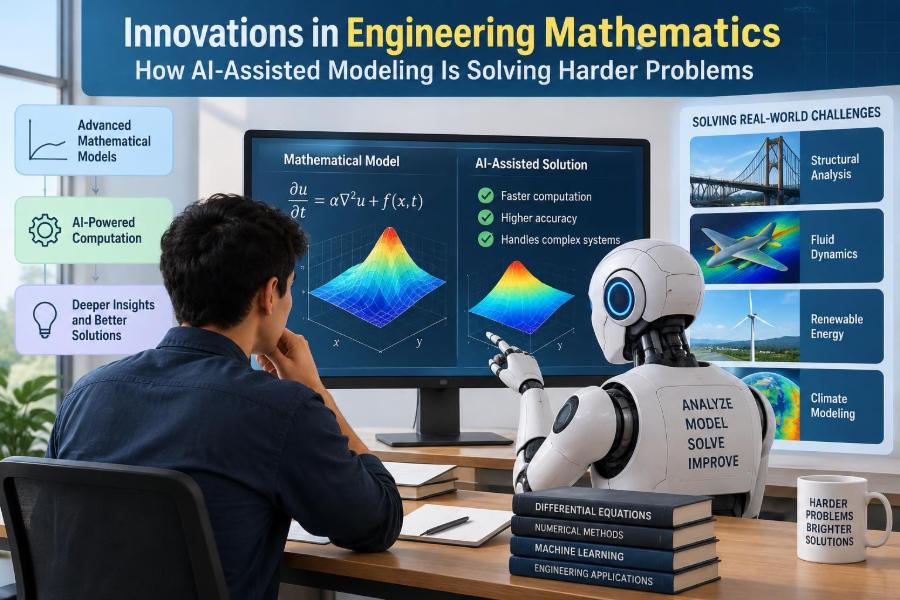
Engineering mathematics gives these situations a workable form: equations, constraints, probabilities, and algorithms. AI-assisted modeling is adding another capability—not replacing that mathematics, but helping engineers build, solve, and interrogate models that were previously too slow, incomplete, or complex to use well.
The useful question is not whether AI can “do the math.” It is whether a combined mathematical and AI workflow can produce decisions that are accurate enough, explainable enough, and reliable enough for the engineering task at hand.
🧭 What AI-Assisted Modeling Actually Means
AI-assisted modeling combines established engineering models with machine-learning methods. The engineering model may be based on conservation of mass, Newton’s laws, heat transfer, circuit theory, or another physical principle. AI contributes patterns learned from data, efficient approximations, or guidance for computational searches.
This is different from asking a general chatbot to answer a technical question. A serious engineering workflow specifies inputs, units, governing assumptions, validation tests, and acceptable error. The output must be traceable to a model and judged against observations or trusted simulations.
📏 Why Engineering Mathematics Remains the Foundation
Mathematics supplies the structure that makes a prediction meaningful. Differential equations describe change over time or space; linear algebra represents coupled systems; optimization chooses among feasible designs; statistics quantifies uncertainty.
Physics-based structure also prevents obviously implausible behavior. A model of a sealed tank should not create mass from nowhere. A structural model should obey boundary conditions, such as supports and applied loads. These requirements matter even when data are plentiful.
AI can improve a model, but it cannot rescue a problem that has been defined without the correct physical quantities, constraints, or operating context.
🧩 The Limits of Traditional Simulation
High-fidelity simulation is often remarkably capable, but it can be expensive. Computational fluid dynamics may divide a flow region into millions of small cells. Finite element analysis may track deformation across a detailed mesh. Repeating either calculation thousands of times for design optimization can become impractical.
Traditional models also depend on parameters that are difficult to measure precisely: surface roughness, material behavior after aging, heat-transfer coefficients, or a poorly known load pattern. A mathematically correct equation can still give a poor operational forecast if those inputs are uncertain.
⚙️ Where AI Adds a New Capability
Machine learning can learn relationships between inputs and outputs from examples. If engineers have many simulated cases or measured operating records, an AI model may estimate a result in seconds that a full simulation needs far longer to calculate.
That speed changes what is possible. Instead of examining a handful of designs, a team can screen a much larger design space. Instead of analyzing equipment after a shift, it may update estimates while the equipment is running.
Speed alone is not a reason to trust a model. It is valuable when paired with error checks, known ranges of validity, and a path back to the underlying engineering reasoning.
🔗 Physics-Informed Learning Connects Data and Laws
Physics-informed machine learning builds known equations or constraints into the training process. For example, a network predicting temperature can be penalized when its predictions violate a heat equation or measured boundary condition.
This approach can be useful when observations are sparse but physical knowledge is strong. Rather than learning any curve that fits the available points, the model is encouraged to learn one that also behaves consistently with the governing system.
It is not a universal replacement for numerical solvers. Training can be difficult, and a poorly posed physical model remains problematic. Still, the approach illustrates a key direction: using AI to work within engineering mathematics rather than outside it.
🗺️ Surrogate Models Make Expensive Calculations Usable
A surrogate model, sometimes called an emulator, is a fast approximation of a slower calculation. Engineers first run a carefully selected set of high-fidelity simulations, then train an AI or statistical model to approximate the input-output relationship.
Consider a hypothetical wind-turbine blade study. Full aerodynamic simulations could be run for selected blade angles, wind speeds, and air densities. A surrogate can then estimate power and loading across many more combinations, allowing rapid design exploration.
The surrogate should never be treated as equally reliable everywhere. It is usually strongest near the conditions represented in its training set and should flag or reject unfamiliar inputs.
🎯 Optimization Becomes More Practical
Engineering design is rarely about maximizing one number. A battery pack may need high energy density, manageable temperature, low mass, manufacturability, cost control, and safety margins. These aims can conflict.
Mathematical optimization formalizes the trade-offs. AI-assisted surrogates reduce the cost of evaluating candidate designs, while optimization algorithms search for combinations that satisfy constraints.
Good practice is to retain explicit constraints rather than hoping an AI will infer them. If a pressure vessel must stay below an allowable stress or a vehicle must meet a stopping-distance requirement, those conditions belong directly in the optimization formulation.
📊 Multi-Objective Design Shows the Trade-Offs
Many design problems produce a Pareto frontier: a set of solutions where improving one objective requires worsening another. For instance, a lighter component may cost more, or a quieter fan may move less air.
AI can help map this frontier quickly, but it cannot decide the organization’s priorities. Engineers and stakeholders still need to choose which trade-off is acceptable for the product, environment, budget, and safety case.
| Modeling task | Mathematical role | Possible AI contribution |
|---|---|---|
| Structural sizing | Stress equations and constraints | Fast response approximation |
| Process control | Dynamic system model | Pattern detection in sensor data |
| Thermal design | Heat-balance equations | Rapid parameter estimation |
| Fleet maintenance | Reliability and probability models | Anomaly scoring from histories |
🏭 Digital Twins Link Models to Operations
A digital twin is a model connected, to varying degrees, with data from a physical asset or process. It may represent a pump, a production line, a building’s energy system, or a transport network.
The term should not imply magic or perfect duplication. Some twins are simple dashboards with a calibrated model; others can estimate hidden states, forecast behavior, and test control actions virtually. Their value depends on data quality, model scope, and maintenance over time.
AI helps when streams of sensor data are too large or variable for manual interpretation. Engineering equations help ensure that the twin remains tied to the physical system rather than merely reproducing historical correlations.
🔍 Parameter Estimation Turns Measurements into Models
Many engineering quantities cannot be measured directly during operation. An engineer may observe temperatures and flow rates but need to estimate a fouling coefficient in a heat exchanger or a stiffness change in a structure.
Parameter estimation uses mathematics to infer those hidden quantities from observations. AI can accelerate the inference process or learn a mapping from sensor patterns to likely parameter values.
The result should include uncertainty. Several parameter combinations can sometimes explain the same data, especially when sensors are sparse. Reporting one precise-looking value without a confidence range can be misleading.
🌊 Fluid Flow Is a Powerful Use Case
Fluid systems are governed by nonlinear equations and can be computationally demanding. Engineers encounter them in aircraft aerodynamics, pipe networks, turbines, ventilation, coastal systems, and chemical equipment.
AI-assisted methods can estimate flow fields, identify operating regimes, or propose improved geometries after being trained on experiments or trusted simulations. A fast estimate is especially useful in early design, where many alternatives need comparison.
However, flow behavior can change abruptly near separation, turbulence transitions, or unusual geometry. These are precisely the conditions where an approximation may need additional testing rather than blind use.
🌡️ Thermal Systems Benefit from Hybrid Models
Heat-transfer models often start with energy balances: heat enters, leaves, is stored, or is generated. The balance is interpretable, but coefficients such as convection rates may vary with operating conditions and be hard to predict exactly.
A hybrid model can preserve the energy balance while using data-driven components for uncertain terms. This is often more informative than a purely black-box forecast because the engineer can distinguish known thermal storage from an uncertain heat-loss mechanism.
For battery management, building HVAC, and industrial ovens, that distinction supports diagnostics as well as prediction.
🏗️ Structural Health Monitoring Detects Change Early
Structures naturally vibrate, and their measured response can shift with temperature, traffic, wind, and use. AI can identify patterns in large vibration datasets and flag a response that differs from the expected operating range.
A flag is not automatically evidence of damage. Seasonal temperature effects, sensor movement, electrical noise, and changes in loading can all alter measurements. The engineering task is to combine statistical anomaly detection with inspection records and structural understanding.
An anomaly is a prompt for investigation, not a structural verdict.
⚡ Power Systems Need Fast, Constrained Decisions
Electrical grids must balance generation and demand while respecting equipment limits and network constraints. Renewable generation and changing demand patterns add variability, making forecasting and operational planning more complicated.
AI can help forecast short-term demand, estimate renewable output, or identify unusual operating behavior. Mathematical optimization then allocates resources subject to voltage, power-flow, and equipment constraints.
Because grid decisions can affect reliability and safety, models require conservative operating procedures, fallback strategies, and human oversight—not just strong performance on historical data.
🚦 Transportation Models Combine Networks and Prediction
Traffic engineering already uses network mathematics to represent roads, junctions, demand, and routing. AI can add short-term forecasts from sensors, cameras, or connected vehicles, helping operators anticipate congestion rather than merely respond to it.
A useful system must consider behavior changes caused by the intervention itself. Diverting traffic away from one route can overload another. The best model therefore couples prediction with network constraints and monitoring after the action is taken.
🧪 Materials Discovery Uses Mathematical Representations
Developing a material involves composition, processing, microstructure, and performance. Testing every plausible combination physically would be slow and costly, so computational models and AI are used to prioritize candidates.
Features such as elemental properties, processing conditions, or simulated descriptors can help a model estimate likely strength, conductivity, or stability. The output is usually best interpreted as a ranking tool: which candidates deserve deeper simulation or laboratory testing?
Experimental validation remains essential. Real manufacturing conditions, impurities, and long-term degradation can reveal effects that a training dataset does not capture.
📡 Sensor Data Is Not Automatically Useful Data
More sensors do not guarantee a better model. A sensor may drift, sample too slowly, be poorly located, or measure a variable only weakly related to the engineering outcome of interest.
Before applying AI, teams should examine units, timestamps, missing values, calibration history, and operating context. A sudden value change may be a genuine event, a maintenance shutdown, or a data-logging fault.
- Record where each measurement comes from and what it represents.
- Check whether sampling rates capture the relevant dynamics.
- Preserve maintenance and operating-event logs alongside sensor values.
- Separate physically impossible readings from rare but valid conditions.
🧹 Data Preparation Is Part of the Engineering Work
Cleaning data is not a clerical step detached from analysis. Removing an “outlier” without understanding it may erase a fault signature. Filling a missing signal without accounting for the gap can create a false smooth trend.
Engineering judgment determines how data should be treated. If a pressure sensor was isolated for calibration, that period should usually be marked rather than blended into normal process data. The model needs context, not just a tidy spreadsheet.
🧠 Explainability Depends on the Decision
Explainability means being able to understand why a model produced a result, at a level appropriate to the risk. A maintenance alert may need to identify the signals and operating changes that caused concern. A safety-critical design recommendation may need far deeper traceability.
Some AI methods are naturally easier to inspect than others. In all cases, engineers can add interpretability through sensitivity analysis, residual plots, feature checks, scenario tests, and comparison with simplified physical models.
A model that cannot be explained at all may still have research value, but it deserves caution when it influences costly or safety-related action.
🧮 Uncertainty Is a Result, Not an Embarrassment
Every model has uncertainty from measurement error, simplified assumptions, variable operating conditions, and limited training data. AI does not remove these sources; in some situations, it can conceal them behind a single confident-looking output.
Useful uncertainty analysis asks questions such as: How much does the output change if an input is slightly wrong? Does the prediction become unstable outside familiar conditions? Which uncertain parameter matters most?
Ranges, intervals, and scenario bands are often more actionable than a single number. They help engineers choose margins and decide when extra measurement or simulation is worth the effort.
🧱 Boundary Conditions Still Matter
Boundary conditions describe what happens at the edges of a modeled system: fixed supports, inlet temperatures, applied voltages, imposed flows, or external loads. They can dominate the result.
AI-assisted tools may make it easier to generate outputs, but they do not make incorrect boundaries harmless. A beautifully resolved model of a component with the wrong mounting condition can lead to a confident but irrelevant conclusion.
When results are surprising, revisit the problem definition before increasing model complexity. Units, geometry, sign conventions, and boundaries are frequent sources of error.
🧯 Extrapolation Is One of the Biggest Risks
Interpolation estimates between examples the model has seen. Extrapolation predicts beyond them. A model trained on normal pump operation may perform well across normal flow rates but fail during cavitation, a startup transient, or a severe blockage.
Physics-based constraints can reduce unreasonable behavior, yet they do not guarantee accuracy in unfamiliar regimes. Teams should define an operating envelope and establish what the system does when inputs fall outside it: warn, reject, revert to a simpler model, or require review.
🧾 Verification and Validation Are Different Checks
Verification asks whether the equations and code were implemented correctly. Validation asks whether the model represents the real system adequately for its intended use.
A program can be verified yet invalid because the physical assumptions are wrong. Conversely, a model might match a small dataset by coincidence while containing implementation errors that appear elsewhere. Both checks are necessary.
🔎 A practical testing sequence
- Test units, simple cases, and known limiting behavior.
- Compare against high-fidelity simulation or measurements not used for training.
- Stress-test unusual but plausible inputs.
- Monitor performance after deployment as conditions evolve.
🧰 Human Review Belongs in the Workflow
Engineers provide the context that models lack: whether a sensor was recently replaced, whether an operating change is planned, whether a predicted design is manufacturable, and whether the risk is acceptable.
Review does not mean manually checking every calculation. It means setting escalation thresholds. Routine, low-consequence estimates can be automated; unusual inputs, safety margins, and major design decisions should receive proportionate scrutiny.
📚 Skills That Matter More Than Ever
AI-assisted modeling increases the value of foundational skills rather than making them obsolete. Engineers need to understand the governing equations well enough to recognize a nonsensical result and statistics well enough to interpret uncertainty and biased data.
Useful capabilities include:
- linear algebra, differential equations, probability, and optimization;
- numerical methods, including stability and discretization error;
- programming for reproducible analysis and automation;
- data visualization and careful communication of assumptions;
- domain knowledge about materials, processes, systems, and failure modes.
🛠️ A Sensible Project Workflow
Start with the decision, not the algorithm. Define what needs to be predicted or optimized, who will use the output, what error is tolerable, and what constraints cannot be violated.
- Build a simple physics-based baseline.
- Audit available data and identify gaps.
- Choose the smallest AI method that addresses a real limitation.
- Validate on withheld cases and relevant operating conditions.
- Quantify uncertainty and establish out-of-range behavior.
- Deploy with monitoring, documentation, and review procedures.
This sequence prevents a common failure mode: building an impressive model before establishing whether it solves the operational problem.
🚫 Common Mistakes to Avoid
One mistake is treating a high prediction score as proof of engineering usefulness. A score can hide poor behavior in rare but consequential conditions. Another is combining datasets collected under incompatible sensor settings or operating definitions.
Teams also sometimes overcomplicate the solution. If a calibrated first-principles model answers the question quickly, a large learning system adds maintenance burden without proportional value.
Finally, avoid confusing precision with accuracy. Outputs with many decimal places may reflect software formatting, not genuine knowledge of the physical system.
🔐 Governance, Security, and Model Ownership
Engineering models can contain proprietary designs, operational data, and safety-relevant logic. Access control, versioning, data provenance, and change records are therefore part of responsible deployment.
Teams should know which dataset and code version generated an output, who approved updates, and how to reproduce an important result. This discipline is useful not only for audits but also for diagnosing why performance changed after a process modification.
🌱 Energy and Sustainability Applications Need Full-System Thinking
AI-assisted mathematics can help optimize energy use in buildings, schedule industrial equipment, model storage systems, and explore lower-impact designs. But an operational efficiency gain does not automatically establish a smaller overall environmental footprint.
Engineers need to include relevant boundaries: materials, maintenance, equipment life, emissions sources, and possible rebound effects. The model should match the claim being made. Optimizing electricity use at one machine is not the same as evaluating a complete lifecycle.
🔬 Research Models and Operational Models Have Different Jobs
A research prototype may explore a promising method under controlled conditions. An operational model must also tolerate messy data, software updates, absent sensors, unusual operating modes, and human handovers.
This distinction explains why a technically elegant model may not be ready for deployment. Reliability, documentation, computational cost, and failure handling are engineering requirements in their own right.
🤝 The Best Systems Are Collaborative Systems
The strongest results usually come from collaboration among domain engineers, applied mathematicians, data specialists, software teams, operators, and decision-makers. Each group sees different failure modes.
For example, an operator may recognize that a recurring signal pattern coincides with cleaning cycles. A mathematician may identify an unstable numerical formulation. A data specialist may uncover a timestamp mismatch. Together, they create a model that is more useful than any isolated contribution.
🚀 What Progress Looks Like in Practice
Progress is not necessarily a fully autonomous engineering system. It may be a reliable surrogate that reduces design iterations, a hybrid thermal model that spots abnormal behavior earlier, or a better uncertainty estimate that prevents overconfident decisions.
The most valuable advance is often a clearer decision made sooner with the right safeguards. That is a practical standard for evaluating innovation: does the method improve understanding, performance, or risk management in a demonstrable engineering setting?
🎓 The Core Principle: Use AI to Strengthen Engineering Judgment
AI-assisted modeling is most effective when it extends—not bypasses—engineering mathematics. Conservation laws, constraints, uncertainty analysis, verification, and validation give learned models the discipline needed for real-world use.
Use AI where data can fill a known gap, accelerate an expensive calculation, detect patterns at useful scale, or guide a constrained search. Use physical reasoning and careful validation to decide whether the resulting answer deserves trust.
The goal is not to replace engineers with predictions; it is to give engineers better mathematical evidence for decisions made under complexity and uncertainty.
As models become faster and more capable, the enduring advantage will belong to those who can connect data, equations, assumptions, and responsible judgment into one coherent engineering process. 📐🤖🔧