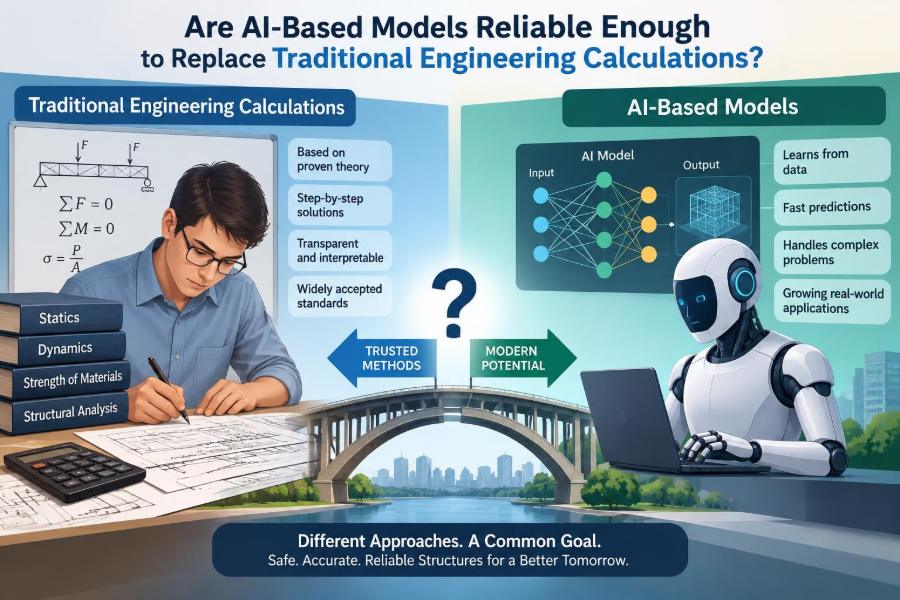

A structural engineer is reviewing a floor-beam design late in the afternoon. A spreadsheet gives one answer, a finite-element model gives another, and an AI tool proposes a third within seconds. The AI result looks plausible—and it comes with a confident explanation.
That situation is no longer hypothetical. Engineers increasingly encounter machine-learning predictions in design software, condition-monitoring systems, manufacturing tools, energy forecasts, and technical assistants. The question is not whether AI can calculate quickly. It clearly can.
The harder question is whether a fast, persuasive prediction deserves the same trust as a calculation built from equilibrium, material laws, boundary conditions, and documented assumptions. When safety, cost, and professional responsibility are involved, that difference matters.
AI-based models can be extremely useful engineering tools. But usefulness is not the same as reliability, and reliability is not the same as being suitable to replace a traditional calculation.
🧭 The short answer: replacement is rarely all-or-nothing
For many routine, well-observed, low-consequence tasks, an AI model may produce results accurate enough to reduce or even remove repeated hand calculations. For novel designs, safety-critical decisions, unusual loading, or code-governed verification, traditional engineering calculations remain essential.
A better framing is: which parts of the engineering decision can AI support, automate, or independently verify? This leads to a safer division of work than asking whether AI should replace engineers or equations altogether.
🧮 What traditional engineering calculations actually provide
Traditional calculations include hand methods, spreadsheets, numerical solvers, and simulation models based on known physical relationships. Their common feature is that the engineer can trace a result back to stated inputs and governing principles.
For a simple beam, loads create shear forces and bending moments; stress follows from geometry and material behaviour. A finite-element model extends that reasoning to complex geometry, but it still aims to enforce physics such as equilibrium and compatibility.
This traceability is valuable because a result can be challenged: Which load case governed? Was the support fixed or pinned? Was temperature included? A good calculation exposes those questions.
🤖 What an AI-based engineering model does differently
Most AI models learn patterns from examples rather than deriving results directly from first principles. A machine-learning model might be trained on past inspection records to predict corrosion risk, or on simulations to estimate a component’s maximum stress.
Its internal parameters may be highly complex. The model can map inputs to outputs effectively without containing an explicit free-body diagram, conservation equation, or material constitutive law.
That distinction does not make AI inferior by definition. It means its reliability depends heavily on whether the new problem resembles the data from which it learned.
🧠 Pattern recognition is not physical understanding
An AI model can recognize that certain combinations of dimensions, loads, and materials often produce particular outcomes. Yet a pattern that worked in past examples can fail when a new case lies outside the learned range.
Consider a model trained to estimate pump efficiency for familiar fluids and operating speeds. It may perform well across ordinary conditions but behave poorly with a fluid of substantially different viscosity. A physics-based analysis at least signals which fluid properties enter the governing equations.
AI prediction is often interpolation; engineering analysis must also cope with extrapolation.
📚 Training data defines the model’s practical boundaries
Data is not just fuel for an AI system. It defines much of the domain in which its outputs deserve confidence. Training records should cover relevant geometries, materials, operating conditions, measurement quality, and failure modes.
A dataset can be large yet incomplete. Thousands of records from standard production conditions do not necessarily teach a model about rare overloads, severe weather, unusual tolerances, or poorly documented repairs.
Before relying on a prediction, ask what the training data represents—and, just as importantly, what it excludes.
🗺️ Distribution shift is a quiet source of failure
Distribution shift occurs when real-world inputs differ meaningfully from the data used to develop a model. It may arise gradually, such as equipment ageing, or suddenly, such as a redesigned component entering service.
For example, an AI maintenance model trained on one factory’s vibration sensors may not transfer cleanly to another factory using different mounting arrangements, sampling rates, or machine duty cycles. The signal may look similar while meaning something different.
Traditional equations also have assumptions, but their limits are usually stated in terms engineers recognize: elastic range, steady flow, small deformation, or idealized boundary conditions.
⚖️ Accuracy is not the same as engineering adequacy
A model can have a small average prediction error and still be unsuitable for design approval. Average performance can hide rare, high-consequence errors in precisely the cases where a conservative answer is needed.
Suppose an AI model estimates retaining-wall movement well for typical soil conditions but occasionally underestimates movement in a poorly represented soil type. That occasional failure may matter more than many accurate routine predictions.
Engineering adequacy involves the direction of error, uncertainty, consequence of failure, and required safety margin—not merely a single accuracy score.
📏 Why error metrics need engineering context
Metrics such as mean absolute error or root-mean-square error summarize predictive performance. They are useful, but they do not automatically answer whether a prediction is acceptable for a particular design decision.
A temperature prediction error that is harmless in office comfort control could be unacceptable near a material-processing limit. Likewise, a small error in a fatigue-life estimate may be serious if it shifts an inspection interval past the onset of damage.
Validation criteria should be tied to the engineering quantity, its allowable range, and the consequences of being wrong.
🛡️ Safety factors cannot repair unknown behaviour
Engineers often use factors of safety, load factors, and resistance factors to manage variability and uncertainty. These are not magic multipliers that make any prediction safe.
A safety margin works best when uncertainty is understood well enough to characterize. If an AI model has an unrecognized blind spot, applying a generic factor may not protect against a prediction that is wrong in an unexpected direction or by an unexpected amount.
Conservatism still has a role, but it should accompany testing, domain checks, and independent verification rather than substitute for them.
🔍 Explainability affects review quality
Explainability means being able to understand, at an appropriate level, why a model produced a result. It does not require every AI model to become simple, but it does require enough visibility for responsible review.
An engineer should be able to identify the input variables, their valid ranges, preprocessing steps, output units, uncertainty information, and known limitations. If a system cannot clearly state what it needs and what it returns, it is difficult to use safely.
A black-box result may still be useful as a screening signal. It is much harder to defend as the sole basis for a critical engineering decision.
🧾 Audit trails matter when decisions are challenged
Engineering work is reviewed by colleagues, clients, regulators, contractors, and sometimes investigators after a failure. Traditional calculations are valuable partly because they create an auditable record of assumptions and checks.
An AI workflow needs an equivalent record. That includes the model version, training-data scope, input data, software environment, validation status, user prompts or settings where relevant, and the human decision made from the output.
Without version control, the same input may produce a different result after a silent model update. That is a governance issue, not merely an IT inconvenience.
🏗️ Physics-based simulation remains a powerful baseline
Finite-element analysis, computational fluid dynamics, circuit simulation, and process models can be computationally demanding. Their advantage is that they encode physical constraints and can be inspected through intermediate fields, reactions, balances, and convergence checks.
They are not automatically correct. A sophisticated simulation with incorrect contact conditions, mesh quality, material data, or loads can be misleading. Still, the error can often be investigated through physical reasoning.
AI is often most valuable when it makes these established methods faster, easier to search, or easier to interpret.
🔗 Hybrid models combine data with governing laws
Hybrid approaches use AI alongside physical models rather than treating them as competitors. A model may learn an uncertain parameter, approximate an expensive sub-calculation, or correct a known simulation bias using measured data.
Physics-informed methods can also penalize outputs that violate known relationships, such as conservation laws or boundary conditions. The details vary by application, but the central idea is straightforward: use what engineering already knows to constrain what data-driven tools infer.
This approach can improve efficiency while reducing the risk of physically impossible answers.
⚡ Surrogate models can save substantial time
A surrogate model is a fast approximation trained to emulate a slower simulation or experimental process. It is particularly useful for optimization, early-stage design exploration, and real-time control.
Imagine evaluating thousands of candidate airfoil shapes. Running a high-fidelity flow simulation for every option may be impractical. A surrogate can rank promising designs quickly, after which the best candidates receive full simulation and engineering review.
The key word is approximation. Surrogates should be checked at decision points, especially near constraints, extremes, and performance limits.
🧪 Validation must resemble intended use
Testing an AI model on data similar to its training examples is necessary but insufficient. Validation should resemble how the model will actually be used: the same sensor quality, operating environment, users, workflow, and decision threshold.
Where possible, use separate data for development and evaluation. Test edge cases deliberately, not just randomly selected examples. Compare outcomes against measurements, trusted calculations, or controlled simulations appropriate to the application.
A model validated for preliminary sizing is not automatically validated for final design certification.
🚧 Edge cases reveal whether a model is robust
Edge cases are inputs near the limits of normal operation or combinations that occur rarely. They include peak loading, damaged components, sensor dropouts, extreme ambient conditions, and unusual geometry.
These cases deserve attention because engineering failures often develop at boundaries rather than averages. A useful test plan includes both expected operating conditions and deliberately awkward scenarios.
- Inputs near stated minimum and maximum values
- Missing, noisy, or conflicting sensor data
- Combinations of variables absent from training data
- Known physical limits, such as zero load or maximum capacity
- Conditions where the correct action is to abstain rather than predict
📉 Uncertainty should travel with every prediction
A single predicted value can create false confidence. Better systems provide an uncertainty estimate, confidence interval, prediction range, or clear warning that the input lies outside the validated domain.
Uncertainty estimates also need validation. A narrow interval is not useful if it routinely misses the true result. Engineers should understand whether uncertainty reflects measurement noise, model variation, limited data, or all of these.
When uncertainty is high, the correct engineering response may be more data, a higher-fidelity calculation, testing, or a conservative design choice.
🚨 A model must be allowed to say “I do not know”
Reliable engineering systems need an abstention path. Instead of always returning a precise-looking number, the model should flag out-of-domain inputs, poor data quality, conflicting signals, or insufficient confidence.
This is not a weakness. A strain gauge that reports an implausible reading should trigger inspection, not force a maintenance algorithm to produce a confident remaining-life estimate.
A well-designed AI tool knows when to hand control back to engineering judgment.
🏭 Condition monitoring is a strong AI use case
AI performs well in many monitoring tasks because equipment generates repeated observations over time. Models can identify unusual vibration patterns, temperature drift, acoustic changes, or energy consumption that may indicate developing faults.
The output is often most valuable as a prioritization signal: inspect this motor sooner, review this pump trend, or compare this unit with similar units. It need not declare the exact physical cause without further investigation.
This use is safer when an incorrect alert leads to an extra inspection rather than an unreviewed decision to keep hazardous equipment in service.
🌬️ Forecasting and control need continuous oversight
Energy demand forecasting, renewable generation prediction, traffic control, and process optimization benefit from AI’s ability to identify time-dependent patterns. These systems can respond quickly to changing conditions.
However, the environment itself can change: demand behaviour shifts, weather patterns differ, sensors are recalibrated, and operating policies evolve. A model that was reliable last year may gradually degrade.
Production deployment therefore requires monitoring for drift, performance review, fallback procedures, and clearly assigned responsibility for intervention.
🏢 Early-stage design benefits from speed, not blind trust
During concept design, engineers compare alternatives under incomplete information. AI can rapidly suggest layouts, estimate quantities, identify feasible parameter ranges, or screen many designs before detailed analysis begins.
This can improve the quality of exploration because more options are considered. But early estimates should not quietly become final design values simply because they are displayed in a polished interface.
Use rapid AI outputs to ask better questions: Which option deserves detailed modelling? Which variable drives cost? Where is the design sensitive to uncertainty?
📐 Code compliance cannot be inferred casually
Engineering codes and standards often specify load combinations, detailing rules, testing requirements, material limits, documentation, and exceptions. Compliance is more than arriving at a numerically plausible answer.
An AI system may summarize requirements or help locate checks, but it can misunderstand context, omit a condition, or rely on outdated material. The responsible engineer must verify the applicable requirements using controlled, current sources and project-specific interpretation.
Where a formal approval is required, an undocumented AI recommendation is not a replacement for a code-based design check.
👩🔧 Human oversight is an engineering control, not a ritual
Human-in-the-loop review is useful only when the reviewer has enough information, time, and authority to challenge the output. Asking someone to click “approve” beside an opaque score is not meaningful oversight.
Effective review involves checking inputs, assessing whether the case lies in the validated domain, comparing with physical expectations, and deciding what additional calculation or inspection is justified.
Automation should reduce repetitive work so engineers can focus more attention on assumptions, interfaces, anomalies, and consequences.
🧩 Independent checks prevent shared mistakes
Two tools can agree because they share the same bad input, embedded assumption, or training data. Independence matters when verification is used to build confidence.
A practical check might compare an AI prediction with a simplified hand estimate, a separate physics model, measured data, or a reviewer’s order-of-magnitude calculation. Exact agreement is not always expected; unexplained disagreement is what deserves investigation.
For a beam, a quick estimate of reaction forces and bending scale can reveal a unit error even when a detailed model appears internally consistent.
🔢 Units, conventions, and data quality still decide outcomes
AI does not remove familiar engineering hazards. Unit mismatches, sign conventions, coordinate errors, incorrect timestamps, and sensor calibration problems can corrupt an advanced model as easily as a spreadsheet.
Input pipelines should include range checks, unit handling, provenance, and alerts for missing or implausible values. Data cleaning should be documented rather than treated as an invisible preliminary step.
Garbage in, garbage out remains true; AI can simply make the output look more convincing.
🧑⚖️ Responsibility does not disappear into software
When an engineering decision affects safety, performance, or compliance, responsibility remains with the organizations and qualified people who specify, deploy, review, and approve the work. A software output cannot carry professional accountability by itself.
This is why procurement questions matter. Who maintains the model? What changes are communicated? What evidence supports its stated use? Can the team inspect records and reproduce a past decision?
Technical reliability and organizational responsibility must be designed together.
🧰 A practical workflow for using AI safely
A disciplined workflow makes AI more useful because it places the tool where its strengths are real and its weaknesses are controlled.
- Define the engineering decision and its consequence if wrong.
- Specify the valid input domain, required data quality, and acceptable uncertainty.
- Use AI for prediction, screening, optimization, or anomaly detection within that domain.
- Apply physical sanity checks and independent calculations at appropriate checkpoints.
- Escalate edge cases, high uncertainty, and out-of-domain inputs to higher-fidelity analysis or testing.
- Record the model version, inputs, outputs, review, and final decision.
- Monitor live performance and revise the model’s permitted use when conditions change.
🧯 Common mistakes when adopting AI tools
The most damaging mistakes are usually workflow failures, not dramatic algorithm failures. Teams may accept a polished result without checking units, treat a prototype as validated software, or assume past accuracy guarantees future performance.
- Using historical data without checking whether it represents future operating conditions
- Measuring average accuracy while ignoring unsafe under-predictions
- Applying a model beyond its stated domain
- Replacing review rather than improving review
- Failing to preserve model and data versions
- Confusing a generated explanation with evidence of correctness
Each mistake can be reduced through clear acceptance criteria, documented controls, and training that combines data literacy with engineering judgment.
🎓 Engineers need new skills, not fewer fundamentals
AI changes which tasks consume time, but it does not make mechanics, thermodynamics, materials, circuits, or statistics less relevant. In fact, foundational knowledge becomes more valuable when engineers must judge whether an automated answer is physically plausible.
Useful additional skills include data provenance, uncertainty interpretation, model validation, basic programming, and clear communication about limitations. The goal is not for every engineer to build neural networks. It is to ensure that those using AI can ask disciplined technical questions.
📊 Choosing the right tool for the decision
| Decision type | Suitable primary approach | Role for AI |
|---|---|---|
| Routine, repeated, low-consequence estimate | Validated automated workflow | May automate prediction with monitoring |
| Early concept comparison | Approximate models and engineering judgment | Rapid screening and optimization |
| Complex design within known physics | Physics-based simulation and code checks | Accelerate setup, search, or post-processing |
| Safety-critical or unusual case | Independent calculations, testing, and expert review | Supporting evidence only unless specifically validated |
| Real-time equipment monitoring | Sensor strategy and maintenance process | Anomaly detection and prioritization |
The correct choice depends on consequence, uncertainty, available evidence, and the ability to verify the result—not on whether a tool is labelled “AI.”
🌱 The most credible future is augmentation
Engineering practice is likely to become increasingly hybrid. AI will handle more searching, pattern detection, repetitive model setup, documentation assistance, and rapid approximation. Physics-based analysis, experiments, standards, and professional judgment will continue to anchor high-consequence work.
The strongest systems will not ask engineers to choose between equations and data. They will make both available, show where they agree or differ, and direct attention toward uncertainty that deserves investigation.
🏁 The core principle: trust must be earned for each use
AI-based models are reliable enough to replace traditional calculations only in narrowly defined situations where their intended use, input domain, error behaviour, uncertainty, and monitoring controls have been demonstrated to be adequate.
Outside those situations, AI should be treated as a capable assistant: fast, scalable, and sometimes insightful, but not automatically authoritative. Traditional calculations remain indispensable because they provide physical structure, transparent assumptions, and a basis for independent challenge.
The engineering question is never simply, “Can the model generate an answer?” It is, “What evidence shows that this answer is fit for this decision, under these conditions?”
AI earns a place in engineering when it strengthens verification and judgment rather than asking us to abandon them. 📐🤖🛠️